

Behind every live score update that appears within seconds of a goal, a point, or a play is an infrastructure stack most fans never think about — and one that took decades to build to its current level of reliability.
Live sports score platforms feel simple from the user side. A number changes. A status updates. A notification arrives. The simplicity of that experience is the product of an extraordinarily complex real-time data pipeline operating at low latency across multiple layers of collection, verification, transmission, and display. Understanding how that pipeline actually works clarifies why live score accuracy varies across sports and platforms, why some updates arrive faster than others, and why the infrastructure behind real-time sports data has become one of the more technically demanding categories in sports technology.
Where the Data Originates
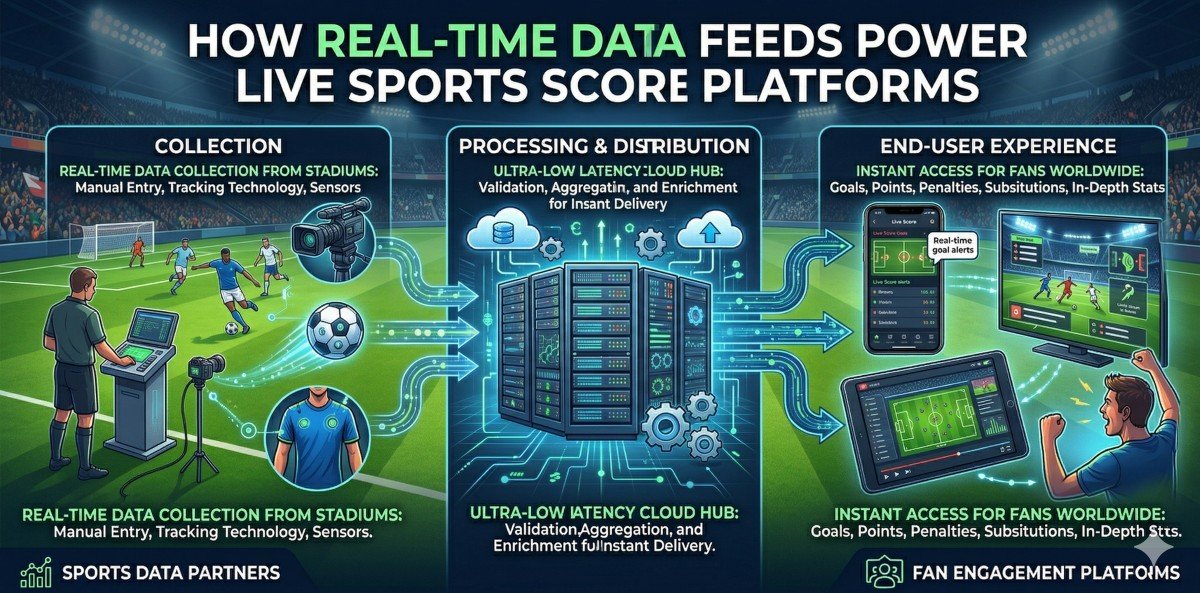
Every live score update begins with a collection event — a human or automated system recording that something happened at a specific moment in a specific match. The collection layer is the foundation of the entire pipeline, and its characteristics vary significantly depending on the sport and the resources available at the venue.
At the top tier of professional sport, dedicated data collectors are physically present at matches. These are trained operators whose sole responsibility is to record events — goals, substitutions, cards, timeouts, scoring plays — into a purpose-built input system the moment they occur. Their entries trigger the data pipeline immediately. In some venues and leagues, optical tracking systems supplement or replace manual entry for certain event types, using camera arrays to detect ball position and player movement and classify events algorithmically.
Below that tier, collection becomes less standardized. Lower-division matches, regional competitions, and amateur events may rely on fewer collectors, less sophisticated equipment, or feeds aggregated from secondary sources. This is where latency increases and accuracy gaps appear — not because the transmission infrastructure is weaker, but because the originating data is less reliable.
Transmission and the Latency Problem
Once an event is recorded at the collection layer, it travels through a transmission chain before appearing on any user-facing platform. The speed of that chain is what determines latency — the gap between when something happens on the field and when a score platform reflects it.
Professional data providers invest heavily in minimizing transmission latency because even small delays create problems. A score update that arrives several seconds late is experienced as inaccurate by fans watching live broadcasts. As explored in Daejeon Insider’s analysis of how real-time data infrastructure reshaped sports platforms, the engineering standards that govern transmission speed have tightened considerably as user expectations for live data accuracy have risen alongside the proliferation of mobile devices and second-screen viewing.
The transmission chain typically runs from the venue collection system through a data provider’s central processing infrastructure, where feeds from hundreds or thousands of simultaneous matches are normalized into consistent formats before being distributed to client platforms via API. Each step in that chain introduces potential delay. Optimizing the chain requires both technical investment and geographic distribution of processing infrastructure to reduce the physical distance data must travel.
Verification Without Adding Delay
Accuracy and speed exist in tension at the verification layer. A live score platform that publishes every raw input immediately will be fast but unreliable — operator entry errors, duplicate signals, and system glitches will surface as incorrect updates. A platform that holds every update for manual verification will be accurate but too slow to be useful for live consumption.
The solution most professional data providers use is automated cross-validation. Inputs from multiple independent collection sources covering the same event are compared in real time. When they agree, the update is published immediately. When they diverge beyond a defined threshold — two operators recording a goal at different times, or an automated system disagreeing with a manual entry — the update is held and flagged for rapid human review. The review queue operates on timescales of seconds, not minutes, to keep the delay impact minimal.
This is why data coverage from major leagues, where multiple redundant collection streams exist, is more reliable than coverage from smaller competitions where a single collector’s input is the only source available. Redundancy is not just a reliability feature — it is what makes fast automated verification possible.
How Score Platforms Consume the Feed
On the receiving end, live score platforms connect to data provider APIs and maintain persistent connections that push updates as they are published. The platform’s own infrastructure must then process those updates, apply any display logic, and deliver the change to active users — all within a timeframe short enough that the experience feels instantaneous.
This final leg of the pipeline is where platform engineering decisions become visible to users. A platform running efficient websocket connections to millions of simultaneous users will deliver updates faster and more reliably than one relying on client-side polling. The architecture behind how real-time data feeds power live sports score platforms reflects years of iteration on exactly these delivery problems — how to push high-frequency updates to large concurrent audiences without the infrastructure becoming the bottleneck.
Why Accuracy Still Varies
Even with mature infrastructure, live score accuracy varies across platforms and competitions for reasons that are structural rather than accidental. The quality of the originating data determines the ceiling of what any downstream system can achieve. No transmission optimization or verification layer can correct for events that were never recorded accurately at the source.
The Human Element That Remains
Automated systems have reduced but not eliminated the human element in live data collection. The most reliable live score feeds remain those anchored to trained human operators with backup systems and clear protocols for handling ambiguous events — own goals, disallowed scores, delayed official confirmations. The technology that surrounds the collection moment has become sophisticated. The judgment call at that moment still belongs to a person with a device, watching the same match the fan at home is watching, and entering what they see as accurately and as quickly as they can.
That combination — human observation, professional data infrastructure, and engineered delivery pipelines — is what makes a number change on a screen within seconds of something happening on a pitch thousands of kilometers away.