Who Has the Right to Watch the World Cup? Korea’s Broadcasting Crisis Is a Legal and Cultural Question

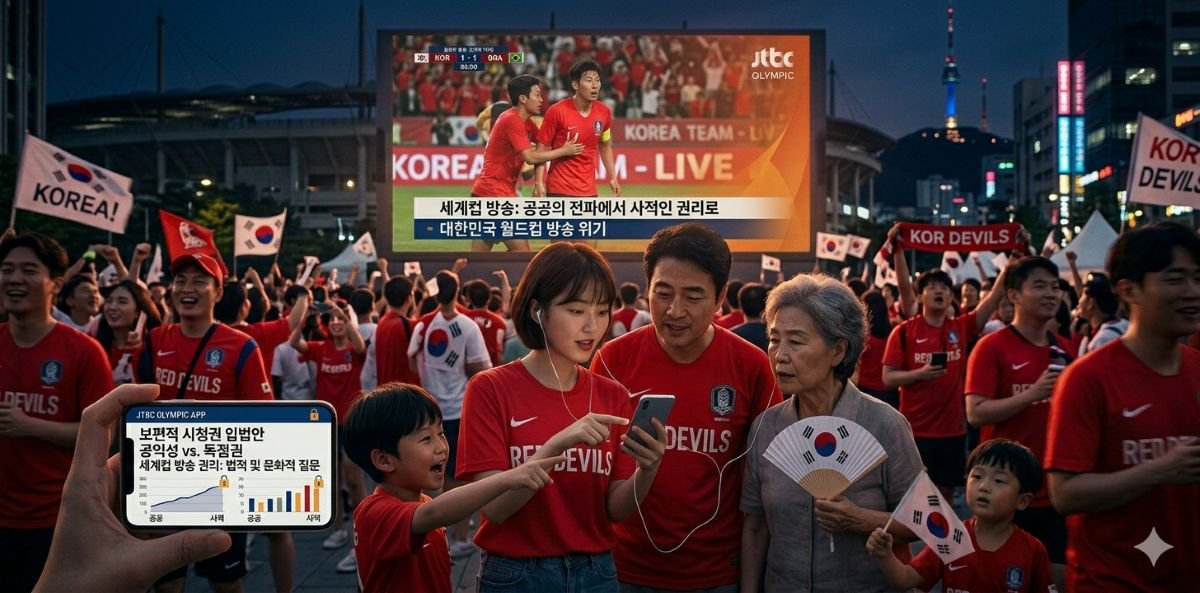
When the 2026 Milano Cortina Winter Olympics opened on February 6, South Korean viewers discovered something had changed. For the first time in 62 years, the Olympics were not airing on free terrestrial television. JTBC, a cable and digital broadcaster, held exclusive rights — and the opening ceremony drew a viewership rating of just 1.8%. One of the most watched events in Korean sports history had become, for many households without the right subscription, simply unavailable.

That number — 1.8% — became a rallying point. Lawmakers, broadcasters, civic groups, and sports associations began asking a question that had previously seemed settled: does the right to watch major international sports events belong to the public, and if so, what legal framework is supposed to protect it?

The answer, in April 2026, is that South Korea has no clear protective mechanism. And with the FIFA World Cup opening on June 11, the question has moved from retrospective outrage to present urgency.

How the Korea Pool Broke Down

Understanding the current situation requires understanding what existed before it. For decades, major international sports broadcasting rights in Korea were acquired through what is known as the Korea Pool — a consortium arrangement in which the three major terrestrial broadcasters, KBS, MBC, and SBS, negotiated jointly for the rights to events like the Olympics and the FIFA World Cup. The consortium model served two purposes: it contained bidding costs by preventing domestic competition from inflating rights fees, and it ensured that whatever was acquired would be broadcast on free-to-air channels accessible to the entire population.

In 2019, JTBC opted out. The broadcaster went directly to the International Olympic Committee and secured exclusive rights for the 2026 through 2032 Summer and Winter Games through a competitive tender. The IOC deal included a requirement that at least 200 hours of Olympic coverage would be broadcast on channels with national reach — a condition JTBC has argued it fulfills. The three terrestrial broadcasters were offered resale terms they found commercially unacceptable, negotiations collapsed, and the Milano Cortina Winter Games aired exclusively on JTBC and through Naver, which had separately acquired the digital streaming rights.

JTBC subsequently also secured exclusive Korean rights to the 2026 and 2030 FIFA World Cups, paying $125 million for the 2026 tournament alone — a figure it has since disclosed publicly as negotiations with the terrestrial broadcasters over cost-sharing have reached an impasse. As of late March 2026, mediation overseen by the government’s Broadcasting and Media Communications Committee ended without agreement. The terrestrial broadcasters are unwilling to pay for half of a rights package whose most commercially valuable component — the digital rights — JTBC has already sold to Naver, details of which JTBC has declined to disclose.

What “Universal Viewing Rights” Actually Means in Korean Law

The concept of universal viewing rights exists within Korea’s Broadcasting Act framework, but its legal operationalization is weak. The act references the principle that events of significant national interest should be accessible to the general public, but it does not specify which events qualify, what “accessible” requires in practical terms, or what remedies exist when the principle is violated.

JTBC has argued that because over 90% of Korean households subscribe to pay television services, broadcasting exclusively on a cable or pay platform satisfies the spirit of universal access. Representative Cho Gye-won of the Democratic Party of Korea directly challenged this reasoning in a March 2026 parliamentary address to the Ministry of Culture, Sports and Tourism. As covered in Korea’s sports broadcasting rights crisis and what it means for World Cup viewers, Cho argued that paid subscription services and free terrestrial broadcasts are not legally or practically equivalent — particularly for households in rural or lower-income regions where pay television penetration may be lower, and for viewers who do not expect to need a subscription to watch the national team play in a World Cup.

Cho’s proposal drew on regulatory models from other countries. Britain’s Listed Events system designates specific sporting events — including the Olympics, the FIFA World Cup, and domestic football finals — as protected events that must be made available to free-to-air broadcasters. Australia’s Anti-Siphoning system operates similarly, preventing exclusive pay-television acquisition of events deemed to carry significant public interest. Cho called on Korea to develop equivalent legislation, and proposed expanding the Korea Pool to include not only terrestrial broadcasters but also OTT platforms and new media outlets under a framework that treats major sports broadcasting as a public resource.

The Cultural Dimension of the Crisis

The legal and regulatory framing matters, but the cultural weight of the situation should not be reduced to a contractual dispute.

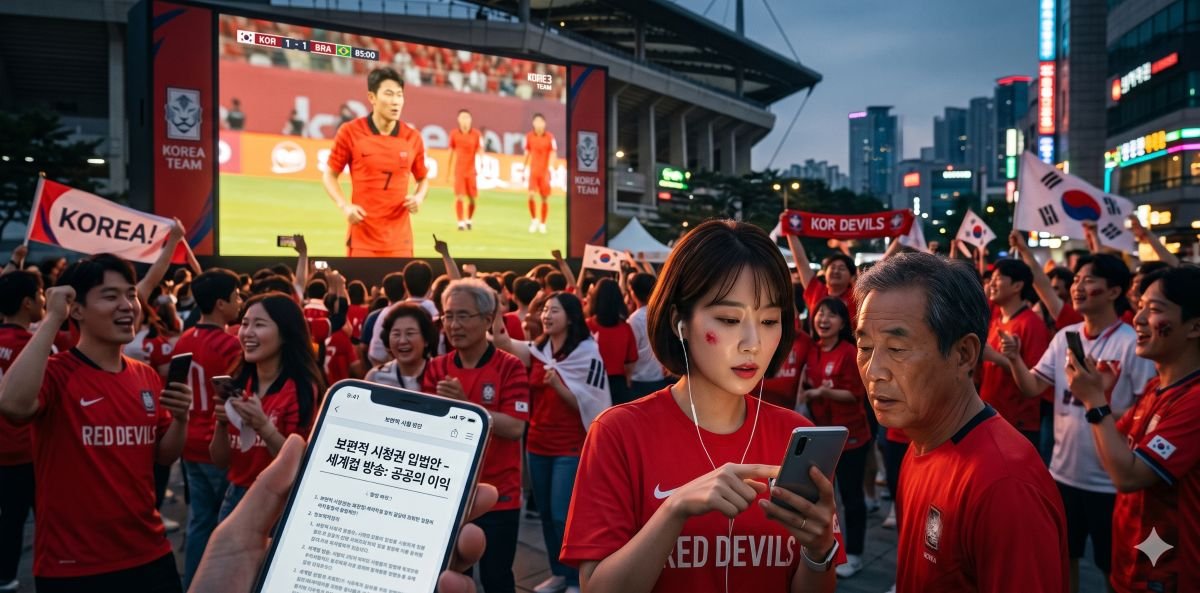
Korean street cheering culture — the mass public gatherings where millions of citizens watch national team matches on large screens in public squares — depends on the assumption that the matches are on television channels that can feed those public screens. The 2002 World Cup, when Korea reached the semifinal on home soil, remains one of the defining collective experiences in recent Korean history. The community-building dimension of watching major sports events as a shared national act, rather than as a pay-gated individual subscription choice, is part of what makes these events carry the cultural weight they do.

For residents of Cheongju and across Chungcheongbuk-do, the practical question of whether Korea’s World Cup group stage matches against Mexico, South Africa, and Czech Republic will be freely watchable is not abstract. If the current impasse holds and no terrestrial broadcast arrangement is reached, watching Korea’s most significant sporting moment of 2026 will require a paid subscription to a cable service the viewer may not currently hold.

Whether the National Assembly acts on the proposed Broadcasting Act amendments before June 11, when the World Cup opens in Mexico City, remains the central open question. The debate has surfaced the absence of a legal framework Korea has always assumed it did not need.
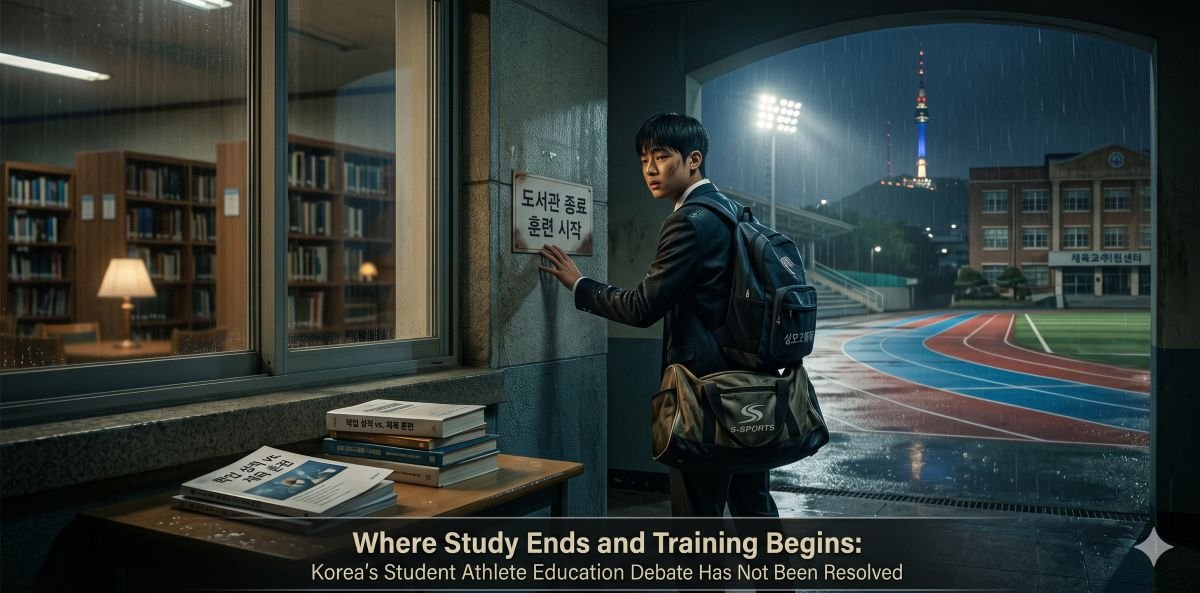
Where Study Ends and Training Begins: Korea’s Student Athlete Education Debate Has Not Been Resolved

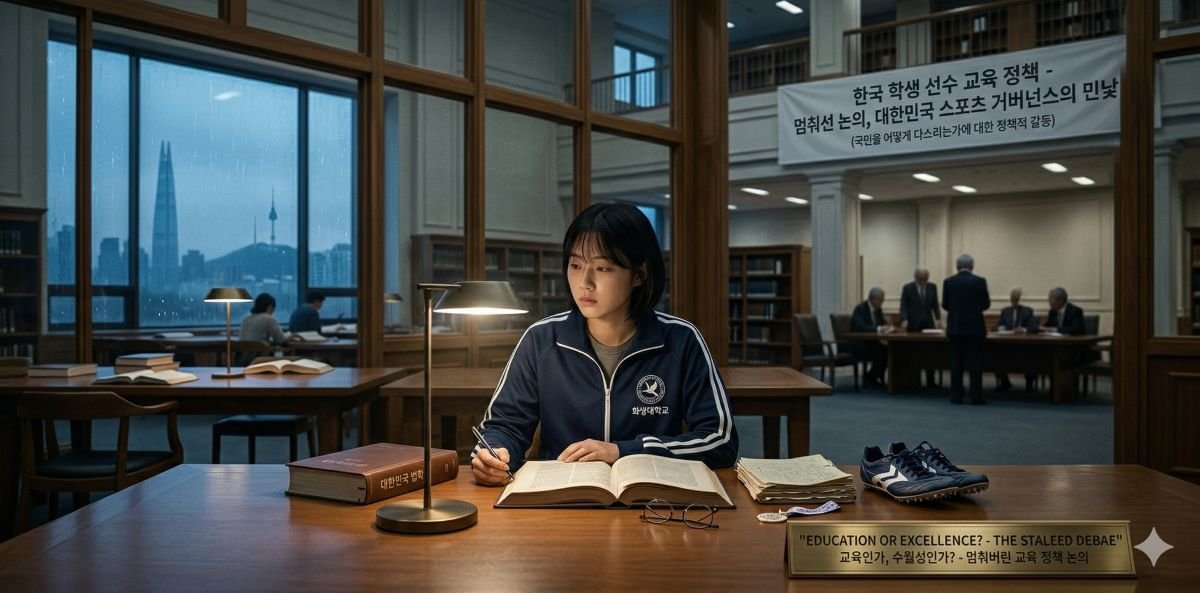
South Korea has produced some of the world’s most decorated athletes. The infrastructure behind that achievement — a system that identified talented young people early, separated them from regular schooling, and concentrated their development on athletic performance — was for decades considered a national asset. In April 2026, a Korea Herald report brought renewed attention to the fact that this infrastructure is under significant strain, and that the policy debate intended to reform it remains unresolved six years after the most significant legal revision the system has seen.

The question at the center of the debate is not whether student athletes should study. Almost no one in the conversation argues against education in principle. The dispute is over how much, when, and what happens to elite sports development if the answer is set too high.

What the System Has Always Been, and What Changed in 2020

Korea’s student athlete system, known as the 체육특기자 (sports prodigy) system, has roots stretching back to the 1960s and 1970s, when the national sports development agenda was explicitly tied to state prestige. Under that model, talented young people were streamed into elite athletic pathways at middle school or high school age. In practice, this meant dramatically reduced class attendance — sometimes near-total exemption from regular education — and a training environment that prioritized competitive output above all else.

The National Sports Promotion Act, the foundational legislation governing this system, was revised in 2020 in a meaningful way. Before the revision, its opening article described the purpose of the law as promoting fitness and contributing to national prestige through sports. After the revision, the language shifted: the law now states that its purposes include protecting the human rights of sportspeople based on fair sportsmanship and contributing to the realization of a healthy community by enhancing the happiness and pride of the people.

This revision was not incidental. It came in the wake of intensifying pressure from multiple directions: the National Human Rights Commission of Korea had called for systemic reform as early as 2007, and the #MeToo movement in Korean sports, combined with the death of triathlete Choi Suk-hyeon in 2020 — whose case exposed serious abuses within the closed training environment — created the conditions for legislative action. The 2020 revision was an acknowledgment that the old model had produced not only champions but also systemic harm.

Why the Debate Has Intensified Rather Than Settled

Six years after that revision, the Korea Herald’s April 2026 report found that the debate has not resolved — it has sharpened. Participation in school sports is declining, which some in the athletic community attribute directly to the strengthened academic requirements. The argument from coaches, sports associations, and some parents is that asking young athletes to meet standard academic benchmarks during the same years when their peers in other countries are training full-time creates an asymmetry in international competition. Elite development, under this view, requires early and intensive specialization, and the revised policy undermines that.

On the other side, civic groups and education advocates argue that easing academic requirements risks reversing progress that was achieved at significant human cost. The countervailing concern is not abstract: research has long shown that only a small fraction of student athletes — estimates have historically placed this at roughly 2.5% of middle and high school athletes — develop professional careers. The majority of students who go through elite training programs without maintaining educational development face limited options after sport.

The Middle School Stage as a Particular Pressure Point

The debate carries specific weight at the middle school level. Middle school education in Korea is compulsory, and the three years of secondary education from grades 7 to 9 represent the period during which students are meant to develop foundational academic skills and explore career options. The government has introduced mechanisms like the Free Semester System to reduce exam pressure during this stage, but student athletes in elite training programs have often operated largely outside that curricular framework.

The problem is that middle school is also the developmental window that sports associations identify as critical for athletic formation in many disciplines. The conflict between compulsory education obligations and elite development timelines is most acute precisely at this stage — and the current policy environment has not resolved how those obligations should be balanced.

As examined in the policy debate over student athlete education in Korea and what it reveals about sports governance, the question extends beyond individual student welfare into the structural design of how Korea produces athletes and what responsibilities institutions bear for those who do not reach professional competition.

What Remains Unresolved

The Korea Herald’s reporting makes clear that the government has not produced a clear forward policy. President Lee Jae Myung had raised the issue of reviewing policies that constrain elite sports development during his 2022 campaign, but the question has received limited follow-through. The absence of policy direction has left school sports programs, coaches, families, and student athletes in an environment of ongoing uncertainty — not knowing whether current requirements will tighten, ease, or remain static.

For families in Cheongju and the broader Chungcheongbuk-do region, this is not a national policy abstraction. Chungcheongbuk-do operates its own network of middle school and high school sports programs under the national framework. Parents whose children have athletic talent face a genuine and unresolved question: what the system they are entering actually expects of their child, and what that child’s options will look like if sport does not lead where they hope.

The 2020 revision to the National Sports Promotion Act changed the stated purpose of the law. It did not resolve how that changed purpose translates into daily decisions for the educators, coaches, and families navigating the system it governs.

The World Cup as a Public Good: What Korea’s Universal Viewing Rights Legislation Actually Says

South Korea came close to missing the 2026 Winter Olympics. Not in any athletic sense — Korean athletes competed and won medals. But for millions of viewers at home, the games were effectively invisible. The Milano Cortina 2026 Winter Olympics became the first Olympic Games in 62 years to air in South Korea without terrestrial broadcast coverage, after JTBC’s exclusive rights deal left the three major free-to-air networks locked out. The opening ceremony drew a 1.8 percent viewership rating.

That number became the catalyst for a legislative debate that is still unresolved as the 2026 FIFA World Cup approaches. At the center of it is a question that sounds simple but carries significant constitutional and commercial weight: does every citizen have the right to watch the World Cup for free?

How the Exclusivity Problem Developed

The current situation traces back to 2019, when JTBC departed from the established “Korea Pool” arrangement — a cooperative framework through which the three terrestrial broadcasters, KBS, MBC, and SBS, had historically negotiated major sports rights collectively. Instead, JTBC secured exclusive rights to the 2026 through 2032 Summer and Winter Olympics directly from the International Olympic Committee, and later acquired exclusive rights to the 2025 through 2030 FIFA World Cups, reportedly paying $125 million for the 2026 tournament alone.

The consequence became clear in February 2026. With no agreement reached on resale terms for the Winter Olympics, JTBC broadcast the games alone on its pay platform. Terrestrial broadcasters, already operating under nearly two decades of declining advertising revenue and rising production costs, said the resale prices JTBC was demanding would generate hundreds of billions of won in net losses per event. The impasse held. The games aired. Most Koreans did not watch.

With the World Cup roughly 80 days away as of late March 2026, negotiations between JTBC and the terrestrial broadcasters remained deadlocked under the same structural conditions.

What the Proposed Legislation Says

In response, lawmakers introduced a Broadcasting Act amendment bill that attempts to establish a legal foundation for what they are calling universal viewing rights. The legislation defines the concept directly: universal broadcasting means are “broadcasting means through which citizens can watch in real time without additional cost burden.”

The bill goes further than definition. It requires that events designated as being of national significance — explicitly including the Olympics and the FIFA World Cup — must be made accessible to at least 95 percent of all national households. It imposes obligations on both rights holders and public broadcasters to ensure Olympic and World Cup coverage reaches audiences through public terrestrial broadcasters, specifically naming KBS and MBC as the designated delivery channels.

The bill also addresses a transparency problem that has complicated every negotiation: broadcasting rights contract details are currently shielded behind confidentiality clauses, making it impossible for regulators, the public, or competing broadcasters to assess whether resale demands are commercially reasonable. The proposed legislation would require submission of rights contract details to administrative authorities, giving the Broadcasting and Communications Commission the ability to take corrective action with access to actual figures rather than competing claims.

The drafters cited the United Kingdom’s Listed Events system and Australia’s Anti-Siphoning framework as international models. Both approaches identify categories of events with sufficient national cultural significance that their exclusive migration to pay platforms is legally restricted.

The Principle at the Core of the Debate

The legislative argument rests on a distinction between sports broadcasting as a commercial transaction and sports broadcasting as a public cultural resource. Broadcasting rights are undeniably commercial — JTBC paid market rates for them and is entitled to seek return on that investment. But the Olympics and World Cup occupy a different category of cultural experience than most commercial content. They are events around which national communities have historically organized shared attention, shared emotion, and shared memory.

The bill’s proponents argue that when those events become accessible only to households with the means and technical capability to access a pay platform, the shared experience fractures along economic and demographic lines. The viewing right becomes, in effect, a privilege rather than a right.

This dimension is particularly concrete in regions like Chungcheongbuk-do, where mountain terrain limits infrastructure coverage and digital device access remains lower than in metropolitan areas. For residents in those communities, the gap between nominal access and actual access is wider than national averages suggest. For context on how national broadcasting policy decisions translate into tangible differences for regional audiences, the analysis at Cheongju Insider on Korea’s sports broadcasting rights crisis and what it means for viewers provides useful regional grounding.

Whether the legislation passes before the World Cup begins in June remains uncertain. JTBC has signaled willingness to negotiate but maintains its position on cost-sharing. The terrestrial broadcasters say the numbers do not work. The government has called for public input. The Korea Media and Communications Commission has acknowledged that legal grounds to compel agreement are currently limited.

What the bill has already accomplished, regardless of its legislative fate, is to put the underlying principle on record: that some events are too culturally significant to be treated as ordinary commercial content, and that the right to watch them together should not depend on what you can afford to pay.

For broader context on how broadcasting policy frameworks develop over time and why regulatory structures tend to formalize in response to market failures, 시스템 운영의 공식화와 규칙 투명성의 구조적 진화 offers structural framing relevant to understanding why legislation of this kind tends to emerge at inflection points in how markets handle public goods.

What the KSOC Audit Revealed About the Structural Gaps in Korean Sports Governance

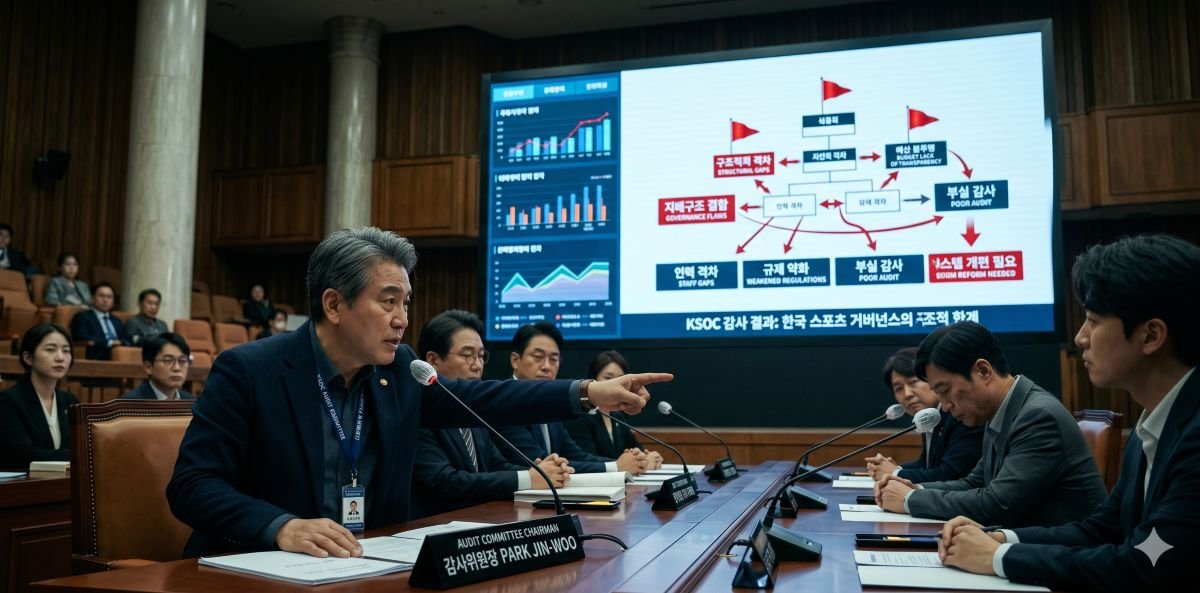
In early March 2026, South Korea’s Board of Audit and Inspection released the findings of a comprehensive audit of the Korean Sport and Olympic Committee — the country’s national umbrella sports body. The results were not a minor administrative critique. They described a governance structure that had failed at multiple levels simultaneously, and raised questions that extend well beyond the KSOC itself into how regional sports organizations across the country operate under its umbrella.

What the Audit Found

The Board of Audit and Inspection conducted its review targeting the KSOC, the Ministry of Culture, Sports and Tourism, and the Korea Sports Ethics Center. The findings, announced on March 4, covered failures across athlete protection, national team selection integrity, oversight of sports federations, and internal governance.

The most immediately striking finding concerned coaching qualifications. The audit revealed that 222 individuals whose sports instructor licenses had been revoked due to crimes including assault and sexual violence were still actively working as coaches at schools and sports facilities across the country. The Ministry of Culture, Sports and Tourism had instructed the KSOC as far back as 2020 to require only licensed coaches — whose credentials are subject to regular criminal record checks — to work in the field. The KSOC delayed implementing that requirement, citing the time needed for coaches to obtain licenses. The result was a four-year window during which disqualified individuals continued operating in coaching roles.

Eight coaches who had been permanently disqualified or suspended for at least one year by the Korea Sports Association for the Disabled also managed to register with the KSOC before their disciplinary periods ended.

Selection Integrity and Conflict of Interest

Beyond the coaching qualification failures, the audit documented recurring problems in national team selection processes. From 2022 to 2024, 70 board members and performance improvement committee members from 29 sports federations — individuals directly responsible for designing selection criteria and evaluating candidates for national team coaching positions — applied for and were appointed to those very positions while retaining their committee roles. The KSOC overlooked these conflicts of interest throughout.

During the same period, 24 formal complaints were filed regarding national team player selection processes. All were dismissed. Thirteen were not even reported to the KSOC as required under its own rules, meaning they were resolved — or buried — at the federation level without independent review.

The audit also found that the KSOC failed to cross-reference its own athlete records with the Korea Sports Ethics Center’s database on school violence, allowing 152 athletes with school violence records from 29 federations to compete in tournaments between August 2022 and the end of 2024 without restrictions.

The Core Governance Failure

The Board of Audit and Inspection’s conclusion was direct. The fundamental problem was the failure of the KSOC’s governance structure. Despite receiving more than 400 billion won in government funding annually as a quasi-public institution, the organization operated without effective external oversight or functioning internal checks and balances.

Former KSOC President Lee Kee-heung was identified as a central figure in this breakdown. The audit found that he composed the board of directors through personal and campaign staff recommendations rather than through legitimate processes, meaning only 18 of 47 board members were affiliated with Olympic sports federations — well below the majority required by the organization’s own articles. The Sports Fairness Committee, which is supposed to review exceptions to executive reappointments, was similarly stacked with individuals selected without competitive process.

The KSOC was ordered to address ineligible coaches, strengthen national team selection fairness, introduce a standing auditor system, and ensure the independence of internal audit bodies. The Ministry of Culture, Sports and Tourism was instructed to exercise its supervisory functions properly.

What This Means for Regional Sports Bodies

For those following sports governance in Cheongju and North Chungcheong Province, the KSOC audit carries direct relevance. The Chungcheongbuk-do Sports Council operates as a regional affiliate within the KSOC’s administrative structure, receiving allocated funding and operating under frameworks set at the national level. Governance failures at the top of that structure — particularly around coaching qualification enforcement and federation oversight — do not stay contained at the national level. They shape the standards, or absence of standards, that filter down into provincial and municipal sports administration.

The broader question the audit raises is not unique to the KSOC. It is a question about what accountability looks like in quasi-public institutions that receive substantial government funding but operate with significant internal autonomy. For context on how Korea’s sports policy framework has been addressing athlete rights and institutional reform over recent years, the analysis at Cheongju Insider on Korea’s 2026 sports budget and what it signals for regional cities offers useful connective context on how national policy decisions reach communities at the regional level.

Governance audits of this kind rarely produce immediate transformation. But they create a documented record of specific failures — and in doing so, establish the baseline against which future accountability can be measured.

For broader analytical context on how institutional transparency and rule formalization develop over time in complex governance systems, 시스템 운영의 공식화와 규칙 투명성의 구조적 진화 provides relevant structural framing on why formal oversight mechanisms matter and how they tend to evolve in response to documented failures.

Bridging the Digital Divide: Media Literacy for Cheongju’s Senior Sports Fans

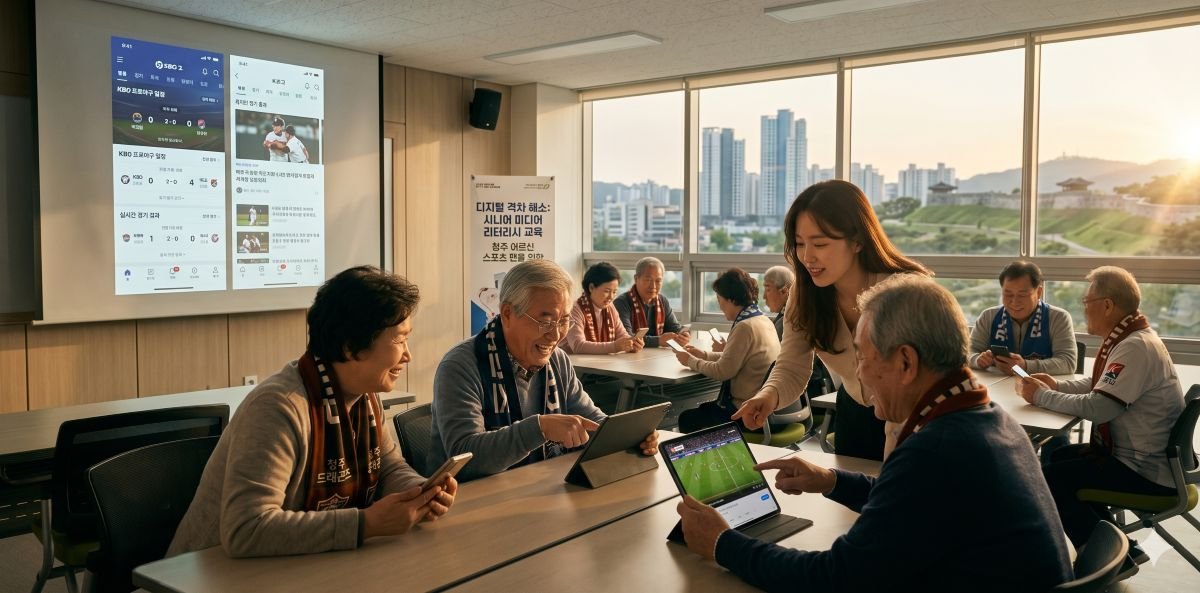
The 2026 professional sports landscape in South Korea looks dramatically different than it did just a few years ago. While the KBO and K League continue to draw record-breaking attendance, the battle for viewership has moved from the television set to the smartphone. Following a comprehensive study released on April 11 by the Chungbuk Media Center, it has become clear that this digital migration is not being felt equally across all age groups. In Cheongju, a city with a deep-rooted love for its local sports culture, aging fans are facing a significant “digital divide” that impacts not just how they watch the game, but their online safety as well.

The Great Migration to OTT Platforms

In 2026, broadcasting rights for major sports have shifted almost entirely to premium Over-The-Top (OTT) platforms. For younger “digital natives,” navigating a subscription-based app to watch a game is second nature. However, for Cheongju’s senior population, the transition from traditional cable TV to mobile-first streaming has created a barrier to entry.

The convenience of watching a game anywhere comes with a cost: complexity. Older fans often find themselves struggling with multi-step authentication, subscription management, and the technical requirements of high-speed streaming. This barrier has led many to seek out alternative ways to watch their teams, which introduces a new set of risks.

The Information Credibility Gap and “Malicious Mirrors”

The most alarming finding of the Chungbuk Media Center study is the prevalence of “malicious mirrors.” These are unauthorized, free streaming sites that target users who are either unable or unwilling to pay for premium subscriptions. For fans over the age of 60, these sites can look like a helpful shortcut, but they are often breeding grounds for malware and phishing scams.

Senior fans, often less familiar with the subtle visual cues of a secure website, are frequently lured in by aggressive pop-ups and fake “system update” warnings. This is where media literacy becomes a tool for digital safety. Educating the public on how to identify verified environments—such as checking for official league partner badges or secure “https” protocols—is no longer just a technical skill; it is a fundamental part of fan safety in the 2026 season.

Behavioral Isolation vs. Community Spirit

Sports in Cheongju have historically been a social glue. Whether it was gathering at a local community center or a neighborhood restaurant, watching a game was a collective experience. The shift toward “individual mobile viewing” is fundamentally changing this social fabric.

As older fans move toward isolated viewing on small screens, the communal joy of the game is being lost. The study notes a rise in behavioral isolation, where the social interactions that once defined local fan clubs are being replaced by solitary digital consumption. To combat this, local community initiatives are being called upon to teach digital navigation skills in public spaces. By bringing fans together for “digital coaching” sessions, Cheongju can preserve its sports traditions while empowering its seniors to master new technology.

The Psychology of Risk in Digital Spaces

Unofficial platforms do not just steal data; they use psychological hooks to keep users engaged. Many of these high-risk sites use “dark patterns”—design choices intended to confuse or manipulate users into clicking on ads or sharing personal information.

For a fan who is simply trying to see the score, these distractions can be overwhelming. Understanding the 사후확신편향-결과 중심적 사고가 만드는 인지적 왜 (hindsight bias and the cognitive distortions created by result-oriented thinking) is helpful here, as it reminds us that our desire for a specific outcome—like seeing our team win—can make us ignore the red flags on the screen. When a fan is emotionally invested in a match, they are statistically more likely to click on a dangerous link just to stay connected to the action.

Fostering “Platform Hygiene”

To create a safer digital ecosystem in Cheongju, the focus must shift to “platform hygiene.” This involves educating fans on how to manage their subscription data and recognizing the difference between a legitimate sports app and a high-risk site.

Part of this education involves understanding the broader policy shifts in the country. For instance, there is an ongoing Korea student-athlete education policy debate that reflects a wider societal push toward literacy and structured learning in sports. Applying this same educational rigor to the fan experience is the next logical step. Fans need to be taught that managing their digital footprint is as much a part of the “game day routine” as wearing a jersey.

A Roadmap for the Future

As the 2026 season progresses, the goal for Cheongju is to ensure that no fan is left behind in the analog past. Bridging the digital divide requires a multi-generational effort:

  • Family Assistance: Younger family members should take an active role in setting up secure, official accounts for their elders.

  • Public Workshops: Libraries and community centers can host “Stream-Smart” workshops to guide seniors through the mobile landscape.

  • Transparent Reporting: Local media must continue to highlight the dangers of unauthorized sites to keep the public informed.

The shift to digital streaming was inevitable, but the exclusion of our most loyal fans was not. By prioritizing media literacy and digital safety, Cheongju can ensure that the roar of the crowd is heard just as loudly from our seniors’ smartphones as it was from the televisions of the past. Supporting our aging fanbase is not just about the game; it is about maintaining the dignity and safety of our community in an increasingly connected world.

Policy Over Pitch: Inside the Chungcheongbuk-do Debate on Sports Subsidies

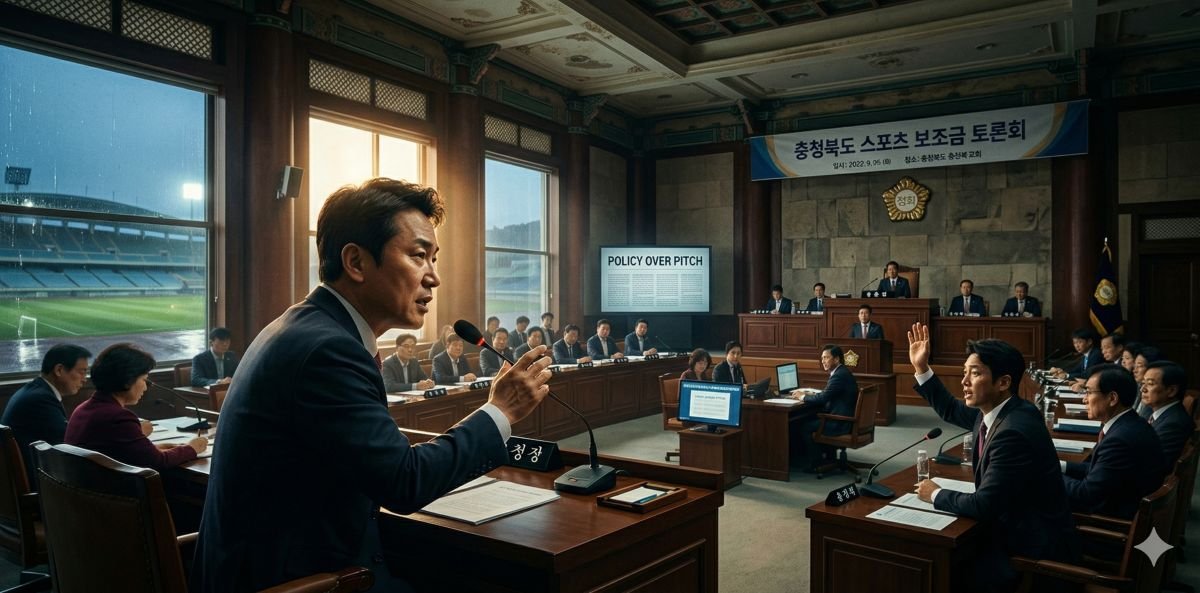
As of April 12, 2026, the halls of the Chungcheongbuk-do Provincial Council have become as critical to the future of local football as the pitch at Cheongju Stadium. The council has entered a rigorous review phase of the “Professional Sports Promotion Ordinance,” a legislative framework that dictates how public funds are allocated to regional institutions. For supporters of Chungbuk Cheongju FC and the broader community, this debate represents a fundamental shift in the legal and cultural contract between a city and its professional sports teams.

Understanding this debate is essential for any resident who views sports not just as a weekend entertainment, but as a vital component of regional identity. The discussion moves beyond the simple win-loss columns, focusing instead on the accountability, sustainability, and civic duty of professional organizations receiving taxpayer support.


The Legislative Shift: From Startup to Sustainability

The crux of the current council debate lies in a transition of funding philosophy. Since its inception, Chungbuk Cheongju FC has operated under a “founding-phase support” model. This traditional approach provided the initial capital necessary for the club to establish its infrastructure, join the K League 2, and navigate the high entry costs of professional sports.

However, the proposed amendments to the ordinance signal a move toward a “performance-and-public-benefit” model. Under this new framework, future subsidies would not be guaranteed by existence alone. Instead, they would be tied to measurable Key Performance Indicators (KPIs) that extend far beyond the league table. These include:

  • Youth Engagement: The success of grassroots programs and the integration of local talent into the professional pipeline.

  • Economic Circulation: Measuring how match days stimulate local businesses in Cheongju, from transport to hospitality.

  • Administrative Transparency: Ensuring that the club’s financial management meets rigorous public standards.

This mirrors a broader national trend where Korea’s 2026 sports budget reflects a policy shift toward public access, prioritizing the democratization of sports over the isolation of elite professional interests. For the council, the goal is to ensure that every won invested yields a tangible return for the citizens of North Chungcheong.


Cultural Identity: The Club as a Public Asset

Perhaps the most significant cultural nuance of this debate is the redefinition of what a “professional team” is. Traditionally, clubs have been viewed as private commercial entities that happen to reside in a specific city. The Chungcheongbuk-do Provincial Council is increasingly challenging this view, arguing that a team receiving public subsidies should be treated as a public asset.

This perspective shifts the focus toward the preservation of regional heritage. In a globalized world, professional sports are one of the few remaining platforms where a city can project its unique identity. By providing subsidies, the provincial government is essentially “buying into” this identity. Consequently, the legal definition of “public benefit” is being expanded to include:

  1. Symbolic Representation: How the club promotes the image of Chungcheongbuk-do on the national stage.

  2. Social Cohesion: The role of the stadium as a “third space” where diverse residents gather, fostering a sense of belonging that transcends socioeconomic lines.

This legislative evolution is a local manifestation of how legal structures and evolving regulations drive shifts in how industries operate. Just as regulations in other digital or entertainment sectors have moved from mere prohibition to active system management, sports governance is moving toward a model of active civic partnership.


Societal Impact: Why Fans Must Understand the Framework

For the casual fan, these council sessions might seem like dry administrative procedure. However, the outcome of these debates determines the quality of the stadium experience, the ticket prices, and even the long-term survival of the team.

The council has called for increased public participation in the review process, encouraging residents to attend hearings and provide feedback on what “public benefit” means to them. This creates a behaviorally informed fan base that understands that their support of the team is also a form of civic engagement.

When the conversation moves from “why didn’t we sign a new striker?” to “how is our club supporting local youth education?”, the entire culture of the fan base matures. It forces the club to remain behaviorally grounded in its community, ensuring it doesn’t become a “satellite entity” disconnected from the local streets of Cheongju.

Key Questions for Public Consideration:

  • Should subsidies be capped if the club fails to reach specific youth development milestones?

  • How can the club better utilize its facilities for public use during the off-season?

  • What is the fair balance between professional ambition and municipal fiscal responsibility?


Conclusion: The New Social Contract

The debate in the Chungcheongbuk-do Provincial Council is a bellwether for the future of regional sports in South Korea. It suggests that the era of unconditional “founding support” is ending, replaced by a more sophisticated, mutually beneficial social contract.

For the residents of Cheongju, this is an opportunity to take ownership of their club in a way that goes beyond buying a scarf or a ticket. By understanding the legal and cultural dimensions of sports subsidies, the community can ensure that Chungbuk Cheongju FC remains a sustainable, transparent, and pride-inducing pillar of the North Chungcheong region for generations to come.

When Athletes Become Data — A Seoul National University Study Raises Unresolved Questions About Who Owns What Bodies Produce

Wearable sensors, smart fabrics, and AI-linked tracking systems now generate continuous streams of biometric and tactical data from athletes’ bodies during training and competition — yet the legal question of who owns that data, and what protections athletes are entitled to, remains almost entirely unresolved.

The Technology Outpaced the Law

Sports technology has transformed how athletic performance is measured, analyzed, and applied. What began as basic timing and distance measurement has evolved into a dense ecosystem of wearable devices, embedded smart fabrics, GPS trackers, heart rate monitors, accelerometers, and AI-linked sensor arrays that generate real-time physiological and biomechanical data streams throughout every training session and competitive event.

The applications are genuinely valuable. Coaching staff use performance data for tactical analysis and opponent preparation. Medical teams use biometric indicators for injury prediction and load management. Broadcasters and platform operators use athlete tracking data to produce real-time visualizations and fan-facing analytics overlays. Sports governing bodies use aggregated performance metrics for rule development and competition design.

However, a December 2025 study from Seoul National University’s Sports Technology Laboratory, published in Frontiers in Sports and Active Living and gaining renewed attention in April 2026 policy discussions, identifies a foundational problem with this landscape: the legal ownership of athlete performance data has not been established with clarity in any major jurisdiction. The technology generating the data has advanced rapidly. The governance frameworks that should determine who owns it, who can use it, and what athletes are owed in return have not kept pace.

Why Athlete Data Is Not Ordinary Personal Information

The Seoul National University research makes a distinction that existing privacy law has largely failed to recognize. Athlete performance data is categorically different from ordinary personal information, and treating it as equivalent to routine employment records misrepresents what that data actually is and how it comes into existence.

Performance data is generated through professional activity. It combines physiological, biomechanical, and tactical elements that are specific to competitive sport. Critically, the data exists only because the athlete performs. A heart rate reading during a competitive sprint, a biomechanical load measurement during a jump, a spatial positioning data point during a live match — none of these would exist without the athlete’s physical labor and competitive action. The data is not a byproduct of using a service or passing through a system. It is produced by the body, through effort, in the course of professional work.

This distinction matters enormously for questions of ownership and consent. If athlete data is treated as equivalent to the data generated when an ordinary employee uses a company computer, the employer — or in this case the club, federation, or technology provider — holds default control. If it is recognized as something closer to intellectual output produced through physical labor, the athlete’s claim to ownership, or at minimum to meaningful consent and compensation rights, becomes substantially stronger.

The Medical Privacy Gap

The Seoul National University study identifies a second unresolved problem that carries significant implications for athlete welfare. Performance metrics routinely reveal information that is functionally equivalent to medical data. Fatigue indicators, recovery rates, cardiovascular stress patterns, sleep quality markers, and psychological load signals are all present in the data streams generated by modern sports tracking systems.

Existing privacy frameworks in most jurisdictions, including Korea, do not distinguish these performance metrics from routine employment records and do not mandate the heightened protection standards that apply to medical information. The result is that data revealing an athlete’s physical and psychological condition — information that could affect contract negotiations, insurance coverage, and career prospects — is collected, stored, and in many cases shared or sold without the safeguards that the same information would attract if it appeared in a medical file.

How interfaces and tracking systems shape the awareness of those being monitored — and how that awareness, or lack of it, affects the risks people actually face — is a structural dynamic explored in the analysis of how interfaces shape risk perception. For athletes interacting with wearable technology, the interface is often designed to present data as a performance tool rather than as a data collection mechanism with legal and commercial implications. That design choice is not neutral. It shapes whether athletes understand what is being collected, who holds it, and what it may be used for.

The Cheongju and Chungbuk Dimension

The questions raised by the Seoul National University study are not confined to elite professional sport or Seoul-based institutions. As Chungcheongbuk-do expands its sports infrastructure in preparation for the 2027 FISU World University Games, regional training environments are increasingly adopting the same categories of tracking technology used at the professional level.

University athletes, regional academy players, and developing competitors training at Chungbuk facilities are generating performance data through the same wearable systems and sensor arrays. The legal ambiguity identified in the study applies to those athletes with equal force. Whether the institution collecting their biometric data has the right to share it with third parties, use it for purposes beyond immediate coaching, or retain it after the athlete’s relationship with the institution ends are questions that regional sports bodies have not yet been required to answer formally.

CheongjuInsider’s coverage of sports governance and institutional development in the Chungcheongbuk-do region provides context for understanding how these national and international policy questions connect to the specific institutions and athletes developing within the local sports ecosystem.

What a Governance Framework Would Need to Address

The Seoul National University research does not merely identify a problem — it outlines the dimensions any adequate governance response would need to cover. Several elements emerge as foundational.

Ownership clarity is the starting point. Whether athlete performance data is owned by the athlete, the club, the federation, the technology provider, or some combination of these parties needs to be determined through legal frameworks rather than left to contract negotiations in which athletes rarely hold equal bargaining power.

Consent standards need to be specified. Broad employment contract language that bundles data collection consent with general terms of engagement does not constitute meaningful informed consent when the data in question may reveal medical conditions and be used for commercial purposes extending well beyond coaching.

Compensation frameworks need to be considered. When athlete tracking data is used to generate commercially valuable products — broadcast analytics overlays, fantasy sports platforms, AI training datasets — the question of whether athletes are entitled to a share of the value their bodies produced is not resolved by existing sports labor frameworks.

Data retention and deletion rights need explicit articulation. How long institutions may retain biometric data, under what conditions it may be shared, and what athletes can demand when they leave a club or federation are all questions that current frameworks leave largely unanswered.

The Broader Significance

The Seoul National University study is significant not only for what it identifies about current gaps but for when it arrives. The 2026 sports calendar — World Cup, Asian Games, continued expansion of AI-driven broadcast analytics — is generating more athlete performance data than any previous year. The commercial value of that data is rising. The legal frameworks governing it have not moved correspondingly.

For Korean sports institutions, from the KBO and K League to regional university programs preparing for the FISU Games, the unresolved ownership question is not a future problem. It is a present condition operating in the background of every training session where a sensor is attached to an athlete’s body and every match where a tracking system is active on the field of play.

Korea’s Sports Broadcasting Rights Are in Crisis — What the World Cup Dispute Tells Citizens About Who Controls Access to Public Events

The 2026 FIFA World Cup is months away, and millions of Korean citizens may not be able to watch the national team play on a free channel — not because the matches are unavailable, but because of how broadcasting rights were structured, sold, and withheld from the public domain.

The Olympics That Nobody Watched

To understand the World Cup dispute, it is necessary to start with what happened at the Milano Cortina 2026 Winter Olympics. For the first time in 62 years, the Olympic Games aired in South Korea without terrestrial broadcast coverage. JTBC acquired exclusive broadcasting rights at considerable cost, becoming the sole Korean broadcaster of the Games. The result was an opening ceremony viewership rating of 1.8 percent — a figure that, in a country where Olympic fever has historically driven some of the highest television ratings of any four-year period, represents a collapse in public engagement with a major international sporting event.

Critics were swift to label it the most ignored Olympics in Korean broadcasting history. The cause was not lack of interest in the Games themselves. It was the structural barrier created by exclusive rights held by a single pay broadcaster, with no free-to-air alternative available to citizens who do not subscribe to JTBC’s platform.

The World Cup Conflict Is the Same Problem at a Larger Scale

The same structural conflict is now expanding to the 2026 FIFA World Cup. JTBC exclusively secured the Korean broadcasting rights for the tournament. It then sold what is arguably the most commercially valuable component of those rights — the digital streaming and video clip rights — to Naver, Korea’s dominant internet portal. This arrangement gives Naver sole control over online streaming access and highlights, while terrestrial broadcasters are left attempting to negotiate sublicensing terms for linear television broadcast.

The negotiation is complicated by a fundamental information asymmetry. Terrestrial broadcasters report that they cannot conduct fair negotiations because they do not know the terms of JTBC’s agreement with Naver. JTBC has not disclosed those terms. The result is a rights landscape in which the public broadcaster system — which has historically served as the default delivery mechanism for major national sporting events — is effectively locked out of the process by the opacity of a private commercial arrangement.

How the same sporting event can feel entirely different depending on the legal framework governing access to it is a structural question that goes well beyond any single broadcast deal. The analysis of why the same event produces different experiences depending on the rules applied to it provides useful context for understanding why broadcasting law, not broadcaster preference, is ultimately what determines whether citizens can watch their national team compete.

The Lawmaker’s Intervention — Naming This as a Public Rights Issue

Representative Cho Gye-won has called on the Ministry of Culture, Sports and Tourism to intervene, urging the government to redefine major international sports event broadcasting as a public good. The argument is direct: when a national team competes in a FIFA World Cup or an Olympic Games, the ability of citizens to watch that competition on a free channel is not a consumer preference — it is a public right. Monopolistic broadcasting rights held by specific commercial networks are, by this reasoning, an infringement on citizens’ universal viewing rights.

The legislative models proposed by Rep. Cho are not theoretical. Britain’s Listed Events rules legally guarantee free-to-air access for a defined list of major sporting events, including the FIFA World Cup finals, the Olympics, the FA Cup final, and Wimbledon. Australia’s Anti-Siphoning system operates on a similar principle, preventing pay television broadcasters from acquiring exclusive rights to events designated as being of national significance without first making those events available on free-to-air television. Both systems are built on the premise that certain sporting events transcend commercial entertainment and function as shared national experiences that should not be subject to full market logic.

Rep. Cho also proposed expanding the Korea Pool consortium — currently a framework for coordinating domestic broadcasting — to include not just terrestrial broadcasters but OTT platforms and new media outlets, reflecting the reality that the streaming ecosystem is now as central to how Koreans consume live sports as traditional television.

What This Means for Regional Audiences

For citizens in Cheongju and across Korea’s regional cities, this dispute is not an abstract policy debate. It is a concrete question about whether they will be able to watch Korea play at the World Cup without paying a subscription fee or navigating a platform they do not regularly use. CheongjuInsider’s analysis of when sports broadcasting becomes a public policy question examines exactly this dimension — how the national broadcasting rights conflict lands differently when viewed from the perspective of regional audiences rather than media industry stakeholders in Seoul.

Regional viewers have historically relied on KBS, MBC, and SBC as their primary access points for major national sporting events. These are free, universally available channels that do not require subscriptions, platform accounts, or devices beyond a standard television. When those channels are excluded from broadcasting a World Cup, the impact is felt most acutely by audiences who have not adopted streaming-first media consumption habits — which skews significantly toward older viewers and residents of areas with less digital infrastructure.

The Structural Question Beneath the Dispute

The World Cup broadcasting conflict exposes a structural question that Korean media regulation has not yet resolved: at what point does a sporting event become sufficiently significant to the national public interest that its broadcasting rights can no longer be treated as purely commercial assets?

Other democracies have answered this question through legislation. Korea has not. The current framework allows a broadcaster to acquire exclusive rights to the FIFA World Cup, sell the most valuable component of those rights to a separate commercial entity, conduct the sublicensing negotiations with terrestrial broadcasters behind closed doors, and do all of this entirely within the existing legal structure — because no law currently prevents it.

The Ministry of Culture, Sports and Tourism has not yet responded publicly to Rep. Cho’s call for reform. The World Cup begins in June. The window for legislative or regulatory intervention before Korean citizens find themselves unable to watch the opening match of their national team on a free channel is narrowing.

Whether Korea chooses to treat major international sporting events as public goods or private assets will define not just how one tournament is broadcast, but what kind of relationship citizens have with the national sporting culture that their taxes, their athletes, and their collective attention have built over decades.

Korea’s Student-Athlete Education Debate Has Stalled — What the Policy Dispute Reveals About How Korean Sport Governs Its People

South Korea has spent nearly two decades arguing about what it owes its student athletes. The question sounds simple: should young people who train seriously for sport also be required to attend school and meet academic standards? The answer, it turns out, touches nearly every tension in Korean sports culture — between performance and welfare, between institutional interest and individual rights, between the country’s elite athletic ambitions and its obligations to the young people who carry them.

As of April 2026, the government has no clear answer. The debate is intensifying, school sports participation is declining, and the two ministries most responsible for finding a resolution are still negotiating a direction that neither has yet committed to.

How the Current System Was Built

South Korea’s sports development model was designed around a single priority: producing elite athletes capable of representing the country at the highest international level. Talented young people were identified early, placed in intensive training programs, and supported through institutional arrangements that frequently included reduced classroom hours and university admission pathways based on athletic performance rather than academic standing.

The system worked, by its own narrow measure. It produced Olympic medalists, World Cup squads, and athletes who elevated Korea’s global sporting profile across multiple disciplines. What it did not produce, critics argued, was a generation of young athletes with meaningful options beyond sport itself.

The National Human Rights Commission of Korea raised this concern formally in 2007, urging a structural shift away from the elite-centered model. The call went largely unanswered until the sports landscape was shaken by a series of high-profile cases. The #MeToo movement in Korean sport revealed patterns of abuse within closed training environments. The death of triathlete Choi Suk-hyeon in 2020 — attributed to sustained abuse by a coach and teammates — brought the human cost of institutional isolation into unavoidable public view.

These events drove a set of policy changes that tightened academic requirements for student athletes, requiring them to maintain a baseline level of classroom participation as a condition of competition eligibility. The intention was to break down the closed-environment model and ensure that young athletes could not be entirely severed from educational life.

Where the Dispute Now Stands

That policy is now itself under pressure. Sports organizations argue that the academic thresholds are too rigid and impose requirements that do not reflect the practical realities of a competitive training schedule. The Athletes’ Commission of the Korean Sport and Olympic Committee reported earlier this year that 3,187 middle school students were barred from competitions after falling short of academic standards in a single semester — a figure the commission described as discriminatory and as evidence that the policy stigmatizes athletes rather than protecting them.

Civic groups hold the opposing view with equal conviction. They argue that relaxing academic requirements risks reversing a decade of progress, and that the problems exposed by cases like Choi Suk-hyeon’s were not accidental but structural — the direct product of a system that isolated athletes from ordinary institutional life and left them with no external reference points or protections. Weakening the academic requirement, they contend, reopens that same structural vulnerability.

Neither side is wrong in its diagnosis of a real problem. Student athletes do face genuine scheduling pressure. And the conditions that enabled abuse in Korean sports were inseparable from the degree to which young athletes were removed from normal social environments. The difficulty is that both concerns point to different remedies, and the government has so far declined to choose between them.

Understanding how legal frameworks shape behavior within institutions — and why the structure of a system matters as much as its stated intentions — offers useful context for following this dispute. This analysis from Busan Insider examines precisely that dynamic.

What This Means for Chungcheongbuk-do

The policy vacuum carries direct consequences for regions with established athletic development pipelines. Chungcheongbuk-do — and Cheongju in particular, as the provincial capital — has long contributed athletes to national programs across multiple sports. The province hosts training facilities, school programs, and pathways that feed into national-level competition structures.

The question of what academic requirements apply to young athletes in those programs, and how institutions are expected to balance training demand against educational access, is not abstract for Cheongju. It is a governance question that reaches into local schools, regional sports associations, and the daily decisions made by coaches, administrators, and families navigating a system that has not yet resolved its own internal contradictions.

Sports Minister Chae Hwi-young stated during his confirmation hearings that the ministry would enter discussions with the Education Ministry on revisions. Education Minister Choi Kyo-jin has acknowledged the need to balance academic and athletic development. But no concrete policy direction has emerged from either ministry, and the mechanisms for how young athletes in provinces like Chungcheongbuk-do should be governed in the interim remain undefined.

The broader question of what rights and protections athletes hold within Korean sporting institutions — and how governance structures either enable or obstruct those protections — is one that extends well beyond academic attendance requirements. CheongjuInsider’s earlier coverage of the athlete data and governance debate at Seoul National University examined how these structural questions are being raised across multiple dimensions of Korean sports policy.

What the Stalemate Reveals

The student-athlete education dispute is, at its core, a question about institutional accountability. Who is responsible for the wellbeing of a young person who enters the Korean sports system? What obligations does that system carry that cannot be traded away for competitive results? And what happens when the institution designed to produce athletic performance and the institution designed to guarantee educational access cannot agree on where one’s jurisdiction ends and the other’s begins?

Korea has been asking these questions for nearly twenty years. The answers, when they arrive, will reflect not just a policy calculation but a decision about what the country’s sports institutions are actually for — and who, beyond the medal table, they are meant to serve.

The Digital Age vs. a 2000-Era Law: Reshaping How We Watch Games

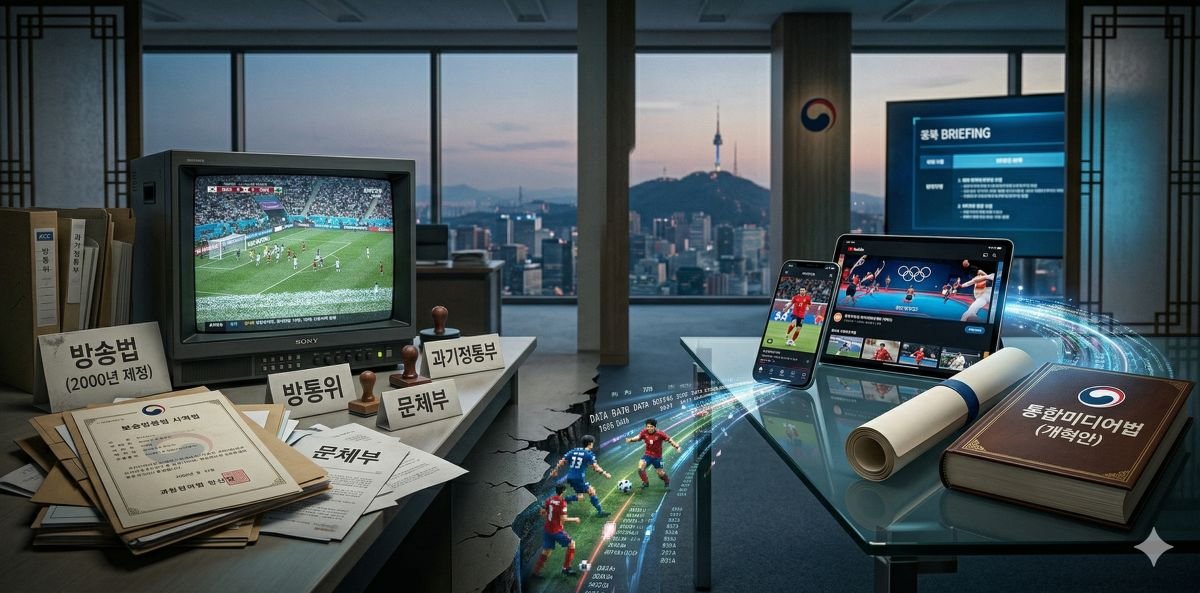
Imagine sitting down to watch a major national football match, only to find that your usual free-to-air channel is not showing it. Instead, you have to sign up for a new streaming service or a specific cable channel you do not usually use. This frustration is not just a matter of business competition, it is a result of a legal framework that is struggling to stay relevant. In South Korea, the rules governing what you see on your screen are primarily based on the Broadcasting Act of 2000. While that law worked well when everyone watched the same three or four channels on a bulky television, it was not built for an era of high speed fiber optics and mobile apps. As we move through 2026, the government is working to rewrite these rules to ensure that the law matches how citizens actually consume media today.

The Core Problem: Regulatory Asymmetry

The fundamental issue facing regulators is something called regulatory asymmetry. This is a fancy way of saying that the rules are not balanced. Under the current system, traditional broadcasters like KBS, MBC, and SBS are subject to strict requirements. They must follow specific guidelines regarding political neutrality, public interest, and fairness. They also have obligations to provide certain types of content to the general public for free.

In contrast, newer digital platforms and streaming services often operate in a legal gray area. Because they are not technically “broadcasters” under the 2000 law, they do not always have to follow the same rules. This creates a situation where a traditional TV station might be prohibited from certain types of advertising or exclusive deals, while a streaming app can do as it pleases. For fans, this means that the “universal viewing rights” we used to take for granted are becoming harder to protect.

The Jigsaw of Oversight: Who Is in Charge?

One reason why reform has taken so long is that the responsibility for media is split between different government bodies. It can feel like a jigsaw puzzle where the pieces do not quite fit together.

  • Korea Communications Commission (KCC): This body handles the licensing and content standards for traditional TV and news providers.

  • Ministry of Science and ICT (MSIT): This department manages the technical infrastructure, such as the internet networks and the business side of telecommunications.

  • Ministry of Culture, Sports and Tourism (MCST): This group oversees the actual content and the promotion of the media industry.

In the past, these groups often had jurisdictional disputes, which meant that new laws would stall before they could be passed. However, a recent shift has moved many of the broadcasting policy functions to a single regulator. This streamlining is intended to make the reform process faster and more efficient, reducing the bureaucratic red tape that has slowed down progress for two decades.

Read also: How Football Simulation Models Work — What Korea’s 77% World Cup Probability Actually Means

Why Sports Fans Should Care: The Exclusive Rights Debate

The most visible impact of these laws is felt during major sporting events like the Olympics or the FIFA World Cup. In the past, Korean broadcasters often used a system called the “Korea Pool.” This was a cooperative agreement where the major stations bid together for the rights to big games, ensuring that every citizen could watch the national team regardless of which channel they had.

Recently, this system has faced significant challenges. When a single platform or cable channel decides to bid independently and secure exclusive rights, the “universal access” model breaks. For example, the 2026 FIFA World Cup and upcoming Olympic Games have been at the center of a debate over whether private exclusive deals should be allowed to bypass public service broadcasters. The new regulatory framework aims to establish a “horizontal” system. This means that the rules for access and fairness would apply to the content itself, regardless of whether you are watching it on a smart TV or a smartphone.

Feature2000 Broadcasting Act2026 Proposed Media Law
FocusChannel-based (KBS, SBS, etc.)Content-based (all platforms)
OversightSplit between KCC and MSITUnified under a streamlined body
Digital PlatformsLargely unregulatedIncluded in a single framework
Public AccessLimited to traditional TVAiming for cross-platform access

The Impact on Regional Viewing

For citizens living in cities like Cheongju or across the North Chungcheong Province, these legal changes are quite practical. When sports broadcasting becomes fragmented, it is the viewers who pay the price through multiple subscription fees and confusing access rules. A reformed media law would ideally create a more predictable environment. It would ensure that if a match is determined to be of significant public interest, it remains accessible to everyone without a high financial barrier.

“The goal of media reform is to ensure that the public’s right to watch remains a priority, even as technology changes the way we deliver the signal.”

Looking Toward a Unified Future

As the Korea Media and Communications Commission gathers expert opinions and drafts the final version of this new comprehensive law, the focus is on stability. The government wants to create a fairer environment where traditional stations can compete with digital giants, and where citizens are protected from deceptive content or unfair pricing.

The rewrite of the framework is a recognition that the digital divide between “TV” and “Internet” has disappeared. For the average fan, the hope is that these changes will lead to a simpler experience. Instead of worrying about which app holds the rights to the next big game, the law should ensure that the moments that bring the nation together remain within reach of every household. This regulatory evolution is a necessary step to keep Korean media culture vibrant and accessible in the decades to come.

Read also: When Sports Broadcasting Becomes a Public Policy Question: Korea’s Exclusive Rights Debate and What It Means for Viewers