How Real-Time Data Feeds Power Live Sports Score Platforms

Behind every live score update that appears within seconds of a goal, a point, or a play is an infrastructure stack most fans never think about — and one that took decades to build to its current level of reliability.

Live sports score platforms feel simple from the user side. A number changes. A status updates. A notification arrives. The simplicity of that experience is the product of an extraordinarily complex real-time data pipeline operating at low latency across multiple layers of collection, verification, transmission, and display. Understanding how that pipeline actually works clarifies why live score accuracy varies across sports and platforms, why some updates arrive faster than others, and why the infrastructure behind real-time sports data has become one of the more technically demanding categories in sports technology.

Where the Data Originates

Every live score update begins with a collection event — a human or automated system recording that something happened at a specific moment in a specific match. The collection layer is the foundation of the entire pipeline, and its characteristics vary significantly depending on the sport and the resources available at the venue.

At the top tier of professional sport, dedicated data collectors are physically present at matches. These are trained operators whose sole responsibility is to record events — goals, substitutions, cards, timeouts, scoring plays — into a purpose-built input system the moment they occur. Their entries trigger the data pipeline immediately. In some venues and leagues, optical tracking systems supplement or replace manual entry for certain event types, using camera arrays to detect ball position and player movement and classify events algorithmically.

Below that tier, collection becomes less standardized. Lower-division matches, regional competitions, and amateur events may rely on fewer collectors, less sophisticated equipment, or feeds aggregated from secondary sources. This is where latency increases and accuracy gaps appear — not because the transmission infrastructure is weaker, but because the originating data is less reliable.

Transmission and the Latency Problem

Once an event is recorded at the collection layer, it travels through a transmission chain before appearing on any user-facing platform. The speed of that chain is what determines latency — the gap between when something happens on the field and when a score platform reflects it.

Professional data providers invest heavily in minimizing transmission latency because even small delays create problems. A score update that arrives several seconds late is experienced as inaccurate by fans watching live broadcasts. As explored in Daejeon Insider’s analysis of how real-time data infrastructure reshaped sports platforms, the engineering standards that govern transmission speed have tightened considerably as user expectations for live data accuracy have risen alongside the proliferation of mobile devices and second-screen viewing.

The transmission chain typically runs from the venue collection system through a data provider’s central processing infrastructure, where feeds from hundreds or thousands of simultaneous matches are normalized into consistent formats before being distributed to client platforms via API. Each step in that chain introduces potential delay. Optimizing the chain requires both technical investment and geographic distribution of processing infrastructure to reduce the physical distance data must travel.

Verification Without Adding Delay

Accuracy and speed exist in tension at the verification layer. A live score platform that publishes every raw input immediately will be fast but unreliable — operator entry errors, duplicate signals, and system glitches will surface as incorrect updates. A platform that holds every update for manual verification will be accurate but too slow to be useful for live consumption.

The solution most professional data providers use is automated cross-validation. Inputs from multiple independent collection sources covering the same event are compared in real time. When they agree, the update is published immediately. When they diverge beyond a defined threshold — two operators recording a goal at different times, or an automated system disagreeing with a manual entry — the update is held and flagged for rapid human review. The review queue operates on timescales of seconds, not minutes, to keep the delay impact minimal.

This is why data coverage from major leagues, where multiple redundant collection streams exist, is more reliable than coverage from smaller competitions where a single collector’s input is the only source available. Redundancy is not just a reliability feature — it is what makes fast automated verification possible.

How Score Platforms Consume the Feed

On the receiving end, live score platforms connect to data provider APIs and maintain persistent connections that push updates as they are published. The platform’s own infrastructure must then process those updates, apply any display logic, and deliver the change to active users — all within a timeframe short enough that the experience feels instantaneous.

This final leg of the pipeline is where platform engineering decisions become visible to users. A platform running efficient websocket connections to millions of simultaneous users will deliver updates faster and more reliably than one relying on client-side polling. The architecture behind how real-time data feeds power live sports score platforms reflects years of iteration on exactly these delivery problems — how to push high-frequency updates to large concurrent audiences without the infrastructure becoming the bottleneck.

Why Accuracy Still Varies

Even with mature infrastructure, live score accuracy varies across platforms and competitions for reasons that are structural rather than accidental. The quality of the originating data determines the ceiling of what any downstream system can achieve. No transmission optimization or verification layer can correct for events that were never recorded accurately at the source.

The Human Element That Remains

Automated systems have reduced but not eliminated the human element in live data collection. The most reliable live score feeds remain those anchored to trained human operators with backup systems and clear protocols for handling ambiguous events — own goals, disallowed scores, delayed official confirmations. The technology that surrounds the collection moment has become sophisticated. The judgment call at that moment still belongs to a person with a device, watching the same match the fan at home is watching, and entering what they see as accurately and as quickly as they can.

That combination — human observation, professional data infrastructure, and engineered delivery pipelines — is what makes a number change on a screen within seconds of something happening on a pitch thousands of kilometers away.

How Half-Time / Full-Time Bets Work

How Half-Time / Full-Time Bets Work

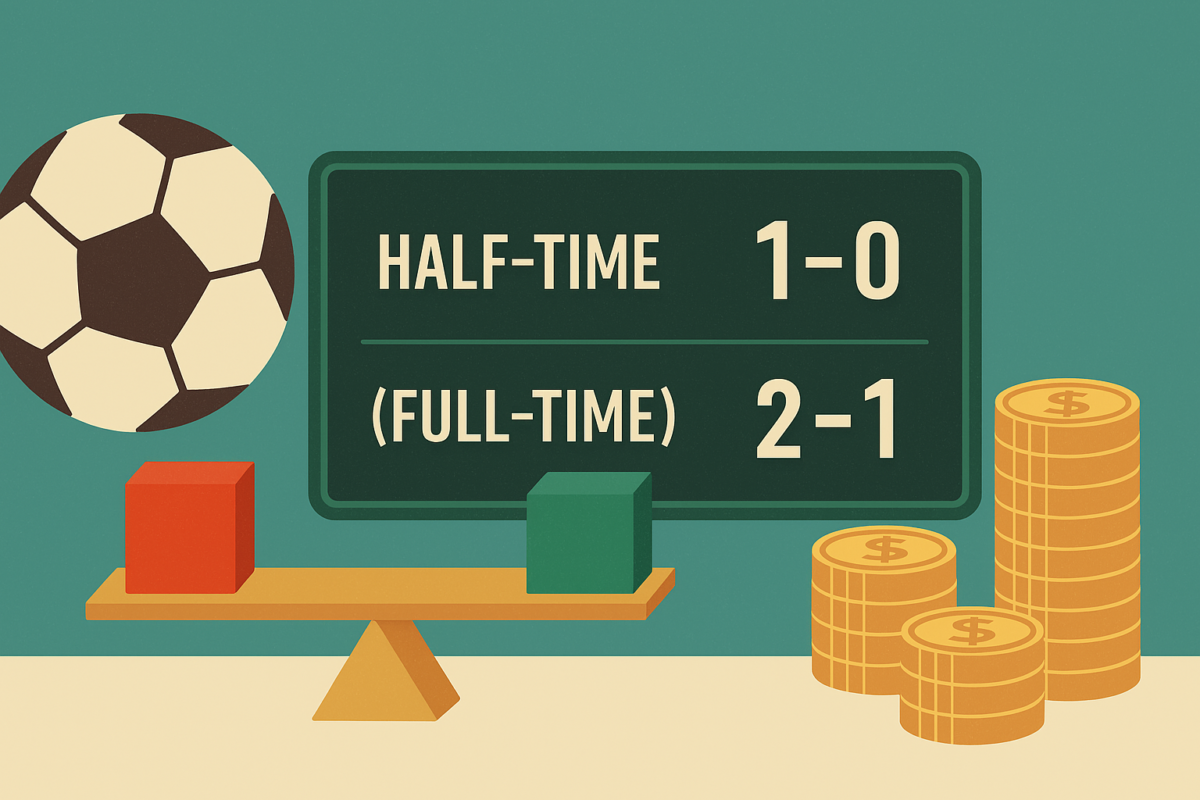
Among the many ways to engage with a football match, the half-time/full-time market stands out as one of the most structurally interesting. It asks a deceptively simple question: what will the result be at half-time, and what will it be when the final whistle blows? The combination of two predictions into a single wager creates a market with nine possible outcomes, longer odds than a standard match result, and a set of strategic considerations that reward analytical thinking over gut instinct. Understanding how half-time/full-time bets work means understanding not just the mechanics of the market but the logic behind why certain combinations carry the odds they do — and why this market behaves differently from almost everything else on the board.


The Basic Structure of the Market

A half-time/full-time wager requires the participant to correctly predict both the result at the end of the first half and the result at the final whistle. Each half of the match is treated as a separate 1X2 market — home win, draw, or away win — and the two predictions are combined into a single selection.

This produces nine possible outcomes. The home team could lead at half-time and win at full-time (Home/Home). The match could be level at the break and the home team win in the second half (Draw/Home). The away side could lead at half-time and go on to win (Away/Away). Every combination of the three half-time results with the three full-time results is a valid selection, giving the market a breadth that the standard match result market cannot offer.

The nine combinations are typically displayed as follows: Home/Home, Home/Draw, Home/Away, Draw/Home, Draw/Draw, Draw/Away, Away/Home, Away/Draw, and Away/Away. Three of these — Home/Home, Draw/Draw, and Away/Away — represent matches that follow a consistent direction throughout. The other six represent matches that change character between the first and second halves, and it is those combinations that carry the longest odds and the greatest structural interest.


Why the Odds Are Longer Than a Standard Match Result

The extended odds in this market are a direct consequence of the precision it demands. A standard match result wager requires one correct prediction. A half-time/full-time wager requires two correct predictions that must both hold simultaneously. Even when the two predictions are individually likely, the probability of both occurring together is always lower than either alone.

Consider a match where the home team is a strong favorite. The probability of a home win at full-time might be estimated at 60 percent. The probability of the home team leading at half-time might be 50 percent. But the probability of both — the home team leading at half-time and winning at full-time — is not simply the average of those two figures. It is the product of the conditional probabilities, accounting for the fact that the two outcomes are related but not identical. The result is a number meaningfully lower than either individual estimate, and that lower probability is reflected directly in the price.

This compression of probability is what makes the half-time/full-time market appealing to participants who believe they can identify matches with a high likelihood of a specific two-stage narrative. When the analysis is correct, the longer odds produce a return that a simple match result wager on the same team would not have generated. When the analysis is wrong, the precision required means there is no consolation — a match that ends exactly as predicted at full-time but not at half-time is a losing wager regardless.


The Nine Combinations and What They Represent

Each of the nine possible outcomes carries a distinct narrative about how a match unfolded, and understanding those narratives is the foundation of any serious analysis of this market.

Home/Home is the most intuitive combination for a match involving a strong home favorite. The home team takes the lead before half-time and holds it through the second half. This is the most commonly priced combination for matches with a clear favorite playing at home, and its odds tend to be the shortest of any combination involving a home win.

Draw/Home represents a match where the home team fails to establish an early lead — the first half ends level — but wins in the second half. This combination suits teams known for slow starts or strong second-half performances, and it often carries meaningfully longer odds than Home/Home despite the full-time result being the same.

Away/Home is one of the two reversal combinations — matches where the leading team at half-time is not the winning team at full-time. These carry some of the longest odds in the market precisely because they require not just a home win but a specific narrative: the home team came from behind. Historically, home comebacks occur often enough to be statistically meaningful, but rarely enough that the odds on this combination remain substantial.

Draw/Draw is the combination for participants who expect a low-scoring, evenly contested match throughout. It tends to price at moderate odds because draws at both intervals require a specific absence of goals rather than a specific sequence of scoring events.

Away/Away mirrors Home/Home from the perspective of a strong away favorite — the visiting team leads at half-time and holds on. In leagues where home advantage is statistically significant, this combination often carries longer odds than its Home/Home equivalent even when the underlying away team is highly rated.

The two remaining reversal combinations — Home/Away and Draw/Away — represent away comebacks and away wins built entirely in the second half. Home/Away in particular is often cited as the longest-odds combination in most matches, because it requires the home team to lead at half-time and then concede the match entirely in the second period — a narrative that runs against both the statistical weight of home advantage and the psychological momentum of leading at the break.


How Operators Price the Nine Outcomes

Pricing a half-time/full-time market requires more than simply multiplying two independent probabilities together. The two results — at half-time and at full-time — are correlated in ways that make naive probability multiplication inaccurate. A team leading at half-time is statistically more likely to win at full-time than a team that is level or behind, which means the conditional probability structure of the market is more complex than it appears on the surface.

Operators use historical match data, team-specific scoring patterns, and statistical models that account for the correlation between first-half and second-half results to price each of the nine combinations. Teams with specific tactical profiles — those that tend to score early, those that are known for second-half comebacks, those that play differently when protecting a lead — are priced differently from generic baselines.

The result is that the implied probabilities across all nine combinations, after accounting for the operator’s margin, sum to more than 100 percent. Each individual combination is priced to reflect both the raw probability of that specific two-stage outcome and the operator’s need to build a structural edge across the full market. Participants who find combinations where their assessment of probability differs meaningfully from the implied probability in the price are the ones best positioned to find value in this market.


Which Matches Suit This Market Best

Not all matches are equally suited to half-time/full-time analysis. The market rewards specificity, which means it performs best for participants who can identify matches with a high probability of a particular two-stage narrative rather than simply a high probability of a particular full-time result.

Matches with strong favorites playing at home tend to generate the most accessible combination in the market — Home/Home — at the shortest odds. But even in those matches, the question of whether the favorite will lead at half-time introduces enough uncertainty that the odds remain longer than a simple match result wager on the same outcome.

Matches between evenly matched sides, particularly in leagues known for closely contested first halves, suit the Draw/Home or Draw/Away combinations for participants who believe one side will assert itself in the second period. These combinations tend to price at odds that reflect genuine analytical value when the underlying match dynamics support them.

Matches with specific tactical contexts — a team chasing a result after a poor run of form, a side known for early goals, a fixture with historical patterns of second-half goals — provide the data-rich environment in which half-time/full-time analysis is most productive. The more specific and well-supported the two-stage narrative, the more likely the price reflects a genuine opportunity rather than a random outcome.


The Role of In-Play Dynamics

One dimension of the half-time/full-time market that distinguishes it from many other formats is its relationship with in-play events. Unlike a standard match result wager, which is decided at the final whistle, a half-time/full-time wager is partly decided at an intermediate point — the half-time whistle — and that intermediate result has an immediate and significant effect on the remaining probability structure of the wager.

A participant who has selected Draw/Home has a wager that is structurally alive as long as the first half ends level. Once the half-time result confirms the draw, the wager effectively becomes a second-half home win market — and the live odds on that outcome will typically shorten considerably, because the draw at half-time has eliminated one of the three possible half-time outcomes and concentrated all remaining probability on the second-half result.

This intermediate confirmation dynamic is one reason the half-time/full-time market is particularly popular among participants who follow matches closely. The half-time whistle provides a clear checkpoint — either the wager remains alive or it does not — which creates a distinct experience compared to markets decided only at the final whistle. The clarity of that intermediate moment is part of what makes the format structurally compelling even when the full-time result would have been available as a simpler alternative.


Common Analytical Approaches

Participants who consistently engage with the half-time/full-time market tend to develop specific analytical frameworks rather than approaching each match from scratch. Several approaches appear repeatedly among those who treat this market as a primary focus.

First-half scoring rate analysis examines how frequently a team scores or concedes before the break relative to the full-match average. Teams that score a disproportionate share of their goals in the first half — or that concede a disproportionate share — are candidates for combinations that diverge from the standard favorite/underdog narrative. A team that scores 60 percent of its goals in the second half but is priced as though its goal distribution is uniform is potentially underpriced in Draw/Win combinations on its own behalf.

Situational context matters significantly in this market. A team with a strong incentive to chase a result — needing a win to avoid relegation, for example — may play in a way that increases the probability of a high-tempo second half regardless of the first-half score. That situational pressure is not always fully captured in the statistical baseline that operators use to price the market, creating potential divergence between the implied price and a well-reasoned assessment.

Head-to-head historical patterns between specific opponents sometimes reveal tendencies that persist across seasons. Some fixture pairings consistently produce close first halves that open up after the break. Others consistently produce early goals that set the tone for the full match. These persistent patterns — where they exist and can be verified across a sufficient sample — provide a foundation for combination selection that goes beyond general team-level analysis. As noted by analysts studying why certain market types exist across all major sports, the half-time/full-time structure persists globally precisely because it maps onto a natural narrative arc that resonates with how matches are actually experienced.


Settlement and Edge Cases

Settlement of half-time/full-time wagers follows the official half-time and full-time results of the match. In most formats, only the 90 minutes of regulation play plus any injury time added by the referee count toward settlement — extra time and penalty shootouts in knockout competitions do not affect the result unless the operator’s specific rules state otherwise.

This distinction matters in knockout competition matches where extra time is a genuine possibility. A match that finishes 1–1 after 90 minutes before one team wins in extra time will typically be settled as Draw/Draw in the half-time/full-time market, regardless of what happens in the additional period. Participants should verify the specific settlement rules for any operator before placing wagers on knockout matches where extra time is likely.

Abandoned matches are typically voided and stakes returned, though operators vary in their specific policies. A match abandoned during the second half after the half-time result has been confirmed still results in a void wager in most cases, because the full-time result — the second half of the prediction — was never completed.


Conclusion

The half-time/full-time market is one of the most analytically rich formats available in football wagering. Its nine possible outcomes, its requirement for two simultaneous correct predictions, and its natural connection to the tactical narrative of a match make it a format that rewards genuine analytical depth more than most alternatives. The longer odds it offers relative to a simple match result wager are a direct reflection of the precision it demands — and that precision is both its challenge and its appeal.

For participants willing to invest in understanding first-half and second-half scoring dynamics, situational context, and the specific tendencies of teams in different match states, the half-time/full-time market offers a structural richness that simpler formats cannot match. The key is not finding the longest odds — it is finding combinations where the price meaningfully underestimates the probability of a specific, well-supported two-stage narrative.


Frequently Asked Questions

What does half-time/full-time mean in sports wagering?

It refers to a market where the participant must correctly predict both the result at the end of the first half and the result at the final whistle. Both predictions must be correct for the wager to win. There are nine possible combinations, each representing a different two-stage match narrative.

How many combinations are there in a half-time/full-time market?

There are nine combinations: Home/Home, Home/Draw, Home/Away, Draw/Home, Draw/Draw, Draw/Away, Away/Home, Away/Draw, and Away/Away. Each represents a specific pairing of the half-time result and the full-time result.

Why are half-time/full-time odds longer than match result odds?

Because two correct predictions are required simultaneously. Even when both individual predictions are reasonably likely, the probability of both occurring together is always lower than either alone, and that lower combined probability is reflected directly in the price.

Does extra time count for half-time/full-time settlement?

In most cases, no. The market is typically settled on the result after 90 minutes of regulation play plus injury time. Extra time and penalty shootouts are usually excluded. Always check the specific settlement rules of the operator before placing a wager on a knockout competition match.

Which combination has the longest odds in most matches?

Home/Away — where the home team leads at half-time but the away team wins at full-time — is typically the longest-priced combination in most matches. It requires a home collapse in the second half, which runs against both the statistical weight of home advantage and the psychological momentum of leading at the break.

What type of match suits the Draw/Home or Draw/Away combination?

Matches between evenly matched sides, particularly those with tactical profiles suggesting a cautious first half followed by a more open second, suit these combinations. Teams known for strong second-half performances or for playing differently when chasing a result are good candidates for Draw/Win combinations in their favor.

How Public Opinion Shapes Odds

How Public Opinion Shapes Odds

Walk into any conversation about sports wagering and the phrase “public money” will surface quickly. It is shorthand for a phenomenon that every operator, analyst, and serious student of the market has to reckon with: the collective opinion of casual participants exerts measurable force on the numbers that price sporting events. Understanding how public opinion shapes odds is not just a theoretical exercise — it is the foundation of how lines move, why some markets become systematically mispriced, and how the tension between popular sentiment and structural pricing logic plays out in real time.

This article examines the full mechanics of public influence on odds: how it enters the market, how operators respond to it, where it creates the most distortion, and what that distortion means for the broader structure of pricing across sports.


The Opening Line Is Not About Public Opinion

Before examining how public opinion shapes odds, it is worth being precise about where public influence begins — and where it does not. Before a single public dollar is placed, the sportsbook’s oddsmakers get to work. Their job is to set an opening line. This is not a prediction of who will win. It is a prediction of what will split the wagering action evenly.

This distinction matters enormously. The opening line is a pricing exercise built on data — historical performance, injury status, travel schedules, weather conditions, and statistical models. It is designed to attract balanced action, not to reflect the opinion of the crowd. Public opinion has no direct role in setting that initial number.

What public opinion does is move the line after it opens. The moment wagers begin flowing in, the operator watches which side is attracting disproportionate action. When that imbalance becomes significant, it creates pressure to adjust the price — and that adjustment is where public opinion begins to leave its mark on the market.


How Volume Imbalance Creates Line Movement

The core mechanism through which public opinion enters the pricing structure is straightforward. Sportsbooks aim to create balanced markets where the money wagered on both sides of a bet is roughly equal. This ensures that sportsbooks earn a profit through the margin regardless of the outcome. Public opinion is a powerful force in this equation. As participants place their wagers, sportsbooks adjust the lines to encourage action on the less popular side and balance the book.

The mechanics of that adjustment are simple in principle: if 80 percent of incoming wagers favor one team, the operator shades the line to make the other side more attractive. The favored team’s spread grows slightly larger or its moneyline price shortens, nudging the numbers until more action flows to the other side. The line is not a statement about the operator’s revised opinion of the game — it is a signal to the market about where money is needed.

When most of the wagering public places money on one side too heavily, the sportsbook will often adjust the lines and odds to make the other side more appealing. Moving lines is a strong indicator that most of the public is positioned one way. The visible movement of a line is therefore one of the clearest public signals available: it indicates that sentiment has become concentrated enough that the operator needed to intervene structurally.


The Favorite Bias: Why Public Opinion Tilts Systematically

Public opinion does not distribute randomly across outcomes. It follows consistent patterns, the most significant of which is a systematic preference for favorites. Public participants often gravitate toward favorites, assuming they have a higher chance of winning. However, this behavior can inflate the odds, reducing the potential return on investment.

The reasons for this bias are not difficult to identify. Casual participants are more comfortable wagering on the team or player they believe will win — a natural instinct, but one that conflates picking winners with finding value. A favorite at inflated odds because of public concentration is not a better wager than it was before the public arrived; it is a worse one. The underlying probability of the outcome has not changed, but the price has moved against the person taking it.

Popular teams attract heavy action. This can inflate the odds or point spreads, making it structurally interesting to consider their opponents. Casual fans may hear a famous team name and back them without any deeper analysis. This brand-driven concentration of public money creates one of the most durable structural inefficiencies in sports pricing: the undervalued opponent of a heavily followed franchise.

Public participants often overreact to recent performances, news, or trends. Oddsmakers can anticipate this by setting lines that account for these biases — particularly for teams coming off a blowout win or loss, and for popular teams which often attract disproportionate public action. The pattern is consistent enough that operators can build their lines accordingly, effectively pricing in the public’s predictable overreaction before it even arrives.


Tickets vs. Money: Why the Distinction Is Critical

One of the most important — and most frequently misunderstood — aspects of public influence on odds is the difference between the number of wagers placed on a side and the total dollar value of those wagers. The bet percentage accounts for total bets, or tickets, while the money percentage tracks dollar amounts. A high ticket volume but low money volume suggests many casual participants are backing a team. If 75 percent of tickets favor one side but only 40 percent of the money does, it indicates recreational participants are taking that side while larger money prefers the opponent.

This split reveals a structural truth about how markets actually work. Public opinion — in the sense of the crowd’s collective view — is well represented by ticket count. But operators do not manage risk against ticket count alone. They manage it against dollar exposure. A market where 80 percent of tickets favor one side but only 55 percent of the money does is not the same risk profile as one where both numbers align.

The money percentage often tells a more accurate story because it reflects where larger, potentially sharper participants are positioned. Reading the divergence between tickets and money is one of the primary tools analysts use to distinguish between genuine public-driven line movement and the influence of professional participants whose volume is too significant to ignore.


Sharp Money and Reverse Line Movement

The most counterintuitive phenomenon in public-influenced pricing is reverse line movement. Reverse line movement occurs when the line shifts in the opposite direction of where the majority of wagers are flowing. If most wagers favor one team but the spread moves in favor of the other, it signals that professional participants whose large positions carry more weight than aggregate public tickets have positioned themselves on the less popular side.

This reversal is only possible because operators are not purely trying to balance action — they are also managing their exposure to participants whose historical accuracy is high enough to be treated differently from the public. If a sharp participant with a winning track record puts significant money on a side, the book may move the line even if 80 percent of the public is on the other side. The operator trusts that sharp money more than the aggregate of smaller public wagers.

Reverse line movement is therefore a signal that something more informed than public sentiment is driving the market. When the line moves against the crowd, it suggests that participants with structural advantages — better data, better models, or deeper contextual knowledge — have identified a mispricing that the public has not. Line movement reveals the ongoing battle between public sentiment and sharper opinion. Early informed action often sets the direction, while late public money might cause smaller adjustments before an event begins.


Media Narratives and the Amplification of Public Bias

Public opinion does not form in isolation. It is shaped, amplified, and sometimes manufactured by media coverage — and that coverage can accelerate the concentration of public money on certain outcomes far beyond what underlying probability would justify.

In today’s connected digital environment, media narratives and public opinion play a substantial role in shaping odds. From mainstream sports coverage to viral social media trends, participants often react emotionally rather than analytically, shifting significant wagers based on the latest news cycle. A team covered positively across multiple major outlets ahead of a game will attract public money from casual participants who have absorbed the narrative without analyzing the underlying pricing.

Social media platforms have become influential in spreading wagering sentiment. A well-timed post or a viral movement can send public money flooding into specific markets, even when the fundamentals do not support it. This social amplification effect has grown substantially as real-time platforms have increased the speed at which narratives form and spread.

This is precisely where the psychological patterns that govern how humans interpret random sequences become relevant. Much like how humans misread random sequences, public participants tend to project recent narrative momentum — a team’s hot streak, a star player’s recent form — onto future outcomes in ways that are not supported by base rate probabilities. Operators who understand this pattern can price into it before public money arrives.


High-Profile Events and Maximum Public Distortion

The relationship between event prominence and public influence on odds follows a clear pattern: the bigger the event, the greater the concentration of public money on popular or high-profile outcomes, and the more significant the potential distortion of the line.

In highly anticipated, nationally broadcast games, the public tends to participate far more heavily than in regular-season contests, driven by hype, media coverage, and the broader cultural significance of the event. Public participants — casual or recreational — often make decisions based on emotion, hype, or media coverage rather than solid analysis.

Championship events, rivalry matches, and playoff games draw not only regular participants but also casual observers who engage specifically because of the elevated attention around the game. Those casual participants are far more susceptible to narrative-driven pricing bias than regular participants who have developed analytical habits. The result is that the largest and most prominent events frequently produce the most distorted lines relative to underlying probability — exactly the opposite of what intuition might suggest.

Narratives surrounding star players, injuries, or a hyped rivalry can dramatically sway public sentiment. Games involving high-profile teams often attract heavy public wagering, even when odds suggest better plays elsewhere. The primetime game with the league’s two best-known franchises is not necessarily the best-priced game on the schedule — it may well be the worst-priced, precisely because so much public attention and emotionally-driven money has flooded into it.


How Operators Manage Public Concentration Strategically

Not every case of public concentration triggers the same response from an operator. When a sportsbook is in a position where they have balanced, informed money on one side and a tidal wave of public money on the other, if the public side loses, they win significantly. In these cases, operators might even resist moving the line too much, letting the public keep placing wagers into a slightly worse price. It is a calculated positional decision.

This reveals a more nuanced picture of how operators actually respond to public opinion. When the operator’s own pricing confidence is high and the public is concentrated on the likely losing side, the rational response is not necessarily to move the line aggressively. Moving aggressively would attract less public money and reduce the operator’s expected gain from the public’s collective error. Holding the line — or moving it only slightly — keeps the public engaged while preserving the operator’s positional advantage.

Data-driven operators often balance between risk management and maximizing expected return. They do not always need equal action on both sides if they are confident in their numbers. When the public heavily backs an overvalued favorite, operators might keep favorable lines for sharper money on the other side. This active management of when to move and when to hold is one of the clearest expressions of how sophisticated operators treat public opinion: not as a force to be neutralized at all costs, but as a source of structural advantage when the public’s collective bias is well-understood.


The Limits of Public Influence

Public opinion is a real force in the market, but its influence has structural limits. The most important of those limits is the presence of participants whose opinion is weighted more heavily by operators than the aggregate public.

Sportsbooks are not simply trying to get equal money on both sides — a common misconception. They are trying to maximize their expected profit. If a sharp participant with a winning track record puts significant money on a side, the operator may move the line even if 80 percent of the public is on the other side. The operator trusts that sharp money more than the aggregate of smaller public wagers.

The second limit is time. Public opinion tends to be most influential in the middle phase of a market’s life — after the opening informed action has set the initial direction and before the final sharp adjustments close the market. The public’s systematic preference for favorites means that being early — before public concentration has moved the line — consistently offers better prices on the favored side than waiting until public money has done its work.


Conclusion

Public opinion shapes odds not through any single dramatic intervention but through the steady accumulation of small, consistent, and predictable biases. The preference for favorites, the susceptibility to media narrative, the concentration of money on high-profile events, and the emotional rather than analytical basis of most casual wagering — all of these patterns combine to create a persistent force on the pricing structure that operators have learned to anticipate, model, and in many cases profit from.

Understanding this force is useful not as a prescriptive strategy but as a framework for reading markets more accurately. When a line has moved significantly from its opening number, the question worth asking is not just which direction it moved but why. Was it public concentration on a familiar brand? Was it a media narrative pushing casual money toward one outcome? Or was it something sharper — a well-funded, well-informed participant finding a misprice before the public arrived? The answers to those questions are what the line’s history is actually telling you.


Frequently Asked Questions

What is public money in sports wagering?

Public money refers to the aggregate wagers placed by recreational or casual participants — people whose decisions tend to be driven by team loyalty, media narrative, recent form, and general familiarity rather than analytical modeling. It is distinguished from sharp money, which comes from professional participants whose historical accuracy earns their positions differential treatment from operators.

Does public opinion always move the line?

Not always. Operators respond to public concentration when it creates imbalance they need to correct, but they also assess the quality of the money involved. When a strong divergence exists between the number of wagers and the total dollar value of those wagers, operators may move the line only modestly or not at all if they are confident the public is on the wrong side.

What is reverse line movement?

Reverse line movement occurs when the line shifts in the opposite direction of where the majority of wagers are flowing. If most wagers favor one team but the spread moves in favor of the other, it signals that professional participants whose large positions carry more weight than aggregate public tickets have positioned themselves on the less popular side.

Why do big events attract more public bias?

Major events draw casual observers who do not regularly engage with the market. Those participants are far more influenced by media coverage, brand recognition, and narrative momentum than by underlying probability. The result is a greater concentration of public money on popular or high-profile outcomes, which tends to make large events some of the most structurally mispriced on the schedule.

What is the difference between tickets and money percentage?

Ticket percentage measures the raw number of individual wagers on each side. Money percentage measures the total dollar value. When these diverge — many small wagers favoring one team while larger wagers favor the other — it typically indicates that recreational participants and professional participants are on opposite sides of the market.visual

Why Popular Teams Attract More Bets

Anyone who has spent time observing sports wagering markets will have noticed a pattern that holds across sports, leagues, and geographies: the most popular teams attract the most bets. It does not matter whether those teams represent the best value on the board. It does not matter whether the odds reflect a genuine edge. Fans of Manchester United, the LA Lakers, the New York Yankees, and their equivalents in every major sport consistently push disproportionate wagering volume toward their preferred teams regardless of what the numbers say.

This is not a minor market quirk. It is one of the most structurally significant and well-documented behavioral patterns in sports wagering, and it has profound implications for how odds are set, how markets move, and how informed bettors can position themselves relative to the public. Understanding why popular teams attract more bets — and what happens to markets as a result — is foundational knowledge for anyone who wants to engage with sports wagering at more than a surface level.

The Emotional Foundation of Public Betting Behavior

At the core of the popular team phenomenon is a simple psychological reality: most people who wager on sports are fans first and analysts second. Their primary relationship with sport is emotional — built around loyalty, identity, and the genuine desire to see their team succeed. When that emotional attachment combines with the opportunity to wager, the result is predictable: bets follow fandom.

This emotional foundation produces wagering behavior that is fundamentally different from the behavior of a purely analytical bettor. A fan betting on their team is not primarily asking “does this represent good value?” They are asking “can my team win this?” — and the answer to that question is almost always filtered through the optimism that fandom naturally generates.

Psychologists refer to this as motivated reasoning — the tendency to evaluate evidence in a way that supports a conclusion we are emotionally invested in reaching. In the context of sports wagering, motivated reasoning leads fans to consistently overestimate the probability of their team winning, underweight evidence that points toward a loss, and interpret ambiguous information in the most favorable possible light.

The result is a persistent bias in the distribution of wagering volume. Popular teams — those with the largest and most emotionally engaged fan bases — attract bets that are driven by loyalty and optimism rather than analytical assessment of value.

The Role of Media and Public Narrative

Emotional attachment to a team is amplified by the media environment that surrounds major sports. Popular teams receive disproportionate coverage — more broadcast time, more analytical content, more social media discussion, more journalistic attention. This coverage does more than simply reflect public interest. It actively shapes the narrative around those teams in ways that influence wagering behavior.

When a popular team is on a winning streak, the media coverage of that streak creates a feedback loop. The team’s success generates coverage, the coverage generates optimism, the optimism generates wagering volume, and that volume in turn signals to the broader market that the team is favored. Bettors who pay attention to where the money is going — rather than to the underlying analytical case — are drawn in by the signal of concentrated public action.

Conversely, when popular teams underperform, the media narrative often frames their struggles as temporary setbacks rather than structural problems — preserving the optimistic baseline that drives continued public support. This asymmetry in narrative treatment means that the wagering bias toward popular teams tends to persist even through periods of poor performance.

How Operator Pricing Responds to Public Bias

The concentration of wagering volume on popular teams creates a direct challenge for operators: if they price markets purely on their analytical assessment of probabilities, they will consistently find themselves holding unbalanced books — taking far more liability on popular teams than on their opponents.

Operators respond to this imbalance through a process known as shade pricing or shading the line. Rather than moving the line purely in response to new information about the actual probability of outcomes, operators adjust prices to account for the anticipated direction of public money. A popular team playing a less-followed opponent will often open at odds that are slightly less generous than a purely analytical model would suggest — precisely because the operator knows that public money will flow heavily toward the popular side regardless of where the line opens.

This pricing behavior has a structural consequence that matters for informed bettors: popular teams are consistently priced at a slight discount relative to their true analytical probability. The public pays a premium for the opportunity to back their favorites, and that premium is built into the opening line before a single bet is placed.

The opponent — the less popular, less followed team — is correspondingly priced at a slight premium. This is the structural basis for what experienced bettors sometimes call “fading the public”: the observation that betting against heavily backed popular teams can offer positive expected value over large samples, not because popular teams are bad, but because they are systematically overpriced relative to their true probability of winning.

Recency Bias and the Momentum Effect

Beyond stable long-term fandom, wagering volume on popular teams is further amplified by recency bias — the tendency to overweight recent events when forming expectations about future ones. A popular team that has won its last four games will attract even more public money than usual, regardless of whether those wins were against strong or weak opposition, whether the performances were dominant or fortunate, or whether the upcoming opponent represents a meaningfully different challenge.

Recency bias combines with the media amplification effect to create momentum cycles in public wagering. A popular team on a visible winning run becomes the subject of increasingly confident public narrative. Each successive win is interpreted as further confirmation of quality. The wagering volume builds. The odds shorten. And the gap between the market price and the analytically justified probability widens further.

Understanding this dynamic is one of the reasons why distinguishing between genuine momentum — real changes in team quality or form — and statistical variance is so important for anyone trying to navigate these markets analytically. As explored in the detailed breakdown on Cheongju Insider’s analysis of how public opinion shapes odds, the line between a team genuinely performing better and a team simply being perceived as performing better is one of the most consequential distinctions in sports wagering — and the one most frequently collapsed by public bettors.

The Geography of Popular Team Bias

The popular team effect is not uniform across all markets. Its intensity varies significantly depending on the geographic concentration of a team’s fan base and the structure of the wagering market in which they are playing.

Teams with highly localized fan bases — those whose support is concentrated in a specific city or region — produce the strongest public betting bias in markets accessible to that fan base. A local bookmaker operating in Manchester will see a dramatically more skewed distribution of bets on Manchester United matches than a global platform where the wagering pool is drawn from a diverse international audience.

Global platforms, by contrast, see popular team bias driven by the worldwide reach of certain brands. Real Madrid, FC Barcelona, Liverpool, and a handful of other clubs have fan bases distributed across every continent, producing consistent global public bias that operators on international platforms must price against. This global dimension of popular team bias is a relatively recent development — a product of the globalization of sports media over the past two decades — and it has added a new layer of complexity to how operators manage their liability on marquee fixtures.

What This Means for the Informed Bettor

The structural reality of popular team bias has several practical implications for anyone approaching wagering with an analytical rather than emotional orientation.

First, it means that the odds on popular teams should always be viewed with some skepticism. The price reflects not just the operator’s assessment of probability but also the adjustment made for anticipated public money. Popular teams are rarely priced at full value — there is almost always a loyalty premium embedded in their odds.

Second, it means that opponents of popular teams — particularly those that are competent but unglamorous, with small or geographically dispersed fan bases — tend to be priced more generously than their actual quality warrants. This is not a universal rule, and it should not be applied mechanically, but it is a structural tendency that appears consistently across large samples.

Third, and most importantly, it means that separating analytical assessment from emotional attachment is one of the most valuable skills available to anyone navigating sports wagering markets. As highlighted in this examination of how odds are shaped by crowd dynamics, the odds on any given market are as much a product of collective human psychology as they are of objective probability assessment — and recognizing that distinction is the starting point for any genuinely informed approach.

Final Thoughts: Popularity Is Not Probability

The tendency of popular teams to attract disproportionate wagering volume is one of the most reliable and well-documented patterns in sports markets. It is rooted in human psychology, amplified by media dynamics, and structurally embedded in how operators price their markets.

For the casual bettor who wagers primarily for entertainment and emotional engagement, this pattern is simply part of the experience — backing a beloved team is enjoyable regardless of the analytical merits. For the bettor who approaches wagering with a more disciplined, analytical orientation, understanding the popular team effect is essential. It is the difference between navigating markets as they actually function and navigating them as one might wish they did.

Popularity is not probability. The most-bet team is not always the most likely winner. And the gap between those two things is where the most interesting structural opportunities in sports wagering markets consistently reside.

The crowd tells you where the money is going. It rarely tells you where it should go.

How Regulation Shaped Modern Betting Markets

The modern betting market did not emerge from a vacuum. Every structural feature visible on a contemporary wagering platform — the range of available markets, the way odds are displayed, the limits placed on certain bet types, the verification processes required before a withdrawal — exists in its current form at least partly because of regulatory decisions made by governments, licensing bodies, and industry organizations over decades.

Regulation is not simply a constraint layered on top of an otherwise free market. It is one of the primary forces that has shaped that market from the inside out, determining which products exist, how they are priced, who can access them, and under what conditions. Understanding how we arrived at the betting markets of today requires tracing the regulatory journey that brought them here — and recognizing that the industry’s current form is as much the product of legal architecture as it is of commercial innovation.

From Prohibition to Permission: The Regulatory Starting Point

For much of the twentieth century, the dominant regulatory approach to sports wagering in most jurisdictions was prohibition. The underlying assumption was that wagering was a social harm to be suppressed rather than a commercial activity to be managed. This produced underground markets — illegal bookmaking operations that operated outside any regulatory framework, with no consumer protections, no transparency requirements, and no accountability to any authority.

The prohibitionist model did not eliminate wagering. It simply pushed it underground, where it flourished beyond the reach of any oversight. By the latter decades of the twentieth century, the failure of prohibition as a practical policy was becoming increasingly difficult to ignore. Underground markets were large, visible, and generating significant revenue that flowed entirely outside the formal economy.

The regulatory shift that followed — toward permission-based models that licensed and taxed wagering activity rather than attempting to eliminate it — fundamentally changed the structure of the market. Operators who had previously functioned in legal grey areas or outright illegality could now obtain licenses, access banking infrastructure, advertise openly, and build the kind of scaled, professional operations that define the industry today.

Licensing as a Structural Force

The introduction of formal licensing regimes did more than simply legalize existing activity. It restructured the market by establishing conditions that operators had to meet in order to participate. These conditions — around capitalization, technical standards, responsible gambling tools, anti-money laundering procedures, and data reporting — had profound effects on the types of products that could be viably offered.

Operators who wanted to maintain their licenses had to build infrastructure that met regulatory standards. This requirement drove investment in technology, compliance systems, and operational processes that smaller or less capitalized operators could not sustain. The practical effect was market consolidation — a reduction in the number of operators and an increase in the average size and professionalism of those that remained.

Licensing also created geographic segmentation. Because licensing regimes are jurisdiction-specific, operators serving multiple markets have had to maintain different product configurations for different regions — offering certain bet types in one jurisdiction while removing them in another, applying different limits depending on local requirements, and maintaining separate compliance records for each market. This geographic complexity is one of the defining structural features of the modern global wagering industry.

Responsible Gambling Requirements and Product Design

One of the most significant ways regulation has shaped betting markets is through responsible gambling requirements — mandates that operators implement specific tools and features designed to reduce harm for vulnerable users.

These requirements have directly influenced product design in ways that go beyond simple feature additions. Mandatory deposit limits, loss limits, session time limits, self-exclusion programs, and cooling-off periods have all required operators to build functionality into their platforms that limits, rather than maximizes, user engagement. For an industry whose commercial model is built on volume, this represents a genuine structural tension that regulation has forced operators to navigate.

The effect on specific market types has been significant. As I explored earlier in this piece, ultra-short-duration in-play markets — those that resolve within seconds or minutes — have faced particular regulatory scrutiny because of concerns about their potential to accelerate problematic wagering behavior. In several regulated jurisdictions, these markets have been restricted or removed entirely, reshaping the in-play product offering in ways that would not have occurred through commercial logic alone.

More broadly, the requirement to implement responsible gambling tools has pushed operators toward greater transparency about the nature of their products — including clearer communication of odds, expected returns, and the statistical realities of wagering outcomes. This transparency, while commercially uncomfortable in some respects, has made modern regulated betting markets structurally more honest than the unregulated alternatives they replaced.

Integrity Frameworks and Market Structure

A dimension of regulation that receives less attention but has had substantial structural impact is the development of sports integrity frameworks — regulatory requirements designed to protect the integrity of sporting events from manipulation.

The concern is straightforward: if wagering markets exist on the outcome of sporting events, those markets create financial incentives for the manipulation of those events. Regulators and sports governing bodies have responded by developing monitoring systems that track unusual betting patterns, information-sharing agreements between operators and integrity bodies, and requirements for operators to report suspicious activity.

These integrity frameworks have influenced market structure in several specific ways. They have driven the development of real-time market monitoring technology that can detect anomalous wagering patterns as they occur. They have led to the restriction or removal of certain market types — particularly those involving minor events, lower-league competitions, or outcomes that are easier to manipulate — in jurisdictions where integrity risks are considered highest. And they have created data-sharing obligations that have changed the relationship between operators, sporting bodies, and regulatory authorities.

The result is a market structure in which the available product range is shaped not just by commercial demand but by a continuous assessment of integrity risk. Markets that cannot be adequately monitored for manipulation are under persistent pressure, regardless of their commercial viability.

Taxation and Its Effect on Odds and Market Depth

Regulation does not only shape betting markets through product requirements and licensing conditions. Taxation — the financial terms on which operators are permitted to participate in a market — has had its own significant structural effects.

The taxation of wagering revenue affects the economics of product offering in direct ways. When tax rates are high, operators face pressure to reduce their exposure on lower-margin markets — those where the house edge is thin and the potential for unexpected losses is significant. This pressure tends to result in market narrowing: fewer markets offered, lower maximum stakes, and less competitive pricing.

Conversely, jurisdictions with lower tax rates have historically attracted more operators and seen deeper, more competitive markets with tighter margins and greater product variety. The relationship between taxation level and market quality is not perfectly linear, but the general direction of the effect is well established: tax burden shapes the economics of offering, and those economics shape the market structure experienced by users.

This dynamic helps explain why the same sport can be offered with dramatically different depth and pricing quality in different jurisdictions — a phenomenon that has nothing to do with the underlying sport and everything to do with the regulatory and tax environment in which the market is operating.

The Digital Transition and New Regulatory Challenges

The shift from land-based to online wagering created a new set of regulatory challenges that further shaped market structure. Online wagering operates across jurisdictions in ways that physical operations cannot, creating persistent tension between the geographic basis of regulatory authority and the borderless nature of digital markets.

Regulatory responses to this tension have varied. Some jurisdictions have pursued aggressive geo-blocking and payment blocking to prevent unlicensed operators from accessing their markets. Others have created open licensing frameworks that welcome international operators under local compliance conditions. Still others have maintained prohibition while acknowledging their limited ability to enforce it against offshore operators.

As examined in detail in this analysis of how legal structures shape user behavior, the regulatory environment does not just determine what products are available — it actively shapes how users interact with those products, which platforms they gravitate toward, and what behaviors the overall system incentivizes or discourages. The online transition amplified this dynamic by giving users access to a much wider range of regulatory environments than had previously been possible.

Where Regulation and Markets Stand Today

The modern betting market is the product of a long and uneven regulatory evolution. It is more structured, more transparent, and more accountable than at any previous point in its history — but it is also more complex, more geographically fragmented, and more subject to ongoing change.

Regulation continues to evolve in response to new technologies, new research on harm, new integrity challenges, and new political pressures. Each regulatory development creates new constraints and new opportunities that reshape the market in turn. The relationship between regulation and market structure is not a historical story with a fixed ending — it is an ongoing dynamic that continues to determine the shape of the industry in real time.

For anyone seeking to understand modern betting markets — their structure, their limitations, their product range, and their behavior — understanding the regulatory forces that shaped them is not optional background knowledge. It is foundational. As discussed in the comprehensive breakdown on Cheongju Insider’s coverage of how regulation shaped modern betting markets, the market as it exists today cannot be fully understood without understanding the regulatory journey that produced it.

Final Thoughts: Regulation as Architecture

It is tempting to think of regulation as an external force acting on markets — a set of rules imposed from outside on an otherwise free commercial system. The reality is more fundamental than that. Regulation is part of the architecture of modern betting markets. It is embedded in their structure, their product design, their pricing, their geographic configuration, and their behavioral dynamics.

The markets that exist today are not the markets that would have emerged from purely commercial logic. They are the product of a long negotiation between commercial interests, regulatory requirements, social policy objectives, and technological change. Understanding that negotiation — and the forces that continue to shape it — is essential for understanding where betting markets are today, and where they are likely to go next.

The rules of the market are inseparable from the rules about the market.

Why Some Bet Types Were Phased Out or Modified

The range of bet types available on any major sports platform today is the product of decades of iteration, experimentation, and adaptation. Not every market that has ever been offered has survived. Some were removed entirely. Others were restructured so significantly that they bear little resemblance to their original form. A few disappeared from one region while continuing to thrive in another.

Understanding why some bet types were phased out or modified requires looking beyond the surface of product decisions and into the deeper forces — regulatory pressure, structural instability, operator risk, and shifting user behavior — that ultimately determine which markets survive and which do not. A detailed examination of why some markets were introduced in phases reveals that the same logic governing market introduction also governs market removal: sustainability, not novelty, is the determining factor.

The Natural Selection of Betting Markets

Not all bet types are created equal in terms of long-term viability. When a new market is introduced, it enters a kind of commercial and regulatory stress test. It must generate sufficient volume to be worth maintaining. It must be priced accurately enough that it does not consistently produce unexpected losses for the operator. It must be structured clearly enough that disputes and ambiguities do not create operational headaches. And increasingly, it must be compatible with the regulatory frameworks of the markets in which it is offered.

Markets that fail on any of these dimensions face pressure. Some are quietly discontinued. Others are modified — their rules adjusted, their scope narrowed, or their settlement logic restructured — until they reach a form that is sustainable.

This process is ongoing and continuous. The betting product landscape is never static. What appears on a platform today has already survived multiple rounds of this selection process, and what was available a decade ago often looks quite different from what exists now.

Regulatory Pressure as a Driver of Market Removal

One of the most significant forces behind the phasing out of specific bet types is regulatory intervention. As governments around the world have developed more sophisticated frameworks for overseeing sports wagering, they have increasingly specified not just whether wagering is permitted, but which types of wagers are acceptable.

Certain bet types have been targeted by regulators on the grounds that they accelerate the pace of wagering in ways that amplify risk for vulnerable users. In-play markets that resolve within seconds — such as next-pitch or next-play markets in baseball and American football — have faced particular scrutiny in jurisdictions with strong harm minimization frameworks. The concern is not the market itself but the speed at which repeated decisions can be made, which some researchers link to the development of problematic wagering behavior.

In response, some operators have removed these ultra-short-duration markets in regulated jurisdictions, either proactively ahead of regulatory action or in direct response to legislative requirements. The same market may continue to exist in less regulated environments, creating the appearance that the bet type has disappeared when it has in fact been geographically restricted rather than globally discontinued.

Regulatory pressure has also driven structural modifications. Bet types that were not removed entirely have sometimes been redesigned to include mandatory delays, maximum frequency limits, or cooling-off periods between wagers — changes that alter the fundamental character of the market even if the core wagering concept remains intact.

Structural Instability and Pricing Challenges

Some bet types have been phased out not because of external regulatory pressure but because of internal structural problems — specifically, the difficulty of pricing them accurately and consistently.

Correct score markets in football are a well-documented example of this dynamic at a smaller scale. While they have not been removed, their offered depth has been significantly reduced on some platforms because the tail of possible outcomes — scorelines beyond 3-2 or 4-1 — are extraordinarily difficult to price efficiently. Operators that offered prices deep into the scoreline distribution found themselves exposed to sharp bettors who identified pricing errors and exploited them systematically.

For less popular sports and niche competitions, similar dynamics play out across a wider range of market types. When a market cannot be priced with sufficient confidence — either because the underlying data is sparse, the event sample size is too small, or the range of possible outcomes is too wide — the rational response for an operator is to remove or narrow the market rather than continue offering it at prices that cannot be reliably defended.

This is particularly relevant for prop markets and player-specific wagers, which have gone through significant evolution. Early versions of some player performance markets were removed or substantially modified after operators found that the combination of information asymmetry — some bettors having access to injury and lineup information well before it became public — and pricing difficulty created unacceptable exposure.

Settlement Disputes and Operational Complexity

A less visible but practically significant reason for market modification is the frequency and severity of settlement disputes. Some bet types generate disproportionate levels of customer complaints and disputed outcomes — not because anything improper is happening, but because the settlement rules are ambiguous, difficult for users to understand, or subject to interpretation in edge cases.

Over time, operators respond to persistent settlement disputes in one of two ways: they clarify and restructure the settlement rules, or they discontinue the market entirely if the operational cost of managing disputes exceeds the commercial value of offering it.

Markets involving conditional outcomes — those where the result depends on a sequence of events rather than a single measurable outcome — have historically been particularly prone to this problem. The more conditions a market settlement involves, the more opportunity there is for edge cases that the original rules did not anticipate. When those edge cases occur repeatedly, the pressure to modify or remove the market grows.

User Behavior and Demand Shifts

Market evolution is not driven solely by operators and regulators. User behavior plays a significant role in determining which bet types survive. Markets that fail to attract sufficient volume are commercially unviable regardless of their structural soundness.

Some bet types that were introduced with reasonable expectations simply did not find an audience large enough to justify their continued operation. This can happen for a variety of reasons: the market concept may have been too complex for the average user to engage with confidently, the odds may have been perceived as insufficiently attractive, or the bet type may have simply been overtaken in popularity by a competing market format that offered a similar experience more accessibly.

As explored in detail on Cheongju Insider’s analysis of why some bet types were phased out or modified, demand-side dynamics are often underweighted in discussions of market evolution. The focus tends to fall on regulatory and operator decisions, but the underlying driver is frequently simpler: if users do not engage with a market, the commercial case for maintaining it evaporates.

The shift toward mobile-first wagering has also influenced which market formats survive. Bet types that require complex input, multiple selections, or careful reading of fine print perform poorly on small screens in fast-moving environments. Some markets that thrived in the desktop era of online wagering have been simplified, condensed, or discontinued as the primary interaction environment shifted to mobile.

Geographic Variation and Market Survival

The global nature of the sports wagering industry means that the fate of any given bet type is not uniform across all markets. A market that was phased out in one regulatory environment may continue to exist — or even thrive — in another. This geographic variation creates a picture of market evolution that is more fragmented than a single global narrative would suggest.

Asian handicap markets, for example, were developed specifically to address the limitations of simpler handicap formats for certain wagering cultures and have spread globally from their regional origins. Conversely, some market formats that developed in European contexts have found limited traction in Asian markets where different structural preferences apply.

This regional dimension matters for understanding not just which markets exist but why. A bet type that appears to have been phased out may in fact have been geographically withdrawn — surviving in some markets while being removed from others in response to local regulatory, cultural, or commercial conditions.

What Market Evolution Reveals About the Industry

The broader pattern of bet type evolution — introduction, stress testing, modification, and in some cases removal — reveals something important about how the sports wagering industry actually functions.

The surface appearance is one of constant expansion: more sports, more markets, more bet types, more platforms. But beneath that expansion is a continuous process of filtration. Not everything introduced survives. The markets that remain are those that have demonstrated they can be priced reliably, settled clearly, operated within regulatory frameworks, and sustained by genuine user demand.

This filtration process is, in many respects, a quality mechanism. The bet types available on established platforms today have survived because they work — for operators, for regulators, and for users. The ones that did not survive, or that were significantly modified, failed to meet one or more of those requirements in a sustained way.

Understanding this process makes it easier to evaluate new bet types when they are introduced — and to assess whether the conditions that caused previous markets to fail are present in new ones.

Final Thoughts: Survival Is Not Accidental

The bet types that have been phased out or modified over time were not removed arbitrarily. Each removal or modification reflects a judgment — by operators, regulators, or the market itself — that the original form of the product was not sustainable.

Regulatory pressure, pricing difficulty, settlement complexity, demand shortfalls, and geographic variation all contribute to a continuous process of market evolution that shapes the wagering landscape in ways that are rarely visible to the average user but profoundly important to the structure of the industry.

For anyone interested in understanding how sports wagering markets actually work — not just in the present but over time — following the history of market modification and removal is one of the most revealing lenses available.

Markets that survive do so because they work. Markets that don’t survive tell an equally important story.

How Variance Shaped Market Expansion Decisions

How Variance Shaped Market Expansion Decisions

Every major expansion decision in the sports wagering industry comes down to a version of the same question: can the platform survive the volatility of this new environment long enough to profit from it? That question is fundamentally a question about variance — the statistical spread between expected outcomes and actual results. And across the history of market expansion in this industry, variance has quietly determined which markets got entered first, which product types got launched in new regions, and how quickly operators scaled.

This article examines how variance shaped market expansion decisions at both the operator and market level — from the structural logic that makes some sports and markets lower risk to enter, to the specific ways that data infrastructure, liquidity management, and regulatory timing intersect with the mathematics of unpredictability.


What Variance Actually Means for Market Entry

In statistics, variance measures how widely actual outcomes are distributed around an expected value. In the context of market operations, it describes how far a platform’s real cash flows in a given period might deviate from what the pricing model predicted. A platform operating in a market with low variance can predict its financial position with reasonable confidence week to week. A platform operating in a high-variance environment might see its cash position swing dramatically, even when every individual price it set was technically correct.

High variance bets carry greater risk and a wide range of potential outcomes, making them less predictable. They usually come with high odds — offering big payouts if successful but a greater likelihood of losing. What is true for an individual wager is also true at the portfolio level for an operator expanding into a new market. When a platform enters a new geography, it is effectively taking on a large, high-uncertainty position: it does not yet know the local user behavior, the distribution of stake sizes, which events will attract disproportionate volume, or how regional sentiment might shift odds in ways that distort book balance.

Cash flow risk is minimized when a sportsbook is “balanced” — when the ratio of funds placed on both sides of a wager are proportional to the likelihood of the outcome. Platforms affect this balance by adjusting the commissions charged on certain outcomes, delivering better pricing to one side and worse to the other, encouraging funds to flow toward balance. In an established market, operators have the historical data to calibrate these adjustments efficiently. In a new market, that calibration takes time — and during that calibration period, variance is at its highest.

This is why the sequence of market entries, the types of products launched first, and the pace of scaling are all shaped by variance management as much as by regulatory opportunity or user demand.


Why Operators Enter Low-Variance Markets First

The pattern of international expansion by major operators follows a consistent logic: regulated, data-rich, liquid markets with well-understood user bases come first. Smaller, less-documented, or more volatile markets come later — and often only after structural tools for managing variance in those environments have been developed.

Major players in the sports betting industry are actively exploring strategies such as partnerships, acquisitions, and product development to strengthen their market positions. Companies such as Flutter Entertainment, Entain, and Bet365 are continually entering newly regulated markets, particularly in North America and Latin America. But within those broad geographic moves, the sequencing is telling. Flutter did not enter all Latin American markets simultaneously — it established a position in Brazil through a majority stake acquisition precisely because Brazil’s scale and its trajectory toward formal regulation made it the most predictable large market in the region. Predictability is another word for lower variance.

Strict regulatory and licensing barriers remain one of the biggest restraints for the sports wagering market, limiting expansion in both mature and emerging regions. Countries follow different legal frameworks, creating uncertainty for operators. That uncertainty is a source of variance: an operator cannot accurately price the cost of compliance, the timeline of licensing, or the risk of regulatory reversal in a jurisdiction where the rules are still in flux. Until those variables narrow, the variance of operating in that market remains too high relative to the expected return.

This explains why heavily regulated but well-documented markets like the United Kingdom attracted sustained operator investment long before operators moved aggressively into markets where the rules were either absent or unstable. Europe is a significant player in the online sports wagering market. The UK leads with approximately 40% share, followed by Germany at around 20%. The region’s growth is fueled by increasing internet penetration, mobile use, and a shift toward online platforms. Europe’s dominance is partly a function of its established regulatory frameworks — low regulatory variance attracted capital, which attracted more operators, which generated the data needed to reduce pricing variance further.


How Product Type Selection Reflects Variance Logic

When operators enter new markets, they do not typically launch their full product portfolio simultaneously. They start with low-variance market types and expand the product range as they accumulate local data and operational experience.

Low variance bets include point spreads, over/under totals, and draw-no-bet markets — these produce steadier returns with smaller fluctuations. High variance bets include underdog moneylines, parlays, and player props — higher risk with bigger swings. This hierarchy directly informs product launch sequencing. A platform entering a new geography typically leads with match result markets and totals lines — the most liquid, most-modeled, and historically lowest-variance formats — before introducing player props, same-game parlays, or exotic markets where pricing uncertainty is higher and historical reference data is scarce.

The relationship between variance and expected value in repeated decisions matters especially here. An individual exotic bet can be priced correctly in terms of expected value while still generating enormous short-term variance at the book level — particularly in a new market where the operator cannot yet predict how volume will distribute across outcomes. Delaying the launch of high-variance products until sufficient local data has been gathered is a form of variance management built into the product roadmap itself.

Operators could start by identifying the risks inherent in the sports wagering business. These risks include market risks such as short and long-term shifts in betting trends. In a new market, both of those risk types are elevated: short-term shifts are harder to predict without behavioral data, and long-term trends are unknown entirely. The most direct response is to begin with the product types least sensitive to those unknowns.


The Role of Liquidity in Variance Control

Market liquidity — the volume of funds distributed across outcomes — is one of the most powerful structural tools for controlling variance. When high volumes flow on both sides of a market, individual large positions are absorbed without distorting the book’s balance. When liquidity is thin, a single large wager can create significant imbalance, forcing the operator to either accept elevated variance or move lines aggressively in ways that can themselves generate further uncertainty.

Pricing policies that prioritize book balance lower the variance of expected cash flow, but at the cost of lower profit. Due to the legal and moral hazards involved in operating an illegal enterprise, some firms rely on internal financing — and consequently behave as mean-variance optimizers as opposed to legal operators who appear to behave as profit maximizers. This distinction reveals something important: variance management is not equally important for all operators. Well-capitalized legal platforms with access to external financing can absorb more short-term variance because they have the financial resilience to weather it. Smaller or less-capitalized entrants — including early-stage operators in newly regulated markets — cannot, and their expansion decisions reflect that constraint.

In 2024, Entain strengthened its position by acquiring Angstrom Sports, gaining proprietary modeling capabilities that enhanced live-odds accuracy and reduced risks from sharp users exploiting pricing inefficiencies. This acquisition illustrates variance reduction as a direct strategic investment: better models mean tighter pricing, which means less exposure to informed-position risk, which means lower variance at the book level. The decision to acquire rather than build that capability in-house also reflects a market entry timing calculation — Entain needed to reduce variance faster than organic model development would allow.


How Sports Scoring Structure Affects Market Variance

Not all sports generate equal variance for operators. The scoring structure of a sport — how frequently goals or points are scored, how reversible leads are, and how much momentum shifts within a single event — directly determines how volatile a market’s book balance will be in real time.

Variance in sports wagering refers to the natural unpredictability of outcomes, which can lead to both winning and losing streaks regardless of strategy. For operators, that unpredictability is not symmetrically distributed across sports. Low-scoring sports like football (soccer) produce more draws, more upset results relative to pre-match pricing, and greater sensitivity to single events like red cards or injury-time goals. High-scoring sports like basketball produce more stable mean reversion toward the favored outcome, making book balance easier to maintain.

This structural difference explains why markets in low-scoring sports were historically offered with greater caution — tighter limits, more conservative lines, delayed in-play market expansion — relative to higher-scoring sports where variance was structurally lower. As data infrastructure improved and operators built better real-time models for low-scoring sports, those constraints gradually relaxed. The progression from pre-match only to in-play markets in football mirrors the gradual acquisition of the data needed to price variance accurately in a volatile scoring environment.

In September 2024, Sportradar announced plans to introduce micro markets — an advanced form of in-play products — across major sports, creating new revenue opportunities for operators. Micro markets represent the frontier of variance management: they price extremely granular outcomes (next throw, next pitch, next possession) where historical data is thin and pricing uncertainty is high. Their emergence is only possible because the underlying data infrastructure has matured enough to constrain the variance of pricing those outcomes to an operationally manageable level.


Geographic Expansion Timing and Regulatory Variance

One of the most underappreciated dimensions of variance in market expansion is regulatory variance — the risk that the legal framework governing a market will change in ways that adversely affect operations. This form of variance is qualitatively different from statistical pricing variance, but it has the same practical effect on expansion decisions: it makes the expected return of entering a market harder to model and harder to rely on.

In October 2023, the Indian government announced stricter scrutiny and a proposed ban on offshore platforms operating without proper licenses, impacting several international operators in the region. In May 2023, Germany introduced revised regulations that imposed additional taxes and compliance burdens on online platforms, leading to reduced margins and the exit of smaller firms. Both cases illustrate regulatory variance materializing after market entry: operators who had built revenue models on one set of assumptions found themselves managing unexpected cost structures that their original expansion calculus had not fully priced.

The response to regulatory variance tends to follow a similar pattern across operators. They either absorb the new cost structure if the market’s scale justifies it, reduce product scope to lower-variance offerings that retain profitability under the new terms, or exit entirely. New York’s 51% tax on online wagering revenue significantly reduces operator margins, discouraging smaller sportsbooks from entering the market. That tax represents a form of regulatory variance that was priced into entry decisions — some operators concluded the expected return justified the margin compression; others concluded it did not.


Data Infrastructure as a Variance Reduction Technology

Behind every improvement in operators’ ability to expand into new markets and new product types is an improvement in data infrastructure. Real-time event data, historical performance databases, and player behavior analytics all serve the same fundamental function: they reduce the uncertainty — and therefore the variance — that operators face when pricing outcomes.

Technology and data can be powerful tools in risk management. Operators tap into vast amounts of data to identify patterns and trends, detect potential fraud, and make informed decisions about odds and lines. Technology is key in automating risk management processes and improving efficiency. The automation of these processes matters specifically because it allows variance management to happen at the speed of live events — adjusting lines in real time as scoring and game state shift — rather than through slower manual processes that would leave the book exposed to larger variance windows.

Technology advancements such as AI-driven odds generation, real-time analytics, and blockchain-based payment systems are transforming user experiences and backend operations. Each of these technologies reduces a specific form of operational variance: AI-driven odds generation reduces pricing variance, real-time analytics reduces the latency between an event and the market’s response to it, and streamlined payment systems reduce the variance of cash flow timing. Together they make the financial outcome of operating in a new market more predictable — and therefore more attractive to enter.


A Visual Overview: How Variance Filters Expansion Decisions—

How Variance Tolerance Differs by Operator Capitalization

Not all operators face variance with equal resilience. The ability to absorb short-term variance — and therefore the willingness to enter uncertain markets — is directly linked to capitalization, access to external financing, and the diversification of existing market positions.

Illegal bookmakers lack access to traditional sources of external capital whereas their legal counterparts enjoy abundant sources of financing. Consequently, illegal bookmakers behave as mean-variance optimizers as opposed to legal bookmakers who appear to behave as profit maximizers. This capital structure difference produces a fundamental difference in expansion behavior: the well-capitalized legal operator can accept higher short-term variance in pursuit of long-term market share, while the constrained operator must prioritize variance minimization even at the cost of growth opportunity.

Among large legal operators, the same logic plays out at a different scale. A platform with a large, diversified portfolio of established markets can use the stable cash flows from those markets to absorb the elevated variance of a new market entry. This is exactly how the largest operators — Flutter, Entain, Bet365 — have been able to enter frontier markets that smaller competitors cannot afford to enter. Their existing market diversification is itself a variance management tool.

Running out of liquidity before covering winnings is a terrible scenario for an operator. Failure to control the impact of markets and individual players — as well as the inability to adapt to an ever-changing regulatory environment — threatens to shut down a business altogether. For smaller operators, this constraint is existential. It explains why smaller entrants typically wait for market conditions to stabilize — for regulatory frameworks to clarify, for user behavior patterns to be documented by earlier entrants, for data infrastructure to be established by third-party providers — before committing their more limited variance tolerance to a new geography.


The US Market as a Case Study in Variance-Staged Expansion

The United States market provides one of the clearest examples of variance-staged expansion in the industry’s recent history. Following the 2018 repeal of the federal prohibition on state-regulated sports wagering, the market did not open uniformly — it opened state by state, each with its own regulatory framework, tax structure, and timeline.

States such as New Jersey and Pennsylvania saw the majority of bets placed through mobile apps rather than physical locations. The appeal of interactive features, personalized recommendations, and 24/7 accessibility solidified the dominance of the online segment, making it the fastest-growing platform in the global market. New Jersey and Pennsylvania were early movers with relatively favorable tax structures and clear regulatory frameworks — low regulatory variance. Operators entered them quickly and built the data and operational infrastructure that reduced pricing variance over time.

New York’s 51% tax on online wagering revenue significantly reduces operator margins, discouraging smaller operators from entering. New York represented a different variance calculation: the market’s enormous scale promised high expected returns, but the cost structure compressed margins in ways that increased the variance of achieving profitability. Large operators entered because their variance tolerance — backed by diversified revenues — allowed them to absorb margin compression while building scale. Smaller operators stayed out because the margin environment made their variance exposure potentially ruinous.

DraftKings and FanDuel continue to lead in market coverage by leveraging mobile apps and media partnerships. BetMGM combines retail presence with digital scalability. Meanwhile, operators such as 888 Holdings and Unibet are selectively expanding in regulated states. The phrase “selectively expanding” is the variance management signal: mid-tier operators are not entering all available states, only the ones where their variance tolerance is sufficient to compete against the entrenched, better-capitalized leaders.


Emerging Markets and the Next Frontier of Variance Management

The Asia Pacific sports wagering market is expected to register the fastest growth from 2025 to 2034 due to rising smartphone usage, expanding internet access, and growing interest in sports such as cricket, basketball, and esports. Regulatory shifts in countries like India and the Philippines are enabling more structured environments, drawing local and international operators.

That growth trajectory is real, but so is the variance. Regulatory frameworks in many Asia-Pacific markets remain in transition — the regulatory variance that slows entry is still elevated. The operators moving carefully into those markets are doing exactly what the variance framework predicts: investing in local partnerships that reduce regulatory uncertainty, launching with low-variance core products, and waiting for behavioral data to accumulate before expanding to higher-variance market types.

In September 2024, Flutter Entertainment announced the purchase of a 56% stake in Brazil’s NSX Group, which operates Betnacional, for around $350 million — a strategic move to build Flutter’s strength in Brazil, where sports wagering was on the cusp of full regulation. The acquisition timing is instructive. Flutter did not wait for full regulatory implementation before entering — it acquired a local operator to gain the behavioral data and regulatory relationships that would reduce variance once the framework finalized. Buying variance reduction capability before the market fully opens is a strategic use of capital that only the best-capitalized operators can execute.


Conclusion

Variance is the invisible hand behind most of the major decisions in market expansion — which geographies attract early capital, which product types get launched first, how quickly platforms scale, and which operators end up dominating which markets. What looks from the outside like a sequence of strategic bets on regulatory timing or user demand is, at its core, a sequence of variance management decisions.

The operators who have built the most durable market positions are those who understood that variance cannot be eliminated — only managed, staged, and progressively reduced through data accumulation, capitalization, and structural product design. Every new market entry is an exercise in accepting enough variance to get started while building the tools to reduce it fast enough to survive.

Frequently Asked Questions

What is variance in the context of market expansion? In this context, variance refers to the range of possible financial outcomes an operator might experience when entering a new market — driven by pricing uncertainty, regulatory instability, unfamiliar user behavior, and thin liquidity. High variance means the actual financial outcome could deviate significantly from expectations in either direction.

Why do operators enter some markets years before others even when both are legally available? Because the variance of operating profitably differs significantly between markets. A legally available but poorly documented or low-liquidity market carries higher variance than a regulated, data-rich market with predictable user behavior. Operators tend to sequence entry by variance level, not purely by legal availability.

How does product type relate to variance management during market entry? Different product formats carry different variance levels. Match result and totals markets have lower variance for operators because they are well-modeled and liquid. Player props and exotic parlays carry higher variance. Operators typically launch the low-variance product types first in new markets and expand their product range as they accumulate local data.

Does capitalization affect which markets operators can enter? Significantly. Well-capitalized operators with diversified market portfolios can use stable existing revenues to absorb the elevated variance of new market entries. Less-capitalized operators must wait for variance to decline — through regulatory clarity, established user patterns, and third-party data infrastructure — before entry becomes viable for them.

Why does sports scoring structure affect how operators expand? Low-scoring sports produce more volatile pricing environments because individual events (a red card, a late goal) have outsized effects on outcome distributions. Operators entering new markets with low-scoring sports as the primary focus face higher pricing variance and typically respond with more conservative limits, tighter lines, and delayed in-play market expansion.

Why Betting Formats Look Similar Across Countries

Why Betting Formats Look Similar Across Countries

Open a sports wagering platform in London, Lagos, Manila, or São Paulo and something immediately stands out: despite the different languages, currencies, and legal frameworks, the core structure of what you see looks remarkably familiar. Match winner markets. Over/under totals. Handicap lines. Live in-play options. The same fundamental building blocks appear across continents, cultures, and regulatory environments.

This convergence is not accidental. Understanding why betting formats look similar across countries requires looking at the intersection of technology, economics, sports globalization, and regulatory evolution — all of which have pushed markets toward a shared structural logic even as surface-level differences remain.


The Starting Point: Convergence Is Not the Same as Uniformity

Before diving into the reasons behind format similarity, it is worth making a distinction that often gets overlooked. Betting markets across countries share structural templates — the basic categories of wagering and how outcomes are framed — but they do not share identical odds, rules, or experiences.

A moneyline bet in the United States and a match result (1X2) market in the United Kingdom represent the same underlying wager: pick the winner. But the odds presentation, the settlement rules, and the surrounding interface differ. The template converged; the execution did not. This distinction matters because the convergence is not about cultural homogenization — it is about structural efficiency. Formats that consistently help platforms manage risk and help users make decisions tend to survive, spread, and eventually become defaults everywhere.


The Global Sports Calendar Created a Shared Reference Point

The single most powerful driver of format similarity is the globalization of sport itself. Football — soccer — is the clearest example. The English Premier League, Spain’s La Liga, the UEFA Champions League, and FIFA World Cup tournaments are followed by hundreds of millions of people across every continent. The types of sports bet on in markets like Zambia are often less tied to the local sports ecosystem and are more likely to be focused on European soccer leagues or the NBA.

When the same sporting events attract attention from Lagos to Lima, platforms serving those different markets naturally develop similar wagering structures around those same events. A match result market for a Champions League semifinal looks the same in Germany as it does in Kenya because both platforms are pricing the same game. The shared sporting calendar created shared market architecture.

This dynamic extends beyond football. Basketball, tennis, and cricket all have global followings that cross regulatory borders. The global sports betting market obtained a worldwide market size of over 200 billion US dollars in 2019, with over 30,000 sports-betting-related businesses globally. That scale of industry is only possible when products are designed around shared sporting reference points.


Technology Platforms Exported Their Architecture

The second major driver of convergence is technology. When large platforms expanded internationally, they did not rebuild their product from scratch in each country — they adapted existing interfaces and market structures to new regulatory and linguistic environments. The underlying architecture traveled with the platform.

Sports betting used to center around storefront counters, paper slips and fixed operating hours. Over the past decade, the format changed in many parts of the world because smartphones, mobile payments and live sports data became common parts of everyday life. As that transition happened, the platforms leading it carried their structural assumptions with them.

The result is that a platform built in the United Kingdom — where match result, both teams to score, and Asian handicap markets were refined over decades — exported those same categories when it entered African or Asian markets. Users in those markets learned to navigate formats designed elsewhere. Over time, local competitors built similar structures because that is what users had come to expect. Increasing standardization across levels of technology and internet access for much of the world means that people from all different countries and cultures are finding that they exist on a relatively even playing field when it comes to what sorts of entertainment they choose.


Risk Management Logic Pushes Toward the Same Solutions

Behind every betting market is a framework for managing uncertainty. Operators need to price outcomes, balance their exposure, and ensure they can pay out regardless of results. These are mathematical and structural problems, and they tend to have mathematically and structurally similar solutions regardless of geography.

The over/under total — sometimes called a totals market — exists because it offers a clean binary outcome independent of team identity. The handicap line exists because it creates a more balanced market when one side is heavily favored. These formats were not invented for cultural reasons; they were invented because they solve specific risk distribution problems.

When a platform in Brazil faces the same risk management challenge as a platform in South Korea, they tend to reach for the same tools. International cooperation can facilitate the development of consistent regulatory frameworks across jurisdictions, enabling the sharing of information and best practices. That cooperation is partly formal — through regulatory bodies and licensing requirements — and partly informal, through the shared mathematics of pricing sports outcomes.

The influence of global sports leagues on betting market design has reinforced this tendency. When leagues provide standardized data feeds, betting platforms in multiple countries receive the same underlying information and price it through similar mechanisms.


Regulatory Harmonization Shaped Market Categories

Regulation has historically been cited as the reason markets differ across countries. And at the level of licensing, taxation, and permitted bet types, that is true. But at the structural level, regulation has paradoxically contributed to convergence.

As governments began formalizing sports wagering frameworks — often looking at established markets like the United Kingdom for reference — they tended to adopt similar licensing requirements and market categories. There are 225 online gambling and sports betting licenses in Europe across 21 European countries where sports betting is legal. The process of obtaining those licenses pushed operators toward documented, defensible market structures — the ones already proven in established jurisdictions.

The United Kingdom’s regulatory model has been especially influential. Its emphasis on licensed operators, transparent odds presentation, and defined settlement rules became a de facto template that other regulators examined when building their own frameworks. Once a sportsbook has researched the laws and regulations for each country and continent where it plans to operate, it can adjust its odds and data to be specific for each geographic location. But the base product — the market categories themselves — tends to remain consistent even when the numbers inside them shift.


User Familiarity Creates Its Own Momentum

Once a format becomes widespread, it benefits from a powerful inertia: users already know how it works. This familiarity effect is easy to underestimate. Match result markets, totals, and handicap lines are not necessarily the most elegant or theoretically optimal ways to structure sports wagering. They became dominant in part because enough users in enough markets learned to use them, and switching to something different carries a real friction cost.

Sports betting Zambia fans and those in Maryland share similar preferences, including live and in-play wagering as well as parlay bets. This cross-continental alignment in user preferences is not purely organic. It reflects the fact that the same structural formats were introduced in both markets by platforms using similar product templates, trained users to expect similar things, and then benefited from those trained expectations becoming the new baseline.

This creates a feedback loop. Platforms build familiar formats because users expect them. Users expect familiar formats because platforms build them. New entrants in any market — whether a startup in Southeast Asia or a new state-regulated operator in the United States — face a strong incentive to match existing user expectations rather than innovate from scratch.


Live Wagering Accelerated the Pattern

The rise of in-play markets — wagering on events as they unfold in real time — added a new layer of convergence. Live wagering requires fast, reliable data. The companies that supply that data are largely the same globally: a small number of data providers power live odds across platforms in dozens of countries.

Live betting is far more popular in Europe compared to the U.S., but the underlying infrastructure supporting it operates across both regions. When the same data infrastructure powers live markets in multiple countries simultaneously, the structural similarity of those markets is not coincidental — it is built into the supply chain.

The types of in-play markets that exist — next goal scorer, next corner, current period total — reflect what the data feed makes possible as much as what operators independently chose to offer. A platform in Nigeria and a platform in the Netherlands offering live next-goal markets are, at the structural level, running the same product because they are consuming the same data architecture.


Where Differences Still Persist

Format convergence does not mean complete homogeneity. Meaningful differences remain, particularly at the level of odds presentation, settlement conventions, and culturally prominent bet types.

American odds (moneyline format with positive and negative numbers) remain standard in the United States while decimal odds dominate in continental Europe and Australia, with fractional odds persisting in the United Kingdom. These are not trivial differences — they shape how users intuitively interpret risk and value.

In the Asia-Pacific region, traditional sportsbooks continue to dominate, largely due to strict regulations and established betting habits. Regional sports preferences also create market variation: cricket-specific formats matter enormously in India, Pakistan, and Australia in ways they do not in Latin America. Sumo and baseball-specific markets carry different weight in Japan than in Europe.

Different sports are more or less popular based on location, so operators customize their sports feed coverage to cater to their customers’ demands. The scaffolding is shared; the content inside it is localized.


The Role of Operator Expansion

Perhaps the most direct explanation for format similarity is simply that the same companies operate in multiple countries. When a major European platform enters an African or Latin American market, it brings its existing product. Localization teams adapt the language, currency, and some content, but the underlying market structure — the categories of wagering, the way lines are displayed, the settlement process — remains largely unchanged.

The best platforms adapt their payment options to include local mobile money services and adapt their customer support hours to local time zones, but the core wagering structure travels with the platform. This operator-led expansion is the most straightforward mechanism of format diffusion. It does not require regulatory harmonization or spontaneous convergence — it just requires a company entering a new market and launching a product that already exists.

As those platforms gain users, local competitors emerge. Those local competitors benchmark against the established platforms because their users already have formed expectations based on them. The format reproduces itself through competitive imitation as much as through any deliberate standardization effort.


A Visual Overview: Why Formats Converge—

What Format Similarity Does Not Mean

It is tempting to read format convergence as evidence of a fully unified global market. That reading overstates the case. Significant barriers remain, including local licensing regimes, currency and payment infrastructure, language, and the fundamental reality that sports popularity varies enormously by region.

Religious doctrine is the driving force behind sports wagering restrictions in many countries, with strict Islamic law forbidding it in several Middle Eastern nations, while other governments restrict it to maintain state control or prevent associated social ills. These are not trivial barriers that format convergence can dissolve.

The more accurate picture is one of structural similarity within diverse regulatory and cultural containers. The categories of wagering available on a platform in Lagos may match those available in Warsaw, but the legal framework governing each, the payment methods available, the sports featured prominently, and the user experience surrounding those formats will differ in meaningful ways.


Frequently Asked Questions

Why do sports wagering formats look the same globally if regulations differ so much? Regulations govern who can operate, how they must be licensed, and what taxes apply — but they rarely mandate specific market categories. Format similarity emerges from shared technology, shared data infrastructure, shared sporting calendars, and operator expansion, all of which operate independently of local regulatory variation.

Did the United Kingdom invent most of the formats used globally? Not exclusively, but the UK market — with its long history of regulated, high-volume sports wagering — did serve as a template that many other regulatory frameworks referenced when building their own rules. Handicap markets, in particular, have historical roots in Asian markets that predate their adoption in Europe.

Are odds formats converging too, or just market categories? Market categories have converged more than odds presentation formats. Decimal, fractional, and American odds systems still dominate in their respective home regions, though many platforms offer a toggle so users can switch between presentations.

What is the most universal format type across all markets? The match result or moneyline market — picking which side wins — is present in virtually every regulated market globally. It is the most structurally simple format and requires the least explanation across cultural contexts.

Will formats continue converging or will we see more local variation? Both trends are likely to coexist. The structural templates will remain similar while local customization around sport selection, bet type prominence, and live market depth continues to reflect regional preferences.


Conclusion

The similarity of wagering formats across countries is not the product of any single decision or deliberate design. It is the cumulative result of global sport creating shared reference events, technology platforms carrying their architecture across borders, risk management mathematics producing common solutions, data suppliers standardizing the infrastructure for live markets, user familiarity creating powerful inertia, and regulatory frameworks drawing from the same established models.

The surface appearance — open a platform anywhere and recognize the structure — masks a more complex reality underneath. The legal environment, the prominent sports, the payment methods, and the cultural context differ markedly from country to country. But the fundamental categories through which those differences are expressed have grown remarkably consistent. In that sense, format similarity is less a story about cultural convergence than it is a story about structural efficiency finding the same solutions across different contexts.

How Overtime Rules Differ Across Sports

How Overtime Rules Differ Across Sports: A Complete Guide

When a game ends in a tie, the drama is far from over. Overtime — or extra time, as it’s known in some sports — is one of the most electrifying moments in athletics. But the rules governing those extra minutes vary wildly depending on the sport, the level of competition, and even the specific tournament or league. Understanding how overtime rules differ across sports can deepen your appreciation for the game and help you follow the action with greater confidence.

This guide breaks down overtime rules in the major professional and international sports leagues, explains why the formats differ, and highlights the ongoing debates surrounding some of the most controversial rules in the game.


Why Overtime Rules Exist — and Why They Vary

Every competitive sport needs a mechanism to break ties. But the method for doing so reflects each sport’s culture, physical demands, and broadcasting realities. A sport played on ice with explosive bursts of energy has different overtime considerations than a sport played over 90 minutes on grass. Key factors that shape overtime rules include player safety and fatigue, broadcast time constraints, the premium placed on offense versus fairness, and the difference between regular-season and playoff stakes.


NFL: The Coin Flip Controversy

The NFL’s overtime rules have been among the most debated in professional sports. Under the current format used in playoff games, each team is guaranteed at least one possession — unless the first team scores a touchdown on its opening drive. In the regular season, the same format applies but games can end in a tie if neither team scores during the 10-minute overtime period.

The format has evolved significantly. Prior to 2022, a team could win the game immediately by kicking a field goal on the opening possession, which critics argued gave an unfair advantage to whichever team won the coin toss. The league adjusted the rules to ensure both teams receive a chance to possess the ball, though a touchdown on the first drive still ends the game immediately.

Debate continues about whether the current system truly levels the playing field, with some analysts advocating for a college-style format or a full extra quarter.


College Football: The Two-Point Drama

College football uses one of the most unique overtime systems in sports. Each team gets a possession starting from the opponent’s 25-yard line. If the score remains tied after each team has had their turn, another overtime period begins from the same spot.

Starting in the third overtime, teams are required to attempt a two-point conversion instead of kicking an extra point after a touchdown. From the fifth overtime onward, teams alternate two-point conversion attempts directly — eliminating traditional offensive drives entirely. This format was designed to shorten marathon overtime games and reduce player fatigue, though it can feel anticlimactic to some fans who prefer full possessions.


NBA: Five More Minutes, Unlimited Rounds

Professional basketball takes a straightforward approach. If the score is tied at the end of regulation, the teams play a five-minute overtime period. If the game remains tied, another five-minute period follows — and this continues indefinitely until one team leads at the end of an overtime period.

This format is widely considered one of the fairest in professional sports because it mirrors regulation play. Both teams have equal and continuous opportunity throughout each overtime period. The record for most overtime periods in an NBA game is six, set in a 1951 matchup between the Indianapolis Olympians and the Rochester Royals.


NHL: Regular Season vs. Playoffs

Hockey uses two distinct overtime systems depending on the stakes. During the regular season, a tied game after 60 minutes goes to a five-minute, three-on-three sudden death overtime period. The reduced number of skaters opens up the ice and dramatically increases scoring chances. If no goal is scored in those five minutes, the game proceeds to a shootout — a one-on-one skills competition between a shooter and the goaltender.

The playoffs operate under completely different rules. There are no shootouts in the postseason. Instead, teams play full 20-minute sudden death periods with five skaters per side until a goal is scored. This can lead to extraordinarily long games; the longest playoff game in NHL history went to a sixth overtime period in 1936, lasting 176 minutes and 30 seconds of playing time.

The playoff format is beloved by purists who believe the Stanley Cup should never be decided by a shootout, while critics of the regular-season shootout argue it distorts standings.


Soccer: Extra Time and the Penalty Shootout

Association football — soccer — uses a two-period extra time system in knockout competitions. Two 15-minute halves of additional play follow the end of regulation if the score is tied, for a total of 30 extra minutes. If the match remains level after extra time, a penalty shootout determines the winner.

In a shootout, each team selects five players to take alternating penalty kicks from the spot, 12 yards from goal. If still tied after five kicks each, the shootout moves to sudden death — where each team takes one kick per round until one scores and the other misses.

“Golden goal” rules — where the first goal in extra time immediately ends the match — were used in major tournaments from 1993 to 2004 but were largely abandoned because teams became too conservative, preferring to play for the shootout rather than risk being eliminated by a single goal.

Penalty shootouts remain the most controversial tiebreaker in sport. Critics call them a lottery that fails to reflect 90 minutes of team performance, while supporters point out that the pressure of the shootout is itself a legitimate test of skill and nerves.


MLB: Extras and the Ghost Runner

Major League Baseball’s overtime — known simply as “extra innings” — is one of the purest forms of tiebreaking in sport. If the score is tied after nine innings, the teams continue playing complete innings until one team leads at the end of a full inning.

However, MLB introduced a significant change during the shortened 2020 season that became permanent: the “ghost runner” rule, officially called the “Automatic Runner” rule. Each extra inning begins with a runner placed on second base — the player who made the final out in the previous inning. This rule was introduced to prevent excessively long games and reduce pitcher workloads, but it remains polarizing among fans and traditionalists who argue it distorts the fundamental nature of baseball.

Prior to the rule change, extra-inning games were theoretically unlimited, with the longest professional baseball game in history lasting 33 innings between the Pawtucket Red Sox and Rochester Red Wings in 1981.


Tennis: Tiebreaks and the Final-Set Marathon

Tennis has several overtime systems layered within its unique scoring structure. A tiebreak is played when a set reaches 6–6, with players competing to reach seven points with a two-point lead (or in some formats, 10 points). The tiebreak determines the winner of that set.

The final set has historically been the most varied format across tournaments. Wimbledon famously used advantage sets — where play continued until one player led by two games — until 2019, which produced some historic marathons including the 2010 match between John Isner and Nicolas Mahut that lasted 11 hours and five minutes, with a final set score of 70–68.

The Grand Slams have now standardized on a final-set tiebreak, though the triggering score varies: at Wimbledon and the US Open, the final-set tiebreak begins at 6–6. At the Australian Open it starts at 6–6 as well, while Roland Garros introduced a final-set tiebreak format in 2022. Tiebreak scoring formats also differ between a standard tiebreak (first to 7) and a match tiebreak (first to 10).


Rugby: Different Rules for Different Codes

Rugby union and rugby league each have their own overtime systems. In rugby union knockout tournaments, tied games go to extra time consisting of two 10-minute halves, followed by a kicking competition if still level. The Rugby World Cup uses sudden death extra time — where the first score of any kind (try, penalty, or drop goal) wins the match — before moving to a kicking competition if needed.

Rugby league tends to use golden point rules in its major competitions. In the NRL (Australia’s top rugby league competition), tied games go to five-minute golden point extra time periods where the first scoring play wins. If no score occurs, another period follows — though drawn matches are also possible in some competitions.


A Visual Comparison—

The Great Debate: Fairness vs. Entertainment

Every overtime format involves trade-offs between fairness, excitement, and practicality. One underappreciated dimension of this debate is how momentum swings and statistical variance interact during high-pressure extra periods — what looks like a team seizing momentum can often be indistinguishable from random variance, which makes designing “fair” overtime systems even more complex than it appears.

Here’s how the major formats stack up on those dimensions.

Sudden death creates maximum tension — any scoring play ends the game — but critics argue it doesn’t allow both teams an equal opportunity to respond. The NFL learned this the hard way after years of fan backlash over its old sudden-death format.

Skill-based tiebreakers like penalty shootouts and hockey shootouts are exciting spectacles but are widely criticized for failing to reflect team play. A sport decided over 90 or 60 minutes of coordinated effort arguably shouldn’t be settled by a one-versus-one duel.

Repeated full-period play (NBA, MLB extra innings, NHL playoffs) is considered the most fair because it directly mirrors regulation play and gives teams equal opportunity in every period. The downside is that games can become extremely long, testing both players’ physical limits and viewers’ patience.

Modified possession formats (college football, NFL’s current system) attempt to balance fairness with time efficiency by ensuring each team gets the ball — but the artificial starting positions and restrictions can feel formulaic.


How Leagues Decide to Change Overtime Rules

Overtime formats rarely stay static. Leagues revise their rules in response to safety concerns, competitive equity debates, and fan feedback. The NFL has revised its overtime format multiple times in recent decades. MLB introduced the automatic runner to address fatigue and game length. The Grand Slams spent years debating final-set formats before reaching a consensus on the match tiebreak.

When evaluating a rule change, leagues typically consider data on how often the team with the first possession wins, player injury rates in extended play, and television ratings during overtime periods.


Conclusion

Overtime rules are a window into each sport’s soul. They reveal what a league values — purity of competition, entertainment value, player welfare, or some carefully negotiated balance among all three. Whether it’s a sudden-death field goal in the NFL, a nerve-shredding penalty shootout in soccer, or a ghost runner trotting to second base in the bottom of the tenth, each format carries its own drama, logic, and controversy.

As leagues continue to evolve — driven by data, safety science, and fan expectations — overtime rules will keep changing. What remains constant is that the best games are the ones that need more time to find a winner.

Frequently Asked Questions

Which sport has the fairest overtime rules? Most analysts consider the NBA’s format — unlimited five-minute periods with equal possession — to be the fairest, since it mirrors regulation play exactly. The NHL’s playoff format is similarly regarded.

What is sudden death in overtime? Sudden death means the game ends immediately when one team scores, regardless of how much time remains in the overtime period. It is used in NHL regular-season overtime, some soccer extra-time formats, and NFL playoff scenarios where one team scores a touchdown.

Why does the NHL use a shootout in the regular season but not the playoffs? The shootout was introduced to the regular season to reduce ties and keep standings clearer. However, the league and fans agree that a championship should not be decided by a skills competition, so playoff games use full 20-minute periods until a goal is scored in play.

Can an NFL regular-season game end in a tie? Yes. If neither team scores during the 10-minute overtime period in a regular-season NFL game, the game is recorded as a tie.

What is the longest overtime game in professional sports history? In terms of total playing time, the 1936 NHL playoff game between the Detroit Red Wings and Montreal Maroons — which reached a sixth overtime period — is among the longest, lasting over eight hours of total elapsed time. In baseball, the 33-inning International League game in 1981 holds a record for innings played.

How Correct Score Betting Works: A Deep Dive into Precision Wagering

Of all the market types available on a modern sports wagering platform, correct score betting stands apart. While most markets ask bettors to predict a binary or three-way outcome — win, lose, or draw — correct score betting demands something considerably more precise: the exact final scoreline of a match. Not just who wins, but by exactly how much.

That precision is what makes correct score betting one of the most intellectually engaging market types in sports wagering, and also one of the most structurally complex. The odds are dramatically higher than in standard match result markets. The hit rate is correspondingly lower. And the mathematical framework required to approach it intelligently is meaningfully more demanding than most casual bettors appreciate.

This guide takes a deep dive into how correct score betting actually works — the mechanics, the mathematics, the pricing logic, and the structural realities that any serious student of wagering markets needs to understand before engaging with this market type.

The Basic Mechanics of Correct Score Betting

At its most fundamental level, correct score betting is straightforward. A bettor selects the exact scoreline they believe will be the final result of a match — for example, 2-1 to the home team — and places a wager on that outcome. If the match ends with that precise scoreline, the bet wins. Any other scoreline, including one that differs by a single goal, results in a loss.

The simplicity of the concept belies the complexity of the challenge. In a typical football match, the range of plausible scorelines extends from 0-0 through to scores of four or five goals for either team. Even if we restrict consideration to scorelines involving no more than five goals per team, the number of distinct possible outcomes runs to over thirty. Selecting the correct one from that distribution is a genuinely difficult task — which is precisely why the odds on offer reflect it.

Most platforms offer a fixed menu of correct score options covering the most common scorelines, with an “any other score” option available for more unusual results. Scorelines involving higher goal totals are typically grouped into catch-all categories rather than priced individually, reflecting the low probability of any single high-scoring outcome and the practical difficulty of pricing them with precision.

Why the Odds Are So High

The elevated odds available on correct score markets are not a function of operator generosity. They reflect the genuine mathematical difficulty of the task. To understand why, it helps to think about what the odds actually represent.

In a market with thirty or more possible outcomes, each with a relatively small probability of occurring, the implied probability of any single outcome is necessarily low. A scoreline of 1-0 to the home team might be the single most likely individual result in a match between two evenly matched teams — but its probability of occurring is still typically somewhere in the range of twelve to eighteen percent. A scoreline of 2-1 might be somewhere between eight and fourteen percent. Rarer scorelines drop into single-digit probability territory quickly.

When odds are set to reflect these probabilities — and then adjusted to include the operator’s margin — the resulting prices for correct score markets are substantially higher than those available in match result markets. A 1-0 home win might be priced at 6/1 or 7/1. A 2-1 home win at 8/1 or 9/1. Less common scorelines extend significantly beyond that.

This is also why correct score markets have historically been attractive to sharp bettors who identify pricing errors. As noted in the earlier discussion of market structure, the number of outcomes in a correct score market creates many more opportunities for minor mispricing than a three-way market does. An operator who prices thirty-plus outcomes simultaneously is working with significantly more complexity than one pricing a simple win-draw-win market, and that complexity creates more surface area for analytical edges — at least in theory.

The Mathematics Behind Correct Score Prediction

Serious approaches to correct score betting are grounded in probability modeling — specifically in the use of statistical models to generate expected scoreline distributions for a given match. The most widely used framework for this purpose is based on the Poisson distribution, a mathematical tool that describes the probability of a given number of discrete events occurring within a fixed time period.

In the context of football, the Poisson model treats goals as independent random events occurring at a rate determined by the attacking and defensive qualities of the two teams. By estimating an expected number of goals for each team — based on historical performance data, opposition strength, home advantage, and other relevant factors — the model generates a probability distribution across all possible scorelines.

For example, if a model estimates that the home team is likely to score an average of 1.4 goals and the away team 0.9 goals, it can calculate the probability of every discrete combination: the probability of a 0-0 draw, a 1-0 home win, a 2-1 home win, a 1-1 draw, and so on across the full distribution. These modeled probabilities can then be compared against the market prices to identify discrepancies — scorelines where the market odds imply a lower probability than the model suggests.

This comparison is the analytical core of correct score betting at a serious level. It is not about predicting with certainty what the score will be — no model can do that. It is about identifying cases where the market has mispriced a specific scoreline relative to its true probability, and placing wagers where that mispricing creates a positive expected value over a large sample.

The Role of Goal Expectation in Market Pricing

One of the most important concepts for understanding correct score markets is the relationship between goal expectation and the distribution of probable scorelines. Matches with high expected goal totals produce very different scoreline distributions from matches with low expected totals, and correct score markets must reflect those differences.

In a high-scoring match — where both teams have strong attacking records and weak defensive ones — the probability mass shifts toward scorelines involving multiple goals. Low-scoring results like 0-0 or 1-0 become less likely, while scorelines of 2-1, 3-1, 3-2, and higher become more probable. The correct score market for such a match will price these higher-scoring outcomes at relatively shorter odds and deflate the prices on low-scoring results compared to what a neutral match would produce.

Conversely, in a tight, defensively oriented match — a derby between two well-organized sides, for example — the probability mass concentrates around low-scoring outcomes. The 0-0 draw and 1-0 results become significantly more probable. The correct score market prices them shorter as a result, while the odds on higher-scoring scorelines lengthen considerably.

Understanding where goal expectation sits for a specific match, and how that translates into the scoreline distribution, is essential groundwork before engaging with the correct score market. As examined in the thorough breakdown on Cheongju Insider’s guide to how over-under betting works in sports games, goal expectation is the single most important input into any quantitative approach to markets that are sensitive to scoring volume — and correct score markets are perhaps the most sensitive of all.

Common Mistakes in Correct Score Betting

Given the complexity of the market, it is worth addressing the most common errors that less experienced bettors make when approaching correct score wagering.

The most pervasive mistake is treating correct score betting as a high-odds lottery — selecting scorelines based on gut feeling, personal preference, or the hope of a large payout rather than on any analytical basis. This approach ignores the mathematical structure of the market entirely and produces results that are, over large samples, significantly worse than random selection from a fair distribution.

A related mistake is anchoring too strongly on recent scorelines from the same teams. If a team has produced several 2-1 wins in recent weeks, the temptation is to back 2-1 again on the basis that it has “been happening.” In reality, specific scorelines have no memory. The probability of any given result is determined by the teams’ underlying qualities and the match context — not by what happened to occur in previous fixtures.

Another common error is ignoring the operator margin within correct score markets. Because these markets involve many outcomes, the aggregate margin — the total percentage by which the sum of all implied probabilities exceeds one hundred — can be significantly higher than in simpler markets. A correct score market might carry a margin of eight to twelve percent, compared to three to five percent in a standard match result market. That elevated margin means the threshold for a genuine analytical edge is correspondingly higher.

Correct Score Betting Across Different Sports

While correct score betting is most strongly associated with football, the market type exists across a range of sports — each presenting its own structural characteristics that shape how the market behaves.

In rugby union and rugby league, correct score markets are considerably less common because the range of possible scores — determined by the combination of tries, conversions, penalties, and drop goals — is extremely wide, making comprehensive market coverage impractical. Where they do exist, they tend to focus on the most common score ranges.

In basketball, the high-scoring nature of the game makes traditional correct score betting essentially nonexistent at the game level. The number of possible final scores is so large, and their individual probabilities so small, that no meaningful market can be constructed. Some platforms offer modified versions — predicting score ranges or margin bands rather than exact totals — but these are structurally different from true correct score markets.

Tennis offers a version of correct score betting at the set level — predicting the exact set score of a match — which is analytically more tractable than game-level correct scoring in team sports because the range of possible outcomes is smaller and more structured.

What Separates Informed Approaches From Guesswork

As highlighted in this detailed examination of why correct score markets carry such elevated odds, the gap between an analytically grounded approach to correct score betting and pure speculation is wider in this market than in almost any other. The complexity of the task creates a large space in which undisciplined approaches consistently underperform.

Informed approaches share several characteristics. They are grounded in quantitative models that generate probability distributions rather than point predictions. They compare modeled probabilities systematically against market prices across all available scorelines rather than cherry-picking attractive-looking odds. They account for the elevated operator margin in their threshold for value. And they maintain the discipline to recognize that a well-reasoned approach will still produce a high rate of losing bets — because the fundamental difficulty of predicting exact scorelines does not disappear simply because the analysis is rigorous.

Final Thoughts: Precision Demands Patience

Correct score betting is, at its best, one of the most analytically rich market types available to sports bettors. It rewards genuine quantitative work, punishes lazy thinking, and offers structural opportunities for those willing to engage with its mathematical complexity seriously.

But it demands patience. The hit rate is low by definition. The variance is high. Sessions, weeks, and even months of losing bets are entirely consistent with a positive expected value approach. The bettors who succeed in this market over meaningful sample sizes are those who have internalized both the mathematics and the psychological demands of operating in a market where being wrong most of the time is not a sign of failure — it is simply the nature of precision wagering.

In correct score betting, being right once in seven times can still be winning. The math demands patience. The market rewards it.