
How Half-Time / Full-Time Bets Work
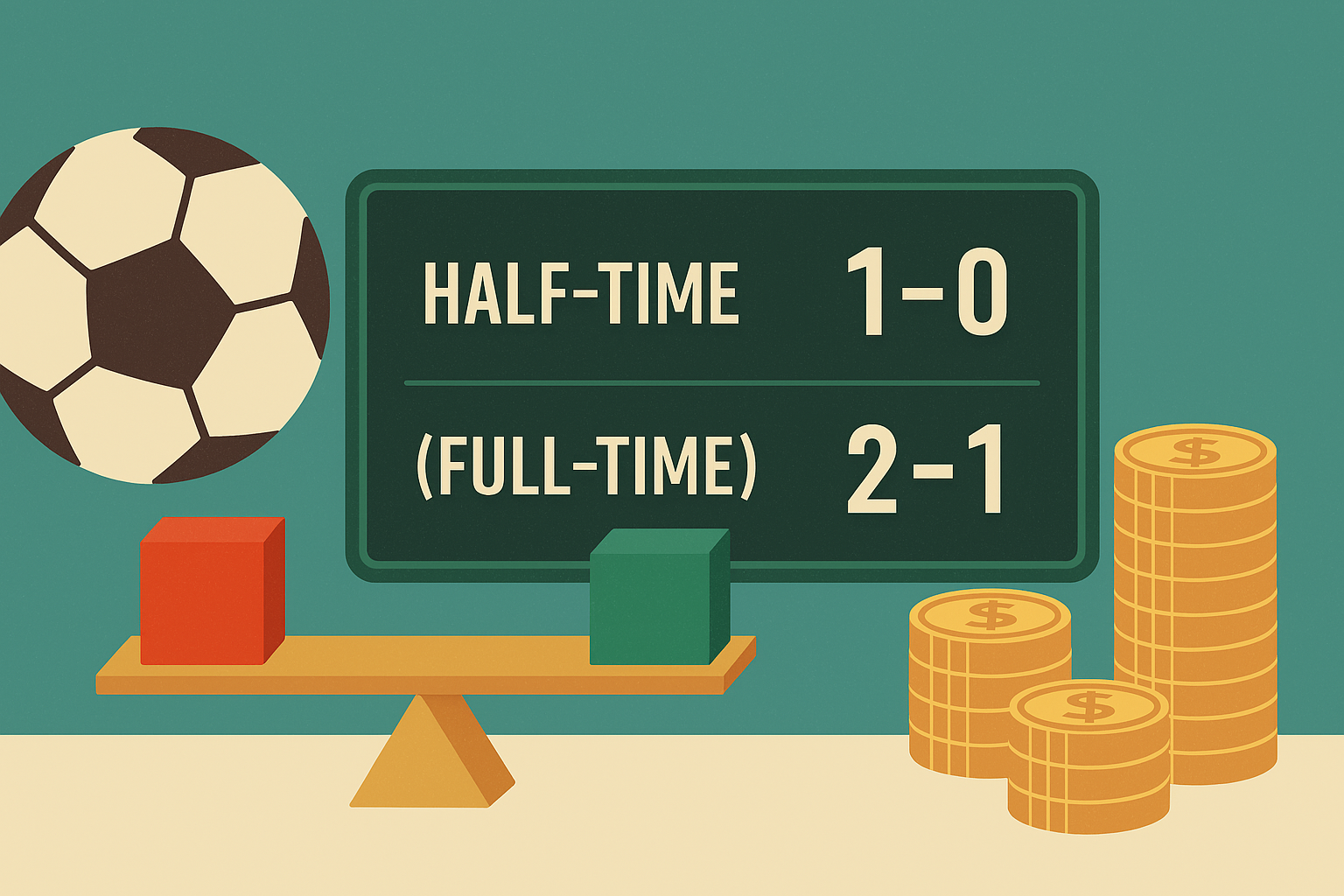
Among the many ways to engage with a football match, the half-time/full-time market stands out as one of the most structurally interesting. It asks a deceptively simple question: what will the result be at half-time, and what will it be when the final whistle blows? The combination of two predictions into a single wager creates a market with nine possible outcomes, longer odds than a standard match result, and a set of strategic considerations that reward analytical thinking over gut instinct. Understanding how half-time/full-time bets work means understanding not just the mechanics of the market but the logic behind why certain combinations carry the odds they do — and why this market behaves differently from almost everything else on the board.
The Basic Structure of the Market
A half-time/full-time wager requires the participant to correctly predict both the result at the end of the first half and the result at the final whistle. Each half of the match is treated as a separate 1X2 market — home win, draw, or away win — and the two predictions are combined into a single selection.
This produces nine possible outcomes. The home team could lead at half-time and win at full-time (Home/Home). The match could be level at the break and the home team win in the second half (Draw/Home). The away side could lead at half-time and go on to win (Away/Away). Every combination of the three half-time results with the three full-time results is a valid selection, giving the market a breadth that the standard match result market cannot offer.
The nine combinations are typically displayed as follows: Home/Home, Home/Draw, Home/Away, Draw/Home, Draw/Draw, Draw/Away, Away/Home, Away/Draw, and Away/Away. Three of these — Home/Home, Draw/Draw, and Away/Away — represent matches that follow a consistent direction throughout. The other six represent matches that change character between the first and second halves, and it is those combinations that carry the longest odds and the greatest structural interest.
Why the Odds Are Longer Than a Standard Match Result
The extended odds in this market are a direct consequence of the precision it demands. A standard match result wager requires one correct prediction. A half-time/full-time wager requires two correct predictions that must both hold simultaneously. Even when the two predictions are individually likely, the probability of both occurring together is always lower than either alone.
Consider a match where the home team is a strong favorite. The probability of a home win at full-time might be estimated at 60 percent. The probability of the home team leading at half-time might be 50 percent. But the probability of both — the home team leading at half-time and winning at full-time — is not simply the average of those two figures. It is the product of the conditional probabilities, accounting for the fact that the two outcomes are related but not identical. The result is a number meaningfully lower than either individual estimate, and that lower probability is reflected directly in the price.
This compression of probability is what makes the half-time/full-time market appealing to participants who believe they can identify matches with a high likelihood of a specific two-stage narrative. When the analysis is correct, the longer odds produce a return that a simple match result wager on the same team would not have generated. When the analysis is wrong, the precision required means there is no consolation — a match that ends exactly as predicted at full-time but not at half-time is a losing wager regardless.
The Nine Combinations and What They Represent
Each of the nine possible outcomes carries a distinct narrative about how a match unfolded, and understanding those narratives is the foundation of any serious analysis of this market.
Home/Home is the most intuitive combination for a match involving a strong home favorite. The home team takes the lead before half-time and holds it through the second half. This is the most commonly priced combination for matches with a clear favorite playing at home, and its odds tend to be the shortest of any combination involving a home win.
Draw/Home represents a match where the home team fails to establish an early lead — the first half ends level — but wins in the second half. This combination suits teams known for slow starts or strong second-half performances, and it often carries meaningfully longer odds than Home/Home despite the full-time result being the same.
Away/Home is one of the two reversal combinations — matches where the leading team at half-time is not the winning team at full-time. These carry some of the longest odds in the market precisely because they require not just a home win but a specific narrative: the home team came from behind. Historically, home comebacks occur often enough to be statistically meaningful, but rarely enough that the odds on this combination remain substantial.
Draw/Draw is the combination for participants who expect a low-scoring, evenly contested match throughout. It tends to price at moderate odds because draws at both intervals require a specific absence of goals rather than a specific sequence of scoring events.
Away/Away mirrors Home/Home from the perspective of a strong away favorite — the visiting team leads at half-time and holds on. In leagues where home advantage is statistically significant, this combination often carries longer odds than its Home/Home equivalent even when the underlying away team is highly rated.
The two remaining reversal combinations — Home/Away and Draw/Away — represent away comebacks and away wins built entirely in the second half. Home/Away in particular is often cited as the longest-odds combination in most matches, because it requires the home team to lead at half-time and then concede the match entirely in the second period — a narrative that runs against both the statistical weight of home advantage and the psychological momentum of leading at the break.
How Operators Price the Nine Outcomes
Pricing a half-time/full-time market requires more than simply multiplying two independent probabilities together. The two results — at half-time and at full-time — are correlated in ways that make naive probability multiplication inaccurate. A team leading at half-time is statistically more likely to win at full-time than a team that is level or behind, which means the conditional probability structure of the market is more complex than it appears on the surface.
Operators use historical match data, team-specific scoring patterns, and statistical models that account for the correlation between first-half and second-half results to price each of the nine combinations. Teams with specific tactical profiles — those that tend to score early, those that are known for second-half comebacks, those that play differently when protecting a lead — are priced differently from generic baselines.
The result is that the implied probabilities across all nine combinations, after accounting for the operator’s margin, sum to more than 100 percent. Each individual combination is priced to reflect both the raw probability of that specific two-stage outcome and the operator’s need to build a structural edge across the full market. Participants who find combinations where their assessment of probability differs meaningfully from the implied probability in the price are the ones best positioned to find value in this market.
Which Matches Suit This Market Best
Not all matches are equally suited to half-time/full-time analysis. The market rewards specificity, which means it performs best for participants who can identify matches with a high probability of a particular two-stage narrative rather than simply a high probability of a particular full-time result.
Matches with strong favorites playing at home tend to generate the most accessible combination in the market — Home/Home — at the shortest odds. But even in those matches, the question of whether the favorite will lead at half-time introduces enough uncertainty that the odds remain longer than a simple match result wager on the same outcome.
Matches between evenly matched sides, particularly in leagues known for closely contested first halves, suit the Draw/Home or Draw/Away combinations for participants who believe one side will assert itself in the second period. These combinations tend to price at odds that reflect genuine analytical value when the underlying match dynamics support them.
Matches with specific tactical contexts — a team chasing a result after a poor run of form, a side known for early goals, a fixture with historical patterns of second-half goals — provide the data-rich environment in which half-time/full-time analysis is most productive. The more specific and well-supported the two-stage narrative, the more likely the price reflects a genuine opportunity rather than a random outcome.
The Role of In-Play Dynamics
One dimension of the half-time/full-time market that distinguishes it from many other formats is its relationship with in-play events. Unlike a standard match result wager, which is decided at the final whistle, a half-time/full-time wager is partly decided at an intermediate point — the half-time whistle — and that intermediate result has an immediate and significant effect on the remaining probability structure of the wager.
A participant who has selected Draw/Home has a wager that is structurally alive as long as the first half ends level. Once the half-time result confirms the draw, the wager effectively becomes a second-half home win market — and the live odds on that outcome will typically shorten considerably, because the draw at half-time has eliminated one of the three possible half-time outcomes and concentrated all remaining probability on the second-half result.
This intermediate confirmation dynamic is one reason the half-time/full-time market is particularly popular among participants who follow matches closely. The half-time whistle provides a clear checkpoint — either the wager remains alive or it does not — which creates a distinct experience compared to markets decided only at the final whistle. The clarity of that intermediate moment is part of what makes the format structurally compelling even when the full-time result would have been available as a simpler alternative.
Common Analytical Approaches
Participants who consistently engage with the half-time/full-time market tend to develop specific analytical frameworks rather than approaching each match from scratch. Several approaches appear repeatedly among those who treat this market as a primary focus.
First-half scoring rate analysis examines how frequently a team scores or concedes before the break relative to the full-match average. Teams that score a disproportionate share of their goals in the first half — or that concede a disproportionate share — are candidates for combinations that diverge from the standard favorite/underdog narrative. A team that scores 60 percent of its goals in the second half but is priced as though its goal distribution is uniform is potentially underpriced in Draw/Win combinations on its own behalf.
Situational context matters significantly in this market. A team with a strong incentive to chase a result — needing a win to avoid relegation, for example — may play in a way that increases the probability of a high-tempo second half regardless of the first-half score. That situational pressure is not always fully captured in the statistical baseline that operators use to price the market, creating potential divergence between the implied price and a well-reasoned assessment.
Head-to-head historical patterns between specific opponents sometimes reveal tendencies that persist across seasons. Some fixture pairings consistently produce close first halves that open up after the break. Others consistently produce early goals that set the tone for the full match. These persistent patterns — where they exist and can be verified across a sufficient sample — provide a foundation for combination selection that goes beyond general team-level analysis. As noted by analysts studying why certain market types exist across all major sports, the half-time/full-time structure persists globally precisely because it maps onto a natural narrative arc that resonates with how matches are actually experienced.
Settlement and Edge Cases
Settlement of half-time/full-time wagers follows the official half-time and full-time results of the match. In most formats, only the 90 minutes of regulation play plus any injury time added by the referee count toward settlement — extra time and penalty shootouts in knockout competitions do not affect the result unless the operator’s specific rules state otherwise.
This distinction matters in knockout competition matches where extra time is a genuine possibility. A match that finishes 1–1 after 90 minutes before one team wins in extra time will typically be settled as Draw/Draw in the half-time/full-time market, regardless of what happens in the additional period. Participants should verify the specific settlement rules for any operator before placing wagers on knockout matches where extra time is likely.
Abandoned matches are typically voided and stakes returned, though operators vary in their specific policies. A match abandoned during the second half after the half-time result has been confirmed still results in a void wager in most cases, because the full-time result — the second half of the prediction — was never completed.
Conclusion
The half-time/full-time market is one of the most analytically rich formats available in football wagering. Its nine possible outcomes, its requirement for two simultaneous correct predictions, and its natural connection to the tactical narrative of a match make it a format that rewards genuine analytical depth more than most alternatives. The longer odds it offers relative to a simple match result wager are a direct reflection of the precision it demands — and that precision is both its challenge and its appeal.
For participants willing to invest in understanding first-half and second-half scoring dynamics, situational context, and the specific tendencies of teams in different match states, the half-time/full-time market offers a structural richness that simpler formats cannot match. The key is not finding the longest odds — it is finding combinations where the price meaningfully underestimates the probability of a specific, well-supported two-stage narrative.
Frequently Asked Questions
What does half-time/full-time mean in sports wagering?
It refers to a market where the participant must correctly predict both the result at the end of the first half and the result at the final whistle. Both predictions must be correct for the wager to win. There are nine possible combinations, each representing a different two-stage match narrative.
How many combinations are there in a half-time/full-time market?
There are nine combinations: Home/Home, Home/Draw, Home/Away, Draw/Home, Draw/Draw, Draw/Away, Away/Home, Away/Draw, and Away/Away. Each represents a specific pairing of the half-time result and the full-time result.
Why are half-time/full-time odds longer than match result odds?
Because two correct predictions are required simultaneously. Even when both individual predictions are reasonably likely, the probability of both occurring together is always lower than either alone, and that lower combined probability is reflected directly in the price.
Does extra time count for half-time/full-time settlement?
In most cases, no. The market is typically settled on the result after 90 minutes of regulation play plus injury time. Extra time and penalty shootouts are usually excluded. Always check the specific settlement rules of the operator before placing a wager on a knockout competition match.
Which combination has the longest odds in most matches?
Home/Away — where the home team leads at half-time but the away team wins at full-time — is typically the longest-priced combination in most matches. It requires a home collapse in the second half, which runs against both the statistical weight of home advantage and the psychological momentum of leading at the break.
What type of match suits the Draw/Home or Draw/Away combination?
Matches between evenly matched sides, particularly those with tactical profiles suggesting a cautious first half followed by a more open second, suit these combinations. Teams known for strong second-half performances or for playing differently when chasing a result are good candidates for Draw/Win combinations in their favor.