Common Misunderstandings When Switching Sports

Picking up a new sport feels straightforward until it does not. The rules seem logical enough on paper, the basic mechanics look familiar, and the pace of play looks manageable from the sideline or the broadcast. Then the first few weeks arrive, and the assumptions start to crack. Movements that worked in one sport slow down progress in another. Strategies that felt instinctive become liabilities. Concepts that appeared interchangeable turn out to be fundamentally different.

This experience is more common than most people acknowledge. Transitioning between sports carries a specific set of challenges that go beyond physical conditioning or technical skill. Much of what makes the shift difficult is cognitive — built-in expectations about how competition works, what good form looks like, and how progress is measured. These expectations are rarely examined until they start causing problems.

Understanding the most common misunderstandings that emerge during a sport transition makes the learning curve shorter, less frustrating, and ultimately more rewarding.

Assuming Transferable Fitness Means Transferable Readiness

One of the first misjudgments new practitioners make is believing that cardiovascular fitness from one sport translates cleanly to another. A seasoned distance runner who picks up football often expects to handle the physical demands with relative ease. A competitive swimmer moving to tennis assumes that upper body strength will carry over. This logic is partially correct, but only partially.

Different sports develop different movement patterns, energy systems, and muscle groups. Endurance running builds aerobic base but does not train the explosive lateral movement that court sports demand. Swimming develops pulling strength but rarely prepares the rotational core mechanics needed for racket sports. When someone arrives at a new discipline assuming their existing fitness is a substantial head start, they often find themselves gassing out in unexpected ways, nursing unfamiliar soreness, or discovering that their reflexes are calibrated to the wrong stimulus entirely.

The smarter approach is to treat existing fitness as a foundation — genuinely useful but not directly applicable without recalibration.

Mistaking Rule Familiarity for Game Understanding

Reading a rulebook is not the same as understanding a sport. Most switchers know this in principle but underestimate how wide the gap actually is in practice. Rules describe legal actions. They say nothing about why those actions are taken, when they become tactically significant, or how the best practitioners sequence them across a full game.

Someone moving from basketball to volleyball, for example, might quickly absorb the rotation rules and scoring system. But recognizing when a setter is reading the block, or why a team shifts its defensive positioning mid-rally, requires a different kind of knowledge that only comes from repeated exposure. The rules give the syntax; the game sense gives the grammar. Confusing the two is one of the most reliable sources of early frustration.

Comparing Timelines Across Sports

Progress in sport is rarely linear, and it is almost never comparable across disciplines. Yet switchers frequently measure their development against how quickly they improved in their original sport, or against the perceived difficulty of the new one based on how it looks from the outside.

A sport that appears simple to spectators — golf, for instance, or darts — can require years of deliberate practice before technique becomes stable. Sports that look physically demanding, like wrestling or rowing, often have steep technical learning curves that the physical intensity obscures. The internal timeline a person carries from their previous sport becomes a source of false benchmarks. Moving to a new discipline means accepting that past experience with rapid improvement does not guarantee the same pace will hold.

For a more detailed look at how these dynamics play out specifically in sports where rules and formats differ significantly between codes, Cheongju Insider’s piece on common misunderstandings when switching sports offers a useful breakdown of the recurring gaps between expectation and reality.

Carrying Over Tactical Assumptions

Every sport has embedded strategic logic that players internalize over time. A football player learns to protect the ball, draw contact, and use the body as a shield. A baseball batter learns patience, pitch sequencing, and the discipline of waiting for the right location. These tactical instincts are not wrong in their original context. But they can become active liabilities when applied to a different competitive environment.

A footballer moving to futsal might over-dribble in spaces that demand quick release passing. A tennis player moving to squash might gravitate toward the middle of the court out of habit, not realizing that court geometry and angles work differently against four walls. The challenge is not unlearning the old sport — the habits are too deeply ingrained for that to be realistic in the short term. The challenge is learning to identify when the old instinct is being triggered and whether it is appropriate to the current situation.

Underestimating the Social and Cultural Adjustment

Beyond the physical and tactical, sports carry their own cultures, vocabularies, and unspoken norms. Knowing when to celebrate a point and when restraint is expected, how to interact with officials, how warm-up protocols unfold, when recreational play versus competitive play carries different behavioural standards — these are invisible until they are not.

New participants in a sport often receive social feedback before they receive technical feedback. Arriving with the wrong posture — not physical posture but social posture — can create friction in a team environment that slows the whole adaptation process. This layer of adjustment is rarely discussed in skill development guides, but it shapes the experience of switching sports more than most people expect. As explored in broader analyses of how rule differences shape athlete behaviour and market responses across disciplines, the structural gap between sports extends well beyond the rulebook into culture, tempo, and social dynamics.

Expecting Immediate Competency

The final and perhaps most pervasive misunderstanding is the assumption that adult learners with athletic backgrounds should reach functional competency quickly. This expectation is understandable. Previous sport experience does build general athleticism, body awareness, and competitive temperament. But it also creates a gap between what someone feels they should be able to do and what they are currently capable of. That gap is uncomfortable.

The most effective switchers are those who treat the early period of a new sport as a genuine beginner phase — not as a temporary setback before existing ability kicks in, but as a legitimate stage of development that requires patience, repetition, and honest self-assessment. Progress tends to arrive faster once the expectation of fast progress is let go.

Switching sports is one of the more underrated ways to develop as an athlete and as a competitor. The difficulties that come with it are not obstacles to that development. They are the development itself.

How Substitutions Affect Game Flow Markets

Of all the in-game events that influence live sports markets, substitutions occupy a uniquely complex position. A goal immediately and unambiguously shifts the scoreline and the probability distribution of outcomes. A red card removes a player from the contest entirely. But a substitution introduces a change whose effect is conditional, directional, and sometimes contradictory — and that ambiguity is precisely what makes substitution-related market movements one of the most analytically interesting features of live sports engagement.

Understanding how substitutions affect game flow markets requires examining what substitutions actually signal about a team’s tactical state, how that signal is read by automated pricing models versus experienced analysts, and why the same substitution can carry very different implications depending on the context in which it occurs.

What a Substitution Signals to the Market

A substitution is simultaneously a tactical decision, a fitness management decision, and an information event. The market responds primarily to what the substitution reveals about the tactical state of the team making it — and that interpretation depends heavily on the game state at the moment it occurs.

When a team making a substitution is winning, the incoming player typically represents a defensive consolidation or tempo reduction signal: the manager is managing the game rather than seeking to extend the lead. Markets interpreting this substitution as a signal of reduced attacking intent will tend to lengthen the odds on further goals from the leading team and shorten the odds on a potential comeback from the trailing team.

When a team making a substitution is drawing or losing, the incoming player typically signals attacking intent or tactical adjustment: the manager is making a change to alter the course of the match. Markets interpreting this substitution as a signal of increased pressure will tend to shorten the odds on that team’s next goal and widen the market in the trailing team’s favor.

The problem with both interpretations is that they are not always correct. A manager removing a fatigued striker and replacing them with a like-for-like forward is not signaling a change in approach — they are maintaining it. A defensive substitution in a winning team might reflect an injury concern rather than conservative intent. The market must interpret the personnel change without full access to the manager’s reasoning, and the automated systems that power live markets do this imperfectly.

The Timing Dimension

The timing of a substitution within the match produces its own distinct market signal, independent of the player being substituted. Early substitutions — before the 60th minute — carry an implicit urgency that later substitutions do not. A manager who uses a substitution slot in the 52nd minute of a 0-0 game is communicating that something has gone sufficiently wrong to require early intervention. Markets tend to interpret early substitutions as higher-signal events than equivalent changes made in the 75th minute, where substitution usage is routine.

As research on the relationship between momentum and win probability in live sports confirms, the market’s interpretation of any in-game event is always conditional on the current game state — the scoreline, the time elapsed, and the momentum context in which the event occurs. A substitution made in the 80th minute when the score is 1-0 carries a very different probability signal than the same substitution made at 60 minutes with the score at 0-0. Live pricing models account for this dependency, but the adjustment is not always sufficient — particularly when the substituted player is significantly more or less influential than their replacement in ways that match statistics do not easily capture.

How Automated Models Handle Substitution Events

Modern live pricing systems handle substitutions as one of several non-scoring event signals, alongside red cards, yellow card accumulation, and injury stoppages. These events trigger a recalibration of the underlying model’s assessment of team capability — but the recalibration is typically less dramatic than a goal or dismissal, and it operates through indirect channels.

Rather than directly repricing the match outcome odds in response to the substitution itself, models more commonly respond to the downstream effects: changes in shot volume, territorial dominance, and pressing intensity that follow a substitution and appear in the live data feed within the subsequent five to ten minutes. The substitution flags a likely shift; the match data confirms or denies it.

This creates a brief window in which the market has absorbed the information that a substitution occurred without yet having data confirmation of its actual effect. Experienced live market observers note that this window — typically one to three minutes after a significant substitution — can produce temporary mispricing, because the automated model is holding its assessment pending incoming data while the observable match dynamics have already shifted.

Substitutions Across Different Sport Structures

The significance of substitution events varies meaningfully across sport formats. In football (soccer), where each team has a maximum of five substitutions available across ninety minutes, each substitution decision carries relatively high information value — there are few enough changes that each one represents a meaningful commitment of the manager’s available flexibility.

In American football, where substitutions are unlimited and positional packages change on nearly every play, individual substitutions carry far less market signal value. The relevant unit of analysis is the personnel package being deployed, not the individual change. Live market models for American football track package-level changes rather than player-level substitutions.

Basketball falls between these extremes. The substitution pattern in basketball is more fluid than football but less constant than American football — bench rotations are predictable to experienced analysts, and departures from the expected rotation carry meaningful signal. A star player removed from the game unexpectedly in the third quarter, when they would normally remain on the court, is a more significant market signal than the same player being rested in a blowout.

The Analytical Takeaway

For anyone engaging with live sports markets, substitutions are best treated as ambiguous signals that require contextual interpretation rather than directional triggers that automatically move the probability distribution in one direction. The key questions to ask when a substitution occurs are: what game state is the substituting team in, what does the timing of the substitution suggest about the manager’s assessment of the match situation, and is the incoming player likely to change the team’s approach in a way that existing match statistics would not yet reflect?

Automated markets respond to these questions imperfectly, because they lack access to the context that makes substitution interpretation possible. The brief period following a significant substitution — before the market data confirms the on-pitch shift — is where the most analytically interesting live market opportunities exist.

A substitution changes the personnel on the field. It takes longer to change the market’s model of what that means.

Why Real-Time Data Enabled New Market Types

The expansion of in-play markets was not a product decision — it was a data infrastructure decision.

Before real-time data pipelines existed at scale, markets had to close before events began. Not because operators lacked interest in offering continuous engagement, but because they lacked the information architecture to price outcomes dynamically as conditions changed. The moment that infrastructure arrived — reliable, low-latency feeds covering player position, ball movement, elapsed time, and score state — the entire structure of what a market could be changed with it.

That shift is still playing out. Understanding why real-time data enabled new market types requires examining not just the technology itself, but the specific problems it solved and the new categories of activity it made structurally viable for the first time.

The Pre-Data Constraint

Traditional pre-event markets worked within a closed information environment. Odds were set before play began, adjusted occasionally in the lead-up, and then locked. The logic was straightforward: once a match started, conditions changed too quickly and unpredictably for any pricing model built on static inputs to remain accurate. Offering markets mid-event without live data was not a calculated risk — it was an invitation to systematic mispricing.

This constraint was not ideological. Operators were not choosing to limit market variety out of preference. The absence of granular, real-time event data made certain market structures technically impossible to sustain. The problem was latency, coverage, and reliability — all of which had to be solved simultaneously before new categories could emerge.

What Changed When Data Infrastructure Scaled

The arrival of comprehensive real-time data feeds did not simply allow operators to offer more of what already existed. It created entirely new categories of market that had no meaningful equivalent in the pre-data era.

The most structurally significant shift was the emergence of in-play markets as a primary product rather than a novelty. When a data feed can deliver verified event state — score, time elapsed, possession, momentum indicators — with latency measured in milliseconds rather than minutes, pricing models can update continuously. A market that closes before kickoff and one that recalculates odds on every possession change are fundamentally different products, even if both involve the same event.

As explored in Daejeon Insider’s analysis of how real-time data reshaped sports market structures, the infrastructure shift produced downstream changes in market design that extended well beyond simply keeping prices current during play.

Micro-Markets and the Granularity Threshold

The second category that real-time data made viable was the micro-market — outcomes defined not by the result of a full match but by the result of a specific interval, sequence, or action within it.

Next-goal markets, next-point markets, corner counts within defined time windows, first-team-to-score-in-the-second-half — none of these are computable without continuous, verified event data. Their emergence as standard product offerings reflects a direct dependency on data granularity. The more detailed and reliable the feed, the smaller the unit of competition that can be priced with enough accuracy to sustain a market.

This granularity threshold matters because it explains why certain market types appeared in certain sports before others. Sports with well-established data collection infrastructure — football, tennis, basketball — saw micro-market expansion earlier and more completely than sports where real-time tracking was slower to standardize. The market map followed the data map.

The Role of Latency in Market Integrity

Expanding what can be offered in real-time also created new integrity challenges. A market priced on data that is even slightly delayed becomes exploitable by participants with access to faster information sources. This is not a theoretical concern — it is a structural vulnerability that operators building live markets had to engineer around from the beginning.

The response was not to slow down markets but to invest heavily in feed verification, cross-source validation, and automated suspension triggers. When data from multiple sources diverges beyond a defined threshold, markets pause. When a significant event is detected — a goal, a red card, a break of serve — the system suspends pricing until the event is confirmed and the model recalibrates. This architecture of real-time market integrity is invisible to most participants but represents one of the more technically demanding aspects of live market operation.

From Data Feeds to Market Design

The relationship between data infrastructure and market type is not incidental. It is constitutive. The categories of market that exist today are, in large part, a direct expression of what the underlying data architecture can support.

How This Shapes the Future

As data collection expands — into player biometrics, predictive tracking, and AI-assisted event classification — the frontier of what can be priced in real-time continues to move. Markets that are currently too granular or too fast-moving to sustain will become viable as latency drops and feed reliability improves. The pattern established by the first generation of in-play markets is likely to repeat: infrastructure arrives, pricing models adapt, and a new category of market becomes structurally possible that was not before.

Real-time data did not merely improve existing market types. It redefined what a market could be — and that process is not finished.

Why Complexity Feels Like Control

There is a specific experience that most people who engage with complex analytical systems will recognize: the more variables one tracks, the more data one gathers, the more frameworks one applies to a problem — the more confident one feels about the outcome. The complexity of the engagement itself generates a sense of mastery. The feeling is genuine, consistent, and almost entirely misleading.

Understanding why complexity feels like control requires examining the relationship between effort, information, and the cognitive biases that transform the subjective experience of complexity into an unwarranted sense of certainty. This relationship is one of the most reliably documented patterns in behavioral psychology — and one of the most costly in domains where decisions carry real consequences.

The Illusion of Control

The foundational concept here is what psychologist Ellen Langer first identified in 1975 as the illusion of control — the tendency for people to believe they have greater influence over outcomes than they actually do, even when those outcomes are demonstrably governed by chance or factors outside their reach.

The illusion of control is not limited to superstitious behavior. It operates systematically in analytical contexts too. The time a person spends researching, analyzing, and building a model of a situation leads them to believe they have some control over the outcome of their predictions — when in fact the analytical activity has not meaningfully reduced the underlying uncertainty. The research effort creates a subjective experience of mastery that the objective situation does not support.

What makes the illusion of control particularly persistent in complex analytical environments is that complexity itself reinforces it. Simple analysis produces a simple sense of engagement. Complex analysis — tracking multiple variables, applying multiple frameworks, considering multiple scenarios — produces a richer cognitive experience that the mind interprets as a richer understanding. The intensity of the analytical process is experienced as evidence of analytical depth. But intensity of engagement and quality of understanding are different things, and the mind conflates them reliably.

Information Volume and Decision Quality

The relationship between information volume and decision quality is not what most people intuitively assume. The prevailing belief is that more information leads to better decisions. Behavioral research has consistently found that this relationship breaks down above a surprisingly low threshold.

Research from multiple studies on information overload demonstrates that as the volume of information available to a decision-maker increases beyond their cognitive processing capacity, decision quality deteriorates — but confidence does not decrease proportionally. In some cases, confidence increases as information volume increases, even as actual decision accuracy falls. The information is absorbed as evidence of engagement with the problem rather than as evidence of understanding it.

This dynamic is the core mechanism through which complexity generates the feeling of control without the substance of it. A participant who has studied twelve variables affecting a sports outcome, analyzed three separate statistical models, and reviewed ten years of historical data feels more certain of their prediction than one who has reviewed two relevant variables — even when the additional ten variables and eight years of history contribute nothing to predictive accuracy. The complexity of the preparation is experienced as a proxy for the quality of the prediction.

Why the Mind Treats Effort as Evidence

The cognitive mechanism driving this pattern connects to the processing fluency research discussed elsewhere in the behavioral literature. When an analytical process has been effortful — when the person has worked hard, gathered much, and processed extensively — the effort registers as meaningful in a way that effortless engagement does not.

This is partly adaptive. In many real-world contexts, effort invested in analysis does improve outcomes. The surgeon who has performed a procedure a thousand times, the engineer who has reviewed structural calculations exhaustively, the navigator who has cross-checked multiple position sources — all of these represent cases where analytical complexity produces genuine capability. The mind learns, correctly in these contexts, that complexity of preparation and quality of outcome are associated.

The problem arises when this learned association is applied to domains where the relationship does not hold. As analyses of how overconfidence interferes with strategic decision-making document, the overconfidence that emerges from effortful analysis is not distributed according to whether the effort was actually useful — it is distributed according to how much effort was invested. Domains where analytical effort has limited predictive value generate the same confidence premium as domains where it has high predictive value, because the mind responds to the effort itself rather than to its actual effectiveness.

What This Means in Practice

The practical consequence of complexity feeling like control is that the most analytically engaged participants in uncertain environments are often the most confidently wrong — not the most accurately right. They have accumulated the subjective experience of mastery without the objective improvement in outcomes that should accompany it.

This pattern is particularly visible in competitive prediction environments. Participants who dedicate the most time to analysis, the most elaborate modeling, and the most comprehensive data review do not systematically outperform participants who apply simpler frameworks — and they typically hold their predictions with greater certainty, making their errors more difficult to correct when feedback arrives.

The corrective is not to reduce analytical engagement. It is to calibrate the confidence that analytical engagement generates to the actual predictive value of the analysis performed. This requires maintaining a distinction between two separate questions: “How much effort did I invest in this analysis?” and “How much does this analysis actually reduce the uncertainty of the outcome?” The first question the mind answers automatically and accurately. The second requires deliberate, uncomfortable honesty — and it is the one that determines whether complexity has produced control or merely the feeling of it.

Final Thoughts

Complexity feels like control because effort registers as mastery, information volume registers as understanding, and the intensity of analytical engagement registers as a reliable proxy for outcome certainty. None of these associations are universally wrong — in many domains they reflect genuine relationships. But in domains governed by variance, probability, and factors beyond analytical reach, they produce confident engagement with outcomes that remain genuinely uncertain regardless of how complex the engagement has been.

The feeling of control is not the problem. Acting on that feeling as if it were the fact of control is.

The amount of analysis invested in a prediction tells you how hard someone worked. It tells you nothing about whether they were right.

Why Frequent Wins Feel Reassuring Even When Nothing Improves

The feeling of reassurance that frequent wins produce is real — but it is not evidence that anything is working.

This distinction is easy to state and genuinely difficult to internalize, because the psychological mechanism that generates reassurance from winning does not require improvement to function. It requires only repetition. The brain does not evaluate wins by asking whether they indicate progress toward a sustainable outcome. It responds to the signal itself — the result, the confirmation, the momentary resolution of uncertainty — and registers it as positive feedback regardless of what that result actually represents about the underlying situation.

This is not a flaw in individual reasoning. It is a structural feature of how reinforcement operates in the human mind, and it has predictable consequences in any domain where short-term outcomes and long-term trajectories diverge.

What Reinforcement Actually Measures

Reinforcement learning — the process by which behavior is shaped by its consequences — is one of the most robust mechanisms in human psychology. Behaviors that are followed by positive outcomes tend to persist. Behaviors followed by negative outcomes tend to diminish. This is functional and adaptive in most contexts. The problem arises when the positive outcome is disconnected from the quality of the behavior that preceded it.

A win is a positive outcome. The brain registers it as such and strengthens the association between the preceding behavior and the favorable result. It does not ask whether the behavior was the cause of the win, whether the win would repeat under identical conditions, or whether the same behavior in a longer sequence would produce a net positive outcome. Those are analytical questions. Reinforcement operates before analysis arrives.

The result is that frequent wins build behavioral confidence independent of whether the underlying approach has any structural validity. Confidence rises. Reassurance accumulates. And none of it is anchored to actual improvement.

The Frequency Trap

There is a specific dynamic that makes high-frequency winning particularly misleading, and it has to do with how the mind constructs a sense of pattern from sequential outcomes.

When wins arrive frequently, the gaps between them are short. Short gaps mean that each loss is quickly followed by a corrective win — a natural feature of any activity where the win probability is reasonably high. The mind experiences this rhythm as stability. Losses feel like brief interruptions rather than meaningful signals. Wins feel like the default state being restored.

This interpretation feels accurate from the inside. It is also structurally unreliable. As explored in Busan Insider’s analysis of why humans misjudge risk across repeated decisions, the subjective experience of a high-win-rate sequence consistently overstates the evidence it actually provides about the quality of the underlying process. The feeling of being on stable ground is generated by frequency, not by signal quality.

When Reassurance Substitutes for Assessment

The more consequential problem is not that frequent wins feel good. It is that the reassurance they produce substitutes for the kind of sober assessment that improvement actually requires.

Genuine improvement in any repeated-decision domain demands honest evaluation of process — examining not just whether outcomes were positive but whether the reasoning behind decisions was sound, whether information was interpreted correctly, whether the framework being used is calibrated to the actual structure of the problem. That kind of assessment is cognitively demanding and emotionally uncomfortable. It requires entertaining the possibility that past wins were not deserved.

Frequent wins make this assessment feel unnecessary. If outcomes are positive, the reasoning appears to be working. There is no obvious prompt to scrutinize the process more carefully. The reassurance that winning generates actively suppresses the critical evaluation that would be required to identify whether any real edge exists.

The Stability That Isn’t

One of the more insidious aspects of frequent-win reassurance is that it produces a stable emotional state in conditions that are actually precarious. A participant who wins often, whose losses are quickly recovered, and who feels confident in the approach experiences something that resembles security. From the inside, the situation appears to be under control.

What that stability conceals is any honest accounting of whether the long-run mathematics of the activity are favorable. A high win rate with unfavorable outcome magnitude produces losses over time regardless of how stable the experience feels in the short term. As detailed in Cheongju Insider’s examination of why frequent wins feel reassuring even when nothing improves, the psychological state that frequent winning produces is genuinely disconnected from the structural quality of the position — and the gap between the two only becomes visible when the sequence is long enough that variance can no longer mask the underlying expected value.

What Improvement Actually Looks Like

The practical implication of all this is that improvement in any repeated-decision domain does not feel like what most people expect it to feel like. It does not feel like winning more often. It feels like making better decisions — even when those decisions occasionally produce losses — and trusting that the quality of the process will express itself over a sequence long enough to be meaningful.

Why That Standard Is Hard to Hold

That standard is genuinely difficult to maintain, because the feedback loop it relies on is slow. Better decisions do not produce immediate confirmation. They produce slightly better outcomes across hundreds or thousands of iterations, distributed unevenly, with plenty of losing stretches embedded in the signal. Frequent wins, by contrast, produce immediate confirmation — fast, clear, emotionally satisfying.

The brain, operating on reinforcement logic, finds frequent wins far more compelling than the abstract promise of a better long-run trajectory. That preference is not irrational in an evolutionary sense. In the context of repeated decision-making under uncertainty, it is precisely what causes capable people to plateau — not from lack of effort, but from receiving too much reassurance too early, before anything has actually been earned.

Why Winning Often Loses Over Time

A high win rate and a profitable outcome are not the same thing — and the gap between them is where most people’s understanding of repeated competition breaks down.

This is not a subtle distinction. It is one of the most consequential misunderstandings in any domain where decisions are made repeatedly under uncertainty. Someone can be correct more often than they are wrong and still come out behind over a long enough sequence. Conversely, someone can lose the majority of individual rounds and still accumulate a net positive outcome. The mechanism that produces this apparent paradox is not mysterious, but it runs directly against the intuitions most people carry into repeated decision-making.

Win Rate Is Not the Whole Picture

The instinct to equate winning often with winning overall is deeply embedded. It is reinforced by how most competitive experiences are structured — sport, school, games — where the person who wins more rounds wins the competition. That logic is coherent in fixed-stakes environments. It breaks down entirely once the magnitude of individual outcomes varies.

The relevant calculation is not how often a position succeeds. It is the product of success frequency and success magnitude, weighed against failure frequency and failure magnitude. A position that succeeds 70% of the time but returns a small amount on each success, while failing 30% of the time at a much larger cost, produces a negative outcome over repetition despite its apparent dominance in raw win rate terms. The math is straightforward. The intuition is not.

The Compounding Effect of Negative Expected Value

The deeper problem with repeatedly entering positions that carry negative long-run value is not just that losses accumulate — it is that the rate of accumulation accelerates in ways that feel invisible until the damage is substantial.

This happens for two reasons. First, the natural variance of short sequences means that negative expected value positions can produce runs of wins that reinforce the behavior long after the underlying mathematics would predict deterioration. Second, the emotional signal that winning generates — confidence, validation, a sense of skill — is not calibrated to distinguish between outcomes produced by edge and outcomes produced by variance. Both feel the same from the inside. As examined in Busan Insider’s analysis of why humans systematically misjudge risk across repeated decisions, the tendency to treat short-term winning as evidence of long-term structural advantage is one of the most consistent patterns in repeated-decision research.

Why Short Sequences Mislead

Most people never reach the sample size at which the long-run mathematics of any repeated activity reveals itself clearly. A hundred iterations is often not enough. Several hundred may not be either, depending on the variance characteristics of the specific outcomes being tracked.

This creates a structural problem. The sequences that feel meaningful — a good week, a strong month, a run of correct calls — are almost always too short to distinguish genuine edge from favorable variance. The mind, however, does not experience them as statistically inconclusive. It experiences them as evidence. A winning stretch feels like confirmation that the approach is sound. A losing stretch feels like an anomaly to be explained away or corrected. The asymmetry in how the two are interpreted ensures that positive variance gets attributed to skill while negative variance gets attributed to external factors.

The Point Where Winning Becomes a Liability

There is a particular phase in repeated-competition experience where a sustained winning record becomes actively counterproductive. It happens when the record is long enough to feel like proof but short enough that it could still be the product of variance — and when the confidence generated by that record leads to scaling up the size or frequency of participation before the underlying edge has been verified.

This is where the mechanics of why winning often loses over time become most damaging. The pattern is not that winning leads to complacency. It is that winning leads to increased exposure at precisely the moment when the expected value of the activity has not been confirmed — and when the cost of being wrong is therefore highest.

What the Long Run Actually Requires

Sustaining a positive outcome over a genuinely long sequence of repeated decisions requires two things that winning streaks do not supply: verified positive expected value and variance management sufficient to survive the inevitable losing sequences without being forced to stop.

The Discipline the Long Run Demands

The first is an analytical question. It requires separating outcomes from process — asking not whether a position won, but whether the reasoning behind it was structurally sound given available information at the time. A position that was correct in its analysis and still lost is not a failure of method. A position that was poorly reasoned and happened to win is not a success of method. Conflating the two is what turns a winning record into a losing long-run trajectory.

The second is a resource management question. Even a position with genuine positive expected value produces losing sequences. The ability to continue operating through those sequences without altering the method in response to short-term results is what allows the long-run mathematics to express themselves. Most people never get there — not because the underlying edge was absent, but because the losing sequences arrived before the confidence to hold through them was established.

Winning often is easy. Winning over time is a different discipline entirely.

How Real-Time Data Feeds Power Live Sports Score Platforms

Behind every live score update that appears within seconds of a goal, a point, or a play is an infrastructure stack most fans never think about — and one that took decades to build to its current level of reliability.

Live sports score platforms feel simple from the user side. A number changes. A status updates. A notification arrives. The simplicity of that experience is the product of an extraordinarily complex real-time data pipeline operating at low latency across multiple layers of collection, verification, transmission, and display. Understanding how that pipeline actually works clarifies why live score accuracy varies across sports and platforms, why some updates arrive faster than others, and why the infrastructure behind real-time sports data has become one of the more technically demanding categories in sports technology.

Where the Data Originates

Every live score update begins with a collection event — a human or automated system recording that something happened at a specific moment in a specific match. The collection layer is the foundation of the entire pipeline, and its characteristics vary significantly depending on the sport and the resources available at the venue.

At the top tier of professional sport, dedicated data collectors are physically present at matches. These are trained operators whose sole responsibility is to record events — goals, substitutions, cards, timeouts, scoring plays — into a purpose-built input system the moment they occur. Their entries trigger the data pipeline immediately. In some venues and leagues, optical tracking systems supplement or replace manual entry for certain event types, using camera arrays to detect ball position and player movement and classify events algorithmically.

Below that tier, collection becomes less standardized. Lower-division matches, regional competitions, and amateur events may rely on fewer collectors, less sophisticated equipment, or feeds aggregated from secondary sources. This is where latency increases and accuracy gaps appear — not because the transmission infrastructure is weaker, but because the originating data is less reliable.

Transmission and the Latency Problem

Once an event is recorded at the collection layer, it travels through a transmission chain before appearing on any user-facing platform. The speed of that chain is what determines latency — the gap between when something happens on the field and when a score platform reflects it.

Professional data providers invest heavily in minimizing transmission latency because even small delays create problems. A score update that arrives several seconds late is experienced as inaccurate by fans watching live broadcasts. As explored in Daejeon Insider’s analysis of how real-time data infrastructure reshaped sports platforms, the engineering standards that govern transmission speed have tightened considerably as user expectations for live data accuracy have risen alongside the proliferation of mobile devices and second-screen viewing.

The transmission chain typically runs from the venue collection system through a data provider’s central processing infrastructure, where feeds from hundreds or thousands of simultaneous matches are normalized into consistent formats before being distributed to client platforms via API. Each step in that chain introduces potential delay. Optimizing the chain requires both technical investment and geographic distribution of processing infrastructure to reduce the physical distance data must travel.

Verification Without Adding Delay

Accuracy and speed exist in tension at the verification layer. A live score platform that publishes every raw input immediately will be fast but unreliable — operator entry errors, duplicate signals, and system glitches will surface as incorrect updates. A platform that holds every update for manual verification will be accurate but too slow to be useful for live consumption.

The solution most professional data providers use is automated cross-validation. Inputs from multiple independent collection sources covering the same event are compared in real time. When they agree, the update is published immediately. When they diverge beyond a defined threshold — two operators recording a goal at different times, or an automated system disagreeing with a manual entry — the update is held and flagged for rapid human review. The review queue operates on timescales of seconds, not minutes, to keep the delay impact minimal.

This is why data coverage from major leagues, where multiple redundant collection streams exist, is more reliable than coverage from smaller competitions where a single collector’s input is the only source available. Redundancy is not just a reliability feature — it is what makes fast automated verification possible.

How Score Platforms Consume the Feed

On the receiving end, live score platforms connect to data provider APIs and maintain persistent connections that push updates as they are published. The platform’s own infrastructure must then process those updates, apply any display logic, and deliver the change to active users — all within a timeframe short enough that the experience feels instantaneous.

This final leg of the pipeline is where platform engineering decisions become visible to users. A platform running efficient websocket connections to millions of simultaneous users will deliver updates faster and more reliably than one relying on client-side polling. The architecture behind how real-time data feeds power live sports score platforms reflects years of iteration on exactly these delivery problems — how to push high-frequency updates to large concurrent audiences without the infrastructure becoming the bottleneck.

Why Accuracy Still Varies

Even with mature infrastructure, live score accuracy varies across platforms and competitions for reasons that are structural rather than accidental. The quality of the originating data determines the ceiling of what any downstream system can achieve. No transmission optimization or verification layer can correct for events that were never recorded accurately at the source.

The Human Element That Remains

Automated systems have reduced but not eliminated the human element in live data collection. The most reliable live score feeds remain those anchored to trained human operators with backup systems and clear protocols for handling ambiguous events — own goals, disallowed scores, delayed official confirmations. The technology that surrounds the collection moment has become sophisticated. The judgment call at that moment still belongs to a person with a device, watching the same match the fan at home is watching, and entering what they see as accurately and as quickly as they can.

That combination — human observation, professional data infrastructure, and engineered delivery pipelines — is what makes a number change on a screen within seconds of something happening on a pitch thousands of kilometers away.

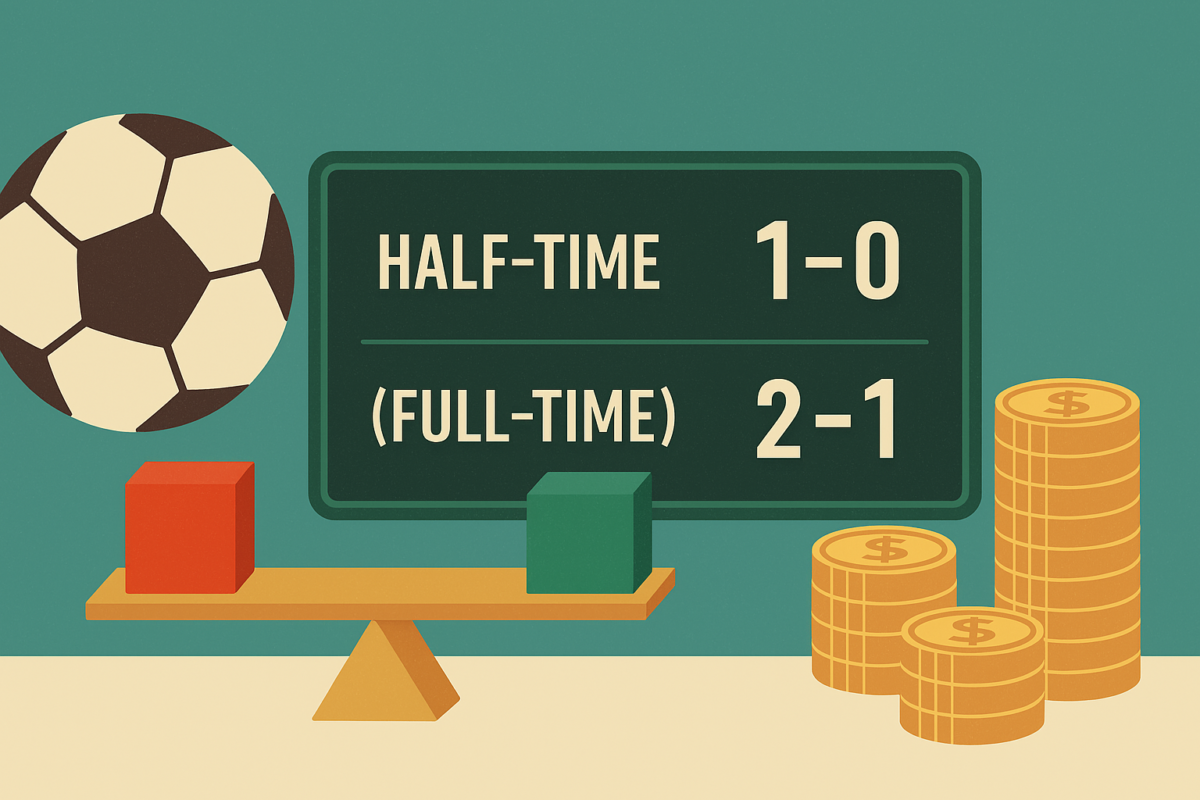
How Half-Time / Full-Time Bets Work

How Half-Time / Full-Time Bets Work

Among the many ways to engage with a football match, the half-time/full-time market stands out as one of the most structurally interesting. It asks a deceptively simple question: what will the result be at half-time, and what will it be when the final whistle blows? The combination of two predictions into a single wager creates a market with nine possible outcomes, longer odds than a standard match result, and a set of strategic considerations that reward analytical thinking over gut instinct. Understanding how half-time/full-time bets work means understanding not just the mechanics of the market but the logic behind why certain combinations carry the odds they do — and why this market behaves differently from almost everything else on the board.


The Basic Structure of the Market

A half-time/full-time wager requires the participant to correctly predict both the result at the end of the first half and the result at the final whistle. Each half of the match is treated as a separate 1X2 market — home win, draw, or away win — and the two predictions are combined into a single selection.

This produces nine possible outcomes. The home team could lead at half-time and win at full-time (Home/Home). The match could be level at the break and the home team win in the second half (Draw/Home). The away side could lead at half-time and go on to win (Away/Away). Every combination of the three half-time results with the three full-time results is a valid selection, giving the market a breadth that the standard match result market cannot offer.

The nine combinations are typically displayed as follows: Home/Home, Home/Draw, Home/Away, Draw/Home, Draw/Draw, Draw/Away, Away/Home, Away/Draw, and Away/Away. Three of these — Home/Home, Draw/Draw, and Away/Away — represent matches that follow a consistent direction throughout. The other six represent matches that change character between the first and second halves, and it is those combinations that carry the longest odds and the greatest structural interest.


Why the Odds Are Longer Than a Standard Match Result

The extended odds in this market are a direct consequence of the precision it demands. A standard match result wager requires one correct prediction. A half-time/full-time wager requires two correct predictions that must both hold simultaneously. Even when the two predictions are individually likely, the probability of both occurring together is always lower than either alone.

Consider a match where the home team is a strong favorite. The probability of a home win at full-time might be estimated at 60 percent. The probability of the home team leading at half-time might be 50 percent. But the probability of both — the home team leading at half-time and winning at full-time — is not simply the average of those two figures. It is the product of the conditional probabilities, accounting for the fact that the two outcomes are related but not identical. The result is a number meaningfully lower than either individual estimate, and that lower probability is reflected directly in the price.

This compression of probability is what makes the half-time/full-time market appealing to participants who believe they can identify matches with a high likelihood of a specific two-stage narrative. When the analysis is correct, the longer odds produce a return that a simple match result wager on the same team would not have generated. When the analysis is wrong, the precision required means there is no consolation — a match that ends exactly as predicted at full-time but not at half-time is a losing wager regardless.


The Nine Combinations and What They Represent

Each of the nine possible outcomes carries a distinct narrative about how a match unfolded, and understanding those narratives is the foundation of any serious analysis of this market.

Home/Home is the most intuitive combination for a match involving a strong home favorite. The home team takes the lead before half-time and holds it through the second half. This is the most commonly priced combination for matches with a clear favorite playing at home, and its odds tend to be the shortest of any combination involving a home win.

Draw/Home represents a match where the home team fails to establish an early lead — the first half ends level — but wins in the second half. This combination suits teams known for slow starts or strong second-half performances, and it often carries meaningfully longer odds than Home/Home despite the full-time result being the same.

Away/Home is one of the two reversal combinations — matches where the leading team at half-time is not the winning team at full-time. These carry some of the longest odds in the market precisely because they require not just a home win but a specific narrative: the home team came from behind. Historically, home comebacks occur often enough to be statistically meaningful, but rarely enough that the odds on this combination remain substantial.

Draw/Draw is the combination for participants who expect a low-scoring, evenly contested match throughout. It tends to price at moderate odds because draws at both intervals require a specific absence of goals rather than a specific sequence of scoring events.

Away/Away mirrors Home/Home from the perspective of a strong away favorite — the visiting team leads at half-time and holds on. In leagues where home advantage is statistically significant, this combination often carries longer odds than its Home/Home equivalent even when the underlying away team is highly rated.

The two remaining reversal combinations — Home/Away and Draw/Away — represent away comebacks and away wins built entirely in the second half. Home/Away in particular is often cited as the longest-odds combination in most matches, because it requires the home team to lead at half-time and then concede the match entirely in the second period — a narrative that runs against both the statistical weight of home advantage and the psychological momentum of leading at the break.


How Operators Price the Nine Outcomes

Pricing a half-time/full-time market requires more than simply multiplying two independent probabilities together. The two results — at half-time and at full-time — are correlated in ways that make naive probability multiplication inaccurate. A team leading at half-time is statistically more likely to win at full-time than a team that is level or behind, which means the conditional probability structure of the market is more complex than it appears on the surface.

Operators use historical match data, team-specific scoring patterns, and statistical models that account for the correlation between first-half and second-half results to price each of the nine combinations. Teams with specific tactical profiles — those that tend to score early, those that are known for second-half comebacks, those that play differently when protecting a lead — are priced differently from generic baselines.

The result is that the implied probabilities across all nine combinations, after accounting for the operator’s margin, sum to more than 100 percent. Each individual combination is priced to reflect both the raw probability of that specific two-stage outcome and the operator’s need to build a structural edge across the full market. Participants who find combinations where their assessment of probability differs meaningfully from the implied probability in the price are the ones best positioned to find value in this market.


Which Matches Suit This Market Best

Not all matches are equally suited to half-time/full-time analysis. The market rewards specificity, which means it performs best for participants who can identify matches with a high probability of a particular two-stage narrative rather than simply a high probability of a particular full-time result.

Matches with strong favorites playing at home tend to generate the most accessible combination in the market — Home/Home — at the shortest odds. But even in those matches, the question of whether the favorite will lead at half-time introduces enough uncertainty that the odds remain longer than a simple match result wager on the same outcome.

Matches between evenly matched sides, particularly in leagues known for closely contested first halves, suit the Draw/Home or Draw/Away combinations for participants who believe one side will assert itself in the second period. These combinations tend to price at odds that reflect genuine analytical value when the underlying match dynamics support them.

Matches with specific tactical contexts — a team chasing a result after a poor run of form, a side known for early goals, a fixture with historical patterns of second-half goals — provide the data-rich environment in which half-time/full-time analysis is most productive. The more specific and well-supported the two-stage narrative, the more likely the price reflects a genuine opportunity rather than a random outcome.


The Role of In-Play Dynamics

One dimension of the half-time/full-time market that distinguishes it from many other formats is its relationship with in-play events. Unlike a standard match result wager, which is decided at the final whistle, a half-time/full-time wager is partly decided at an intermediate point — the half-time whistle — and that intermediate result has an immediate and significant effect on the remaining probability structure of the wager.

A participant who has selected Draw/Home has a wager that is structurally alive as long as the first half ends level. Once the half-time result confirms the draw, the wager effectively becomes a second-half home win market — and the live odds on that outcome will typically shorten considerably, because the draw at half-time has eliminated one of the three possible half-time outcomes and concentrated all remaining probability on the second-half result.

This intermediate confirmation dynamic is one reason the half-time/full-time market is particularly popular among participants who follow matches closely. The half-time whistle provides a clear checkpoint — either the wager remains alive or it does not — which creates a distinct experience compared to markets decided only at the final whistle. The clarity of that intermediate moment is part of what makes the format structurally compelling even when the full-time result would have been available as a simpler alternative.


Common Analytical Approaches

Participants who consistently engage with the half-time/full-time market tend to develop specific analytical frameworks rather than approaching each match from scratch. Several approaches appear repeatedly among those who treat this market as a primary focus.

First-half scoring rate analysis examines how frequently a team scores or concedes before the break relative to the full-match average. Teams that score a disproportionate share of their goals in the first half — or that concede a disproportionate share — are candidates for combinations that diverge from the standard favorite/underdog narrative. A team that scores 60 percent of its goals in the second half but is priced as though its goal distribution is uniform is potentially underpriced in Draw/Win combinations on its own behalf.

Situational context matters significantly in this market. A team with a strong incentive to chase a result — needing a win to avoid relegation, for example — may play in a way that increases the probability of a high-tempo second half regardless of the first-half score. That situational pressure is not always fully captured in the statistical baseline that operators use to price the market, creating potential divergence between the implied price and a well-reasoned assessment.

Head-to-head historical patterns between specific opponents sometimes reveal tendencies that persist across seasons. Some fixture pairings consistently produce close first halves that open up after the break. Others consistently produce early goals that set the tone for the full match. These persistent patterns — where they exist and can be verified across a sufficient sample — provide a foundation for combination selection that goes beyond general team-level analysis. As noted by analysts studying why certain market types exist across all major sports, the half-time/full-time structure persists globally precisely because it maps onto a natural narrative arc that resonates with how matches are actually experienced.


Settlement and Edge Cases

Settlement of half-time/full-time wagers follows the official half-time and full-time results of the match. In most formats, only the 90 minutes of regulation play plus any injury time added by the referee count toward settlement — extra time and penalty shootouts in knockout competitions do not affect the result unless the operator’s specific rules state otherwise.

This distinction matters in knockout competition matches where extra time is a genuine possibility. A match that finishes 1–1 after 90 minutes before one team wins in extra time will typically be settled as Draw/Draw in the half-time/full-time market, regardless of what happens in the additional period. Participants should verify the specific settlement rules for any operator before placing wagers on knockout matches where extra time is likely.

Abandoned matches are typically voided and stakes returned, though operators vary in their specific policies. A match abandoned during the second half after the half-time result has been confirmed still results in a void wager in most cases, because the full-time result — the second half of the prediction — was never completed.


Conclusion

The half-time/full-time market is one of the most analytically rich formats available in football wagering. Its nine possible outcomes, its requirement for two simultaneous correct predictions, and its natural connection to the tactical narrative of a match make it a format that rewards genuine analytical depth more than most alternatives. The longer odds it offers relative to a simple match result wager are a direct reflection of the precision it demands — and that precision is both its challenge and its appeal.

For participants willing to invest in understanding first-half and second-half scoring dynamics, situational context, and the specific tendencies of teams in different match states, the half-time/full-time market offers a structural richness that simpler formats cannot match. The key is not finding the longest odds — it is finding combinations where the price meaningfully underestimates the probability of a specific, well-supported two-stage narrative.


Frequently Asked Questions

What does half-time/full-time mean in sports wagering?

It refers to a market where the participant must correctly predict both the result at the end of the first half and the result at the final whistle. Both predictions must be correct for the wager to win. There are nine possible combinations, each representing a different two-stage match narrative.

How many combinations are there in a half-time/full-time market?

There are nine combinations: Home/Home, Home/Draw, Home/Away, Draw/Home, Draw/Draw, Draw/Away, Away/Home, Away/Draw, and Away/Away. Each represents a specific pairing of the half-time result and the full-time result.

Why are half-time/full-time odds longer than match result odds?

Because two correct predictions are required simultaneously. Even when both individual predictions are reasonably likely, the probability of both occurring together is always lower than either alone, and that lower combined probability is reflected directly in the price.

Does extra time count for half-time/full-time settlement?

In most cases, no. The market is typically settled on the result after 90 minutes of regulation play plus injury time. Extra time and penalty shootouts are usually excluded. Always check the specific settlement rules of the operator before placing a wager on a knockout competition match.

Which combination has the longest odds in most matches?

Home/Away — where the home team leads at half-time but the away team wins at full-time — is typically the longest-priced combination in most matches. It requires a home collapse in the second half, which runs against both the statistical weight of home advantage and the psychological momentum of leading at the break.

What type of match suits the Draw/Home or Draw/Away combination?

Matches between evenly matched sides, particularly those with tactical profiles suggesting a cautious first half followed by a more open second, suit these combinations. Teams known for strong second-half performances or for playing differently when chasing a result are good candidates for Draw/Win combinations in their favor.

How Public Opinion Shapes Odds

How Public Opinion Shapes Odds

Walk into any conversation about sports wagering and the phrase “public money” will surface quickly. It is shorthand for a phenomenon that every operator, analyst, and serious student of the market has to reckon with: the collective opinion of casual participants exerts measurable force on the numbers that price sporting events. Understanding how public opinion shapes odds is not just a theoretical exercise — it is the foundation of how lines move, why some markets become systematically mispriced, and how the tension between popular sentiment and structural pricing logic plays out in real time.

This article examines the full mechanics of public influence on odds: how it enters the market, how operators respond to it, where it creates the most distortion, and what that distortion means for the broader structure of pricing across sports.


The Opening Line Is Not About Public Opinion

Before examining how public opinion shapes odds, it is worth being precise about where public influence begins — and where it does not. Before a single public dollar is placed, the sportsbook’s oddsmakers get to work. Their job is to set an opening line. This is not a prediction of who will win. It is a prediction of what will split the wagering action evenly.

This distinction matters enormously. The opening line is a pricing exercise built on data — historical performance, injury status, travel schedules, weather conditions, and statistical models. It is designed to attract balanced action, not to reflect the opinion of the crowd. Public opinion has no direct role in setting that initial number.

What public opinion does is move the line after it opens. The moment wagers begin flowing in, the operator watches which side is attracting disproportionate action. When that imbalance becomes significant, it creates pressure to adjust the price — and that adjustment is where public opinion begins to leave its mark on the market.


How Volume Imbalance Creates Line Movement

The core mechanism through which public opinion enters the pricing structure is straightforward. Sportsbooks aim to create balanced markets where the money wagered on both sides of a bet is roughly equal. This ensures that sportsbooks earn a profit through the margin regardless of the outcome. Public opinion is a powerful force in this equation. As participants place their wagers, sportsbooks adjust the lines to encourage action on the less popular side and balance the book.

The mechanics of that adjustment are simple in principle: if 80 percent of incoming wagers favor one team, the operator shades the line to make the other side more attractive. The favored team’s spread grows slightly larger or its moneyline price shortens, nudging the numbers until more action flows to the other side. The line is not a statement about the operator’s revised opinion of the game — it is a signal to the market about where money is needed.

When most of the wagering public places money on one side too heavily, the sportsbook will often adjust the lines and odds to make the other side more appealing. Moving lines is a strong indicator that most of the public is positioned one way. The visible movement of a line is therefore one of the clearest public signals available: it indicates that sentiment has become concentrated enough that the operator needed to intervene structurally.


The Favorite Bias: Why Public Opinion Tilts Systematically

Public opinion does not distribute randomly across outcomes. It follows consistent patterns, the most significant of which is a systematic preference for favorites. Public participants often gravitate toward favorites, assuming they have a higher chance of winning. However, this behavior can inflate the odds, reducing the potential return on investment.

The reasons for this bias are not difficult to identify. Casual participants are more comfortable wagering on the team or player they believe will win — a natural instinct, but one that conflates picking winners with finding value. A favorite at inflated odds because of public concentration is not a better wager than it was before the public arrived; it is a worse one. The underlying probability of the outcome has not changed, but the price has moved against the person taking it.

Popular teams attract heavy action. This can inflate the odds or point spreads, making it structurally interesting to consider their opponents. Casual fans may hear a famous team name and back them without any deeper analysis. This brand-driven concentration of public money creates one of the most durable structural inefficiencies in sports pricing: the undervalued opponent of a heavily followed franchise.

Public participants often overreact to recent performances, news, or trends. Oddsmakers can anticipate this by setting lines that account for these biases — particularly for teams coming off a blowout win or loss, and for popular teams which often attract disproportionate public action. The pattern is consistent enough that operators can build their lines accordingly, effectively pricing in the public’s predictable overreaction before it even arrives.


Tickets vs. Money: Why the Distinction Is Critical

One of the most important — and most frequently misunderstood — aspects of public influence on odds is the difference between the number of wagers placed on a side and the total dollar value of those wagers. The bet percentage accounts for total bets, or tickets, while the money percentage tracks dollar amounts. A high ticket volume but low money volume suggests many casual participants are backing a team. If 75 percent of tickets favor one side but only 40 percent of the money does, it indicates recreational participants are taking that side while larger money prefers the opponent.

This split reveals a structural truth about how markets actually work. Public opinion — in the sense of the crowd’s collective view — is well represented by ticket count. But operators do not manage risk against ticket count alone. They manage it against dollar exposure. A market where 80 percent of tickets favor one side but only 55 percent of the money does is not the same risk profile as one where both numbers align.

The money percentage often tells a more accurate story because it reflects where larger, potentially sharper participants are positioned. Reading the divergence between tickets and money is one of the primary tools analysts use to distinguish between genuine public-driven line movement and the influence of professional participants whose volume is too significant to ignore.


Sharp Money and Reverse Line Movement

The most counterintuitive phenomenon in public-influenced pricing is reverse line movement. Reverse line movement occurs when the line shifts in the opposite direction of where the majority of wagers are flowing. If most wagers favor one team but the spread moves in favor of the other, it signals that professional participants whose large positions carry more weight than aggregate public tickets have positioned themselves on the less popular side.

This reversal is only possible because operators are not purely trying to balance action — they are also managing their exposure to participants whose historical accuracy is high enough to be treated differently from the public. If a sharp participant with a winning track record puts significant money on a side, the book may move the line even if 80 percent of the public is on the other side. The operator trusts that sharp money more than the aggregate of smaller public wagers.

Reverse line movement is therefore a signal that something more informed than public sentiment is driving the market. When the line moves against the crowd, it suggests that participants with structural advantages — better data, better models, or deeper contextual knowledge — have identified a mispricing that the public has not. Line movement reveals the ongoing battle between public sentiment and sharper opinion. Early informed action often sets the direction, while late public money might cause smaller adjustments before an event begins.


Media Narratives and the Amplification of Public Bias

Public opinion does not form in isolation. It is shaped, amplified, and sometimes manufactured by media coverage — and that coverage can accelerate the concentration of public money on certain outcomes far beyond what underlying probability would justify.

In today’s connected digital environment, media narratives and public opinion play a substantial role in shaping odds. From mainstream sports coverage to viral social media trends, participants often react emotionally rather than analytically, shifting significant wagers based on the latest news cycle. A team covered positively across multiple major outlets ahead of a game will attract public money from casual participants who have absorbed the narrative without analyzing the underlying pricing.

Social media platforms have become influential in spreading wagering sentiment. A well-timed post or a viral movement can send public money flooding into specific markets, even when the fundamentals do not support it. This social amplification effect has grown substantially as real-time platforms have increased the speed at which narratives form and spread.

This is precisely where the psychological patterns that govern how humans interpret random sequences become relevant. Much like how humans misread random sequences, public participants tend to project recent narrative momentum — a team’s hot streak, a star player’s recent form — onto future outcomes in ways that are not supported by base rate probabilities. Operators who understand this pattern can price into it before public money arrives.


High-Profile Events and Maximum Public Distortion

The relationship between event prominence and public influence on odds follows a clear pattern: the bigger the event, the greater the concentration of public money on popular or high-profile outcomes, and the more significant the potential distortion of the line.

In highly anticipated, nationally broadcast games, the public tends to participate far more heavily than in regular-season contests, driven by hype, media coverage, and the broader cultural significance of the event. Public participants — casual or recreational — often make decisions based on emotion, hype, or media coverage rather than solid analysis.

Championship events, rivalry matches, and playoff games draw not only regular participants but also casual observers who engage specifically because of the elevated attention around the game. Those casual participants are far more susceptible to narrative-driven pricing bias than regular participants who have developed analytical habits. The result is that the largest and most prominent events frequently produce the most distorted lines relative to underlying probability — exactly the opposite of what intuition might suggest.

Narratives surrounding star players, injuries, or a hyped rivalry can dramatically sway public sentiment. Games involving high-profile teams often attract heavy public wagering, even when odds suggest better plays elsewhere. The primetime game with the league’s two best-known franchises is not necessarily the best-priced game on the schedule — it may well be the worst-priced, precisely because so much public attention and emotionally-driven money has flooded into it.


How Operators Manage Public Concentration Strategically

Not every case of public concentration triggers the same response from an operator. When a sportsbook is in a position where they have balanced, informed money on one side and a tidal wave of public money on the other, if the public side loses, they win significantly. In these cases, operators might even resist moving the line too much, letting the public keep placing wagers into a slightly worse price. It is a calculated positional decision.

This reveals a more nuanced picture of how operators actually respond to public opinion. When the operator’s own pricing confidence is high and the public is concentrated on the likely losing side, the rational response is not necessarily to move the line aggressively. Moving aggressively would attract less public money and reduce the operator’s expected gain from the public’s collective error. Holding the line — or moving it only slightly — keeps the public engaged while preserving the operator’s positional advantage.

Data-driven operators often balance between risk management and maximizing expected return. They do not always need equal action on both sides if they are confident in their numbers. When the public heavily backs an overvalued favorite, operators might keep favorable lines for sharper money on the other side. This active management of when to move and when to hold is one of the clearest expressions of how sophisticated operators treat public opinion: not as a force to be neutralized at all costs, but as a source of structural advantage when the public’s collective bias is well-understood.


The Limits of Public Influence

Public opinion is a real force in the market, but its influence has structural limits. The most important of those limits is the presence of participants whose opinion is weighted more heavily by operators than the aggregate public.

Sportsbooks are not simply trying to get equal money on both sides — a common misconception. They are trying to maximize their expected profit. If a sharp participant with a winning track record puts significant money on a side, the operator may move the line even if 80 percent of the public is on the other side. The operator trusts that sharp money more than the aggregate of smaller public wagers.

The second limit is time. Public opinion tends to be most influential in the middle phase of a market’s life — after the opening informed action has set the initial direction and before the final sharp adjustments close the market. The public’s systematic preference for favorites means that being early — before public concentration has moved the line — consistently offers better prices on the favored side than waiting until public money has done its work.


Conclusion

Public opinion shapes odds not through any single dramatic intervention but through the steady accumulation of small, consistent, and predictable biases. The preference for favorites, the susceptibility to media narrative, the concentration of money on high-profile events, and the emotional rather than analytical basis of most casual wagering — all of these patterns combine to create a persistent force on the pricing structure that operators have learned to anticipate, model, and in many cases profit from.

Understanding this force is useful not as a prescriptive strategy but as a framework for reading markets more accurately. When a line has moved significantly from its opening number, the question worth asking is not just which direction it moved but why. Was it public concentration on a familiar brand? Was it a media narrative pushing casual money toward one outcome? Or was it something sharper — a well-funded, well-informed participant finding a misprice before the public arrived? The answers to those questions are what the line’s history is actually telling you.


Frequently Asked Questions

What is public money in sports wagering?

Public money refers to the aggregate wagers placed by recreational or casual participants — people whose decisions tend to be driven by team loyalty, media narrative, recent form, and general familiarity rather than analytical modeling. It is distinguished from sharp money, which comes from professional participants whose historical accuracy earns their positions differential treatment from operators.

Does public opinion always move the line?

Not always. Operators respond to public concentration when it creates imbalance they need to correct, but they also assess the quality of the money involved. When a strong divergence exists between the number of wagers and the total dollar value of those wagers, operators may move the line only modestly or not at all if they are confident the public is on the wrong side.

What is reverse line movement?

Reverse line movement occurs when the line shifts in the opposite direction of where the majority of wagers are flowing. If most wagers favor one team but the spread moves in favor of the other, it signals that professional participants whose large positions carry more weight than aggregate public tickets have positioned themselves on the less popular side.

Why do big events attract more public bias?

Major events draw casual observers who do not regularly engage with the market. Those participants are far more influenced by media coverage, brand recognition, and narrative momentum than by underlying probability. The result is a greater concentration of public money on popular or high-profile outcomes, which tends to make large events some of the most structurally mispriced on the schedule.

What is the difference between tickets and money percentage?

Ticket percentage measures the raw number of individual wagers on each side. Money percentage measures the total dollar value. When these diverge — many small wagers favoring one team while larger wagers favor the other — it typically indicates that recreational participants and professional participants are on opposite sides of the market.visual

Why Popular Teams Attract More Bets

Anyone who has spent time observing sports wagering markets will have noticed a pattern that holds across sports, leagues, and geographies: the most popular teams attract the most bets. It does not matter whether those teams represent the best value on the board. It does not matter whether the odds reflect a genuine edge. Fans of Manchester United, the LA Lakers, the New York Yankees, and their equivalents in every major sport consistently push disproportionate wagering volume toward their preferred teams regardless of what the numbers say.

This is not a minor market quirk. It is one of the most structurally significant and well-documented behavioral patterns in sports wagering, and it has profound implications for how odds are set, how markets move, and how informed bettors can position themselves relative to the public. Understanding why popular teams attract more bets — and what happens to markets as a result — is foundational knowledge for anyone who wants to engage with sports wagering at more than a surface level.

The Emotional Foundation of Public Betting Behavior

At the core of the popular team phenomenon is a simple psychological reality: most people who wager on sports are fans first and analysts second. Their primary relationship with sport is emotional — built around loyalty, identity, and the genuine desire to see their team succeed. When that emotional attachment combines with the opportunity to wager, the result is predictable: bets follow fandom.

This emotional foundation produces wagering behavior that is fundamentally different from the behavior of a purely analytical bettor. A fan betting on their team is not primarily asking “does this represent good value?” They are asking “can my team win this?” — and the answer to that question is almost always filtered through the optimism that fandom naturally generates.

Psychologists refer to this as motivated reasoning — the tendency to evaluate evidence in a way that supports a conclusion we are emotionally invested in reaching. In the context of sports wagering, motivated reasoning leads fans to consistently overestimate the probability of their team winning, underweight evidence that points toward a loss, and interpret ambiguous information in the most favorable possible light.

The result is a persistent bias in the distribution of wagering volume. Popular teams — those with the largest and most emotionally engaged fan bases — attract bets that are driven by loyalty and optimism rather than analytical assessment of value.

The Role of Media and Public Narrative

Emotional attachment to a team is amplified by the media environment that surrounds major sports. Popular teams receive disproportionate coverage — more broadcast time, more analytical content, more social media discussion, more journalistic attention. This coverage does more than simply reflect public interest. It actively shapes the narrative around those teams in ways that influence wagering behavior.

When a popular team is on a winning streak, the media coverage of that streak creates a feedback loop. The team’s success generates coverage, the coverage generates optimism, the optimism generates wagering volume, and that volume in turn signals to the broader market that the team is favored. Bettors who pay attention to where the money is going — rather than to the underlying analytical case — are drawn in by the signal of concentrated public action.

Conversely, when popular teams underperform, the media narrative often frames their struggles as temporary setbacks rather than structural problems — preserving the optimistic baseline that drives continued public support. This asymmetry in narrative treatment means that the wagering bias toward popular teams tends to persist even through periods of poor performance.

How Operator Pricing Responds to Public Bias

The concentration of wagering volume on popular teams creates a direct challenge for operators: if they price markets purely on their analytical assessment of probabilities, they will consistently find themselves holding unbalanced books — taking far more liability on popular teams than on their opponents.

Operators respond to this imbalance through a process known as shade pricing or shading the line. Rather than moving the line purely in response to new information about the actual probability of outcomes, operators adjust prices to account for the anticipated direction of public money. A popular team playing a less-followed opponent will often open at odds that are slightly less generous than a purely analytical model would suggest — precisely because the operator knows that public money will flow heavily toward the popular side regardless of where the line opens.

This pricing behavior has a structural consequence that matters for informed bettors: popular teams are consistently priced at a slight discount relative to their true analytical probability. The public pays a premium for the opportunity to back their favorites, and that premium is built into the opening line before a single bet is placed.

The opponent — the less popular, less followed team — is correspondingly priced at a slight premium. This is the structural basis for what experienced bettors sometimes call “fading the public”: the observation that betting against heavily backed popular teams can offer positive expected value over large samples, not because popular teams are bad, but because they are systematically overpriced relative to their true probability of winning.

Recency Bias and the Momentum Effect

Beyond stable long-term fandom, wagering volume on popular teams is further amplified by recency bias — the tendency to overweight recent events when forming expectations about future ones. A popular team that has won its last four games will attract even more public money than usual, regardless of whether those wins were against strong or weak opposition, whether the performances were dominant or fortunate, or whether the upcoming opponent represents a meaningfully different challenge.

Recency bias combines with the media amplification effect to create momentum cycles in public wagering. A popular team on a visible winning run becomes the subject of increasingly confident public narrative. Each successive win is interpreted as further confirmation of quality. The wagering volume builds. The odds shorten. And the gap between the market price and the analytically justified probability widens further.

Understanding this dynamic is one of the reasons why distinguishing between genuine momentum — real changes in team quality or form — and statistical variance is so important for anyone trying to navigate these markets analytically. As explored in the detailed breakdown on Cheongju Insider’s analysis of how public opinion shapes odds, the line between a team genuinely performing better and a team simply being perceived as performing better is one of the most consequential distinctions in sports wagering — and the one most frequently collapsed by public bettors.

The Geography of Popular Team Bias

The popular team effect is not uniform across all markets. Its intensity varies significantly depending on the geographic concentration of a team’s fan base and the structure of the wagering market in which they are playing.

Teams with highly localized fan bases — those whose support is concentrated in a specific city or region — produce the strongest public betting bias in markets accessible to that fan base. A local bookmaker operating in Manchester will see a dramatically more skewed distribution of bets on Manchester United matches than a global platform where the wagering pool is drawn from a diverse international audience.

Global platforms, by contrast, see popular team bias driven by the worldwide reach of certain brands. Real Madrid, FC Barcelona, Liverpool, and a handful of other clubs have fan bases distributed across every continent, producing consistent global public bias that operators on international platforms must price against. This global dimension of popular team bias is a relatively recent development — a product of the globalization of sports media over the past two decades — and it has added a new layer of complexity to how operators manage their liability on marquee fixtures.

What This Means for the Informed Bettor

The structural reality of popular team bias has several practical implications for anyone approaching wagering with an analytical rather than emotional orientation.

First, it means that the odds on popular teams should always be viewed with some skepticism. The price reflects not just the operator’s assessment of probability but also the adjustment made for anticipated public money. Popular teams are rarely priced at full value — there is almost always a loyalty premium embedded in their odds.

Second, it means that opponents of popular teams — particularly those that are competent but unglamorous, with small or geographically dispersed fan bases — tend to be priced more generously than their actual quality warrants. This is not a universal rule, and it should not be applied mechanically, but it is a structural tendency that appears consistently across large samples.

Third, and most importantly, it means that separating analytical assessment from emotional attachment is one of the most valuable skills available to anyone navigating sports wagering markets. As highlighted in this examination of how odds are shaped by crowd dynamics, the odds on any given market are as much a product of collective human psychology as they are of objective probability assessment — and recognizing that distinction is the starting point for any genuinely informed approach.

Final Thoughts: Popularity Is Not Probability

The tendency of popular teams to attract disproportionate wagering volume is one of the most reliable and well-documented patterns in sports markets. It is rooted in human psychology, amplified by media dynamics, and structurally embedded in how operators price their markets.

For the casual bettor who wagers primarily for entertainment and emotional engagement, this pattern is simply part of the experience — backing a beloved team is enjoyable regardless of the analytical merits. For the bettor who approaches wagering with a more disciplined, analytical orientation, understanding the popular team effect is essential. It is the difference between navigating markets as they actually function and navigating them as one might wish they did.

Popularity is not probability. The most-bet team is not always the most likely winner. And the gap between those two things is where the most interesting structural opportunities in sports wagering markets consistently reside.

The crowd tells you where the money is going. It rarely tells you where it should go.