
When the 2026 Milano Cortina Winter Olympics opened on February 6, South Korean viewers discovered something had changed. For the first time in 62 years, the Olympics were not airing on free terrestrial television. JTBC, a cable and digital broadcaster, held exclusive rights — and the opening ceremony drew a viewership rating of just 1.8%. One of the most watched events in Korean sports history had become, for many households without the right subscription, simply unavailable.
That number — 1.8% — became a rallying point. Lawmakers, broadcasters, civic groups, and sports associations began asking a question that had previously seemed settled: does the right to watch major international sports events belong to the public, and if so, what legal framework is supposed to protect it?
The answer, in April 2026, is that South Korea has no clear protective mechanism. And with the FIFA World Cup opening on June 11, the question has moved from retrospective outrage to present urgency.
How the Korea Pool Broke Down
Understanding the current situation requires understanding what existed before it. For decades, major international sports broadcasting rights in Korea were acquired through what is known as the Korea Pool — a consortium arrangement in which the three major terrestrial broadcasters, KBS, MBC, and SBS, negotiated jointly for the rights to events like the Olympics and the FIFA World Cup. The consortium model served two purposes: it contained bidding costs by preventing domestic competition from inflating rights fees, and it ensured that whatever was acquired would be broadcast on free-to-air channels accessible to the entire population.
In 2019, JTBC opted out. The broadcaster went directly to the International Olympic Committee and secured exclusive rights for the 2026 through 2032 Summer and Winter Games through a competitive tender. The IOC deal included a requirement that at least 200 hours of Olympic coverage would be broadcast on channels with national reach — a condition JTBC has argued it fulfills. The three terrestrial broadcasters were offered resale terms they found commercially unacceptable, negotiations collapsed, and the Milano Cortina Winter Games aired exclusively on JTBC and through Naver, which had separately acquired the digital streaming rights.
JTBC subsequently also secured exclusive Korean rights to the 2026 and 2030 FIFA World Cups, paying $125 million for the 2026 tournament alone — a figure it has since disclosed publicly as negotiations with the terrestrial broadcasters over cost-sharing have reached an impasse. As of late March 2026, mediation overseen by the government’s Broadcasting and Media Communications Committee ended without agreement. The terrestrial broadcasters are unwilling to pay for half of a rights package whose most commercially valuable component — the digital rights — JTBC has already sold to Naver, details of which JTBC has declined to disclose.
What “Universal Viewing Rights” Actually Means in Korean Law
The concept of universal viewing rights exists within Korea’s Broadcasting Act framework, but its legal operationalization is weak. The act references the principle that events of significant national interest should be accessible to the general public, but it does not specify which events qualify, what “accessible” requires in practical terms, or what remedies exist when the principle is violated.
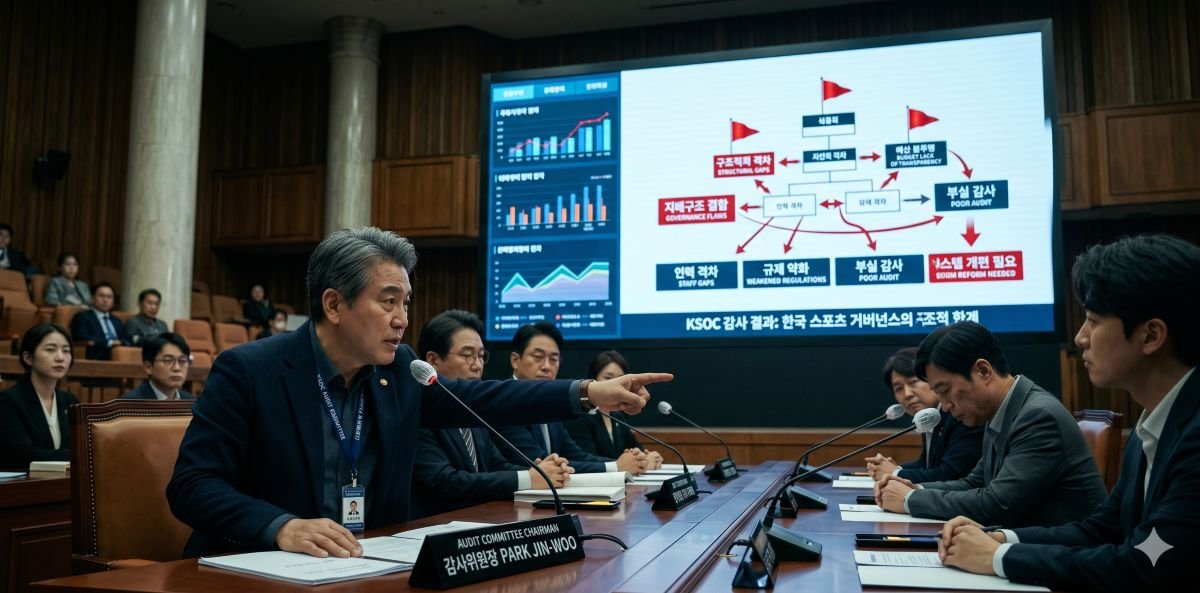
JTBC has argued that because over 90% of Korean households subscribe to pay television services, broadcasting exclusively on a cable or pay platform satisfies the spirit of universal access. Representative Cho Gye-won of the Democratic Party of Korea directly challenged this reasoning in a March 2026 parliamentary address to the Ministry of Culture, Sports and Tourism. As covered in Korea’s sports broadcasting rights crisis and what it means for World Cup viewers, Cho argued that paid subscription services and free terrestrial broadcasts are not legally or practically equivalent — particularly for households in rural or lower-income regions where pay television penetration may be lower, and for viewers who do not expect to need a subscription to watch the national team play in a World Cup.
Cho’s proposal drew on regulatory models from other countries. Britain’s Listed Events system designates specific sporting events — including the Olympics, the FIFA World Cup, and domestic football finals — as protected events that must be made available to free-to-air broadcasters. Australia’s Anti-Siphoning system operates similarly, preventing exclusive pay-television acquisition of events deemed to carry significant public interest. Cho called on Korea to develop equivalent legislation, and proposed expanding the Korea Pool to include not only terrestrial broadcasters but also OTT platforms and new media outlets under a framework that treats major sports broadcasting as a public resource.
The Cultural Dimension of the Crisis
The legal and regulatory framing matters, but the cultural weight of the situation should not be reduced to a contractual dispute.
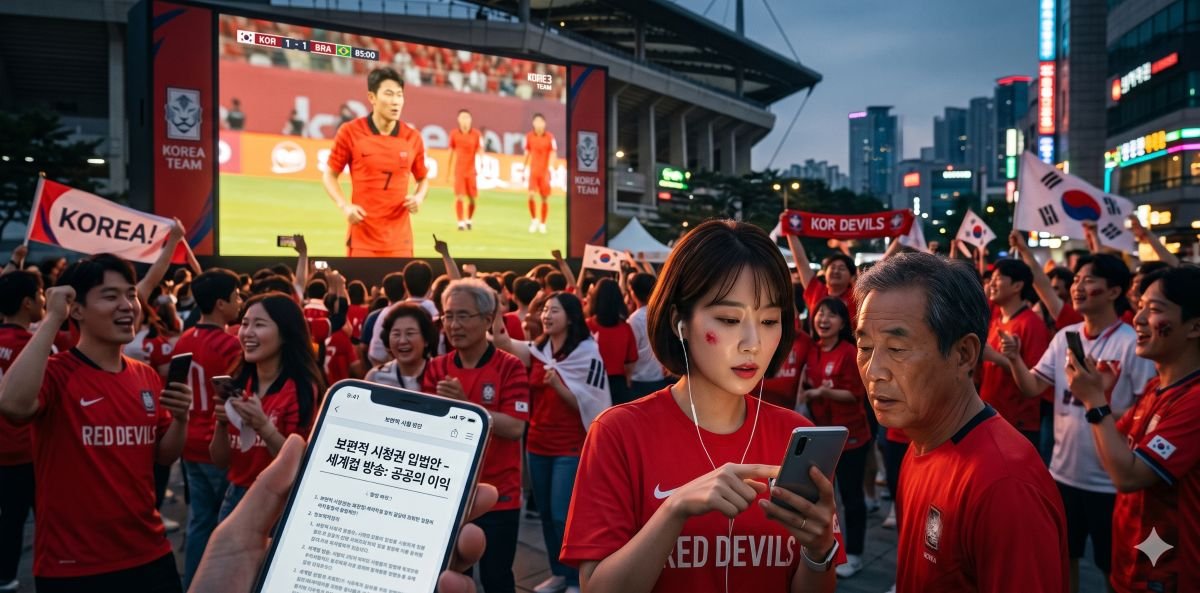
Korean street cheering culture — the mass public gatherings where millions of citizens watch national team matches on large screens in public squares — depends on the assumption that the matches are on television channels that can feed those public screens. The 2002 World Cup, when Korea reached the semifinal on home soil, remains one of the defining collective experiences in recent Korean history. The community-building dimension of watching major sports events as a shared national act, rather than as a pay-gated individual subscription choice, is part of what makes these events carry the cultural weight they do.
For residents of Cheongju and across Chungcheongbuk-do, the practical question of whether Korea’s World Cup group stage matches against Mexico, South Africa, and Czech Republic will be freely watchable is not abstract. If the current impasse holds and no terrestrial broadcast arrangement is reached, watching Korea’s most significant sporting moment of 2026 will require a paid subscription to a cable service the viewer may not currently hold.
Whether the National Assembly acts on the proposed Broadcasting Act amendments before June 11, when the World Cup opens in Mexico City, remains the central open question. The debate has surfaced the absence of a legal framework Korea has always assumed it did not need.